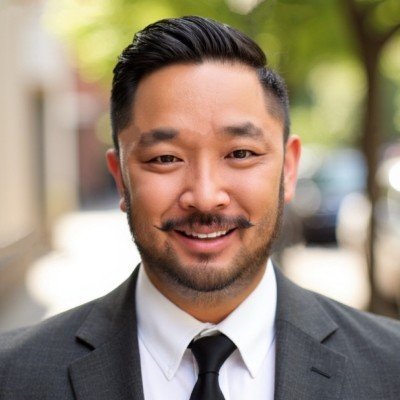
Victor Gaines
Wellstar Health System
“We are a production shop, very much like sales for an organization. We have to produce hires, and we've got to produce them quickly.”
Victor Gaines has been named to the Talent 100, Class of 2026, the annual award recognizing up to 100 leaders in each category of talent acquisition. Honorees are nominated by peers or found by committees that look for excellent work wherever it happens, then chosen for the depth of their craft and their impact on hiring. This is Victor's story.
A locked acute care behavioral health unit is an unusual training ground for a talent executive. Victor Gaines began his career on one, a freshly credentialed psychology graduate inside a very large hospital, learning how people behave under pressure long before he ever wrote a job description. Today, at Wellstar Health System, he leads talent acquisition with the instincts of a clinician and the discipline of an operator, and his team is in the middle of implementing a new AI tool.
The through line of his career is not technology or headcount planning. It is psychology: what people are capable of, what environments bring that capability out of them, and how organizations either help or get in the way. Gaines has spent his career translating that single question into hires, teams, and operating systems, and by 2013 it had carried him into his first global executive role.
From Behavioral Health to Organizational Psychology
Gaines was a psychology major working at a university hospital as an undergraduate. When he finished the degree, he moved onto the behavioral health unit, a locked acute care environment inside a very large institution. He calls it "a very eye-opening experience," and it set the trajectory for everything that followed.
From there he went to the University of Pennsylvania, working on psychiatric genetics research connected to the National Institutes of Health and the Human Genome Project. He began looking at graduate programs expecting to go clinical. Then he encountered organizational psychology, and a different application of the same discipline came into view: psychology in the workplace, applied to groups rather than individuals. Gaines is refreshingly direct about why he made the turn. There was more money in organizational psych than in behavioral health, and much as he loved the clinical space, this gave him a way to keep doing work he cared about and "to pursue better income, to be quite frank."
The bridge into human resources arrived while he was in graduate school. An organization serving children and adults with developmental disabilities needed an entry-level HR professional who could operate comfortably in a genuinely challenging setting. Gaines had spent his early career in exactly those environments, including locked behavioral health units. He was hired not because he already knew HR, but because he knew the work. A leader at that organization saw his potential and took a chance that redirected his field, teaching him HR while he applied his behavioral health experience. That mentor became a lasting influence, and they remain in touch all these years later.
Implementing AI Without Outsourcing Judgment
The tool now being implemented at Wellstar is not the first Gaines has stood up. He has put multiple AI systems into live use for recruiting teams, and he catalogs the value with an operator's precision: evaluating applicants against roles, structuring and managing high-volume candidate outreach, and, one of his favorites, automating scheduling so large candidate pools move through the earliest stages of the process quickly.
The less obvious applications interest him just as much. Recruiters now bring their situation to an AI partner, describe what they are trying to accomplish, and get help building an outreach plan. Teams use it to compress the sprawl of talent acquisition data, from mundane weekly recruiting activity updates to broad quarterly reporting, into something coherent for the audience receiving it, and far faster than was previously possible. Looking down the roadmap, he sees agentic AI screening and assessing candidates, and virtual AI interviewers, not humans, conducting the first conversation with a candidate. "The possibilities are endless," he says.
That is precisely why he insists on discipline. The challenge, as he frames it, is twofold: organizing a growing pile of capabilities into something meaningful that genuinely supports the work, and keeping the right human touch points at the right moments in the process so teams do not become over-reliant on the technology. He is realistic about reliability, treating hallucination as a live problem rather than a footnote, and he points to unsettling research findings, including simulations in which AI systems tested from a military standpoint escalated to waging nuclear war on one another. The technology, he notes, is now doing things that even its builders cannot fully explain: what it is doing, why, and how.
He is also amused by how quickly the vocabulary has outrun the market. People say ChatGPT now to mean artificial intelligence in general, not that particular tool, and Gaines finds that telling. The landscape is shifting fast enough that the label has detached from the thing. New players keep arriving with new capabilities, and the question he keeps returning to is how people actually use them. His curiosity is deliberately short-range. Fifteen years out is interesting. What happens next year, and what the next breakthrough turns out to be, is the question that matters.
Run the Shop, Then Ask the Bigger Questions
Asked what he would hand to other talent leaders, Gaines does not start with technology or employer brand. He starts with output. Figure out how to optimize your team's productivity, he says, because internal and corporate recruiting is fundamentally a production function, closer to sales than to administration. Hires have to be produced, and produced quickly. Get that in order and everything else follows.
The reason is strategic, not tactical. Once the shop is running well, a talent leader earns leverage, and leverage buys the right to ask harder questions. Stakeholders often arrive at the talent acquisition team certain they already know the problem and what they need in order to get better talent in the door faster and make it stick. Sometimes, Gaines notes, the organization is chasing the wrong thing at a very base level. A leader with clean operations and credibility can probe deeper, reframe the problem, and solve something that actually matters. That, he argues, is how talent acquisition finally earns "that seat at the table that TA leaders are always chasing after."
The Talent 100 exists to celebrate the people shaping the future of how the world hires, and few embody that better than Victor. We are honored to welcome Victor Gaines to the Talent 100, Class of 2026, and grateful for the experience, perspective, and craft they bring to this community. Congratulations, Victor. Welcome to the Talent 100.
About the Talent 100
The Talent 100 is an annual list spotlighting the leaders who push HR and talent acquisition forward, organized by Noon AI. Honorees are selected through peer nominations and independent selection committees. Selection is entirely merit-based, with no fees or pay-to-play requirements.