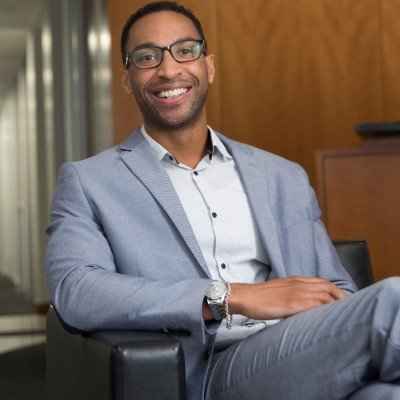
Dr. Benjamin Schultz-Burkel
UW School of Medicine and Public Health
“There's no one way to source candidates in the recruitment space.”
Dr. Benjamin Schultz-Burkel has been named to the Talent 100, Class of 2026, the annual award recognizing up to 100 leaders in each category of talent acquisition. Honorees are nominated by peers or found by committees that look for excellent work wherever it happens, then chosen for the depth of their craft and their impact on hiring. This is Dr.'s story.
Before he ever screened a physician's CV, Dr. Benjamin Schultz-Burkel spent years learning how to hold an audience in a concert hall. He is a classically trained singer with a doctorate in musical arts, and the discipline that shaped him, the ability to read a room, to prepare relentlessly, and to understand that a performance is ultimately about the human beings on the receiving end, turns out to be an unusually good preparation for one of the hardest jobs in American healthcare: convincing the country's best physicians and researchers to come to Wisconsin.
Today he leads faculty recruitment at the UW School of Medicine and Public Health, where he has run executive leadership searches for the dean's office and built, from scratch, a dedicated team of faculty recruiters. He also serves on the board of AAPPR, the national association for physician and provider recruitment professionals, as a member at large.
From the Concert Hall to the Search Committee
"I didn't go through a traditional route per se," he says, "not that there is one, I think." His entry point was the School of Music at UW-Madison, where he spent seven years and was responsible for leading both faculty and staff recruitment. Plenty of academic administrators treat hiring as one more line on a long portfolio of duties. He did the opposite.
"It was that part of my job that I cherished the most," he says. What drew him in was the double satisfaction of the work: meeting people he would otherwise never have met, and matching them to a need the institution genuinely had. That instinct, that recruitment is simultaneously an act of curiosity and an act of institution building, has never left him.
Building a Function Around a Shortage
The move to the School of Medicine and Public Health put that instinct to a much harder test. He began with executive leadership searches for the dean's office, the highest-stakes hires an academic medical center makes. Then he looked at the wider landscape and saw a structural problem.
Physician shortages have made it steadily harder for departments to attract top talent, and departments were trying to compete for scarce specialists using faculty time that was already spoken for. His answer was to create a specialist function inside the school: recruiters whose entire job is to source, engage and shepherd candidates on behalf of the departments. "There was a definite need," he says. "They needed specialists who could designate their time for sourcing those candidates." Building that team is arguably his most durable contribution, because it outlasts any single search.
The Case for Staying Malleable
On the industry's current preoccupation with artificial intelligence, Schultz-Burkel is neither evangelist nor skeptic. He is something more useful: a pragmatist who has watched enough cycles to know how the story goes. Anyone who has spent meaningful time in recruitment, he argues, understands that the field is constantly changing. "As soon as you rest on your laurels or rely on your good old faithfuls, that's when you're going to lose control," he says. "You have to be malleable. You have to be flexible in this space."
That flexibility cuts in both directions. Methods that look archaic are often exactly right for a given population. Certain groups of physicians and providers cluster on a single social platform, which makes it fertile ground. Some subspecialties are still best reached at conferences. In academia, where his researchers are publishing constantly and reading journals online, publications remain a serious sourcing channel. "There's no one way to source candidates in the recruitment space," he says, and his teams deliberately keep a wide toolkit for that reason.
AI, in his view, earns its place by clearing the administrative underbrush. Streamline the repetitive work, make it more efficient, and what you buy back is time for the interpersonal interaction that he calls the humanistic element of recruitment. There is a place for AI, a place for social media, a place for publications. The point of using all of them is reach: the wider the net, the better the odds of finding the diamond in the rough who does not merely fill the gap on the org chart but complements the people already there and brings more to the table than anyone anticipated.
"That's always the goal," he says, "to find the next best thing."
The Talent 100 exists to celebrate the people shaping the future of how the world hires, and few embody that better than Dr.. We are honored to welcome Dr. Benjamin Schultz-Burkel to the Talent 100, Class of 2026, and grateful for the experience, perspective, and craft they bring to this community. Congratulations, Dr.. Welcome to the Talent 100.
About the Talent 100
The Talent 100 is an annual list spotlighting the leaders who push HR and talent acquisition forward, organized by Noon AI. Honorees are selected through peer nominations and independent selection committees. Selection is entirely merit-based, with no fees or pay-to-play requirements.