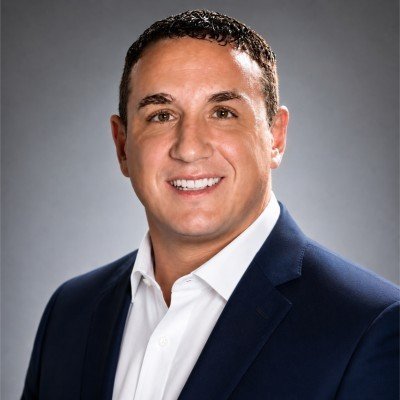
Casey Amend
EnSafe
“It is a matter of using the tools so that you can cut fairly administrative tasks out of your day, so that you can focus on the candidate and the experience.”
Casey Amend has been named to the Talent 100, Class of 2026, the annual award recognizing up to 100 leaders in each category of talent acquisition. Honorees are nominated by peers or found by committees that look for excellent work wherever it happens, then chosen for the depth of their craft and their impact on hiring. This is Casey's story.
At 16, Casey Amend was already keeping a ledger: money in, money out, tracking which sodas moved and which ones sat. An older sibling had handed her a set of pop machines along with a standing deal, that whatever she banked and rolled into a CD at the end of the year would be matched with a second CD.
She calls that sibling her first mentor in life, and the arithmetic stuck. Casey had to sell the product, watch what moved, take the money to the bank every week, and understand what was left at the end. Decades later, as Director of Recruiting at EnSafe, she still frames her function in exactly those terms. When she sits with a C-suite, she can weave that story straight into the bottom line, and in her experience, executives appreciate hearing it in a language they already speak.
That instinct explains a great deal about how she has built her career. Recruiting, in her hands, is rarely presented as a soft function. It is presented as growth, as savings, as a line item that either performs or does not.
The Pitch That Built A Department
Casey was a marketing major at Ohio Northern with a plan that never quite materialized. She thought she would learn Japanese and move into international business. It did not happen. What did happen was four years in a sorority, where she worked her way up the leadership ranks and eventually became president.
After graduation she was asked to come back as a consultant for the organization, which turned into a traveling classroom. She lived in 18 states. She completed 38 university visits. Her job, on campus after campus, was to train sorority sisters on how to recruit and then how to maintain their new members. It was recruiting in everything but title: sourcing, pitching, onboarding, retention, all compressed into a few intense days per school.
She did not move straight from that into talent acquisition. She went into finance and sales, first inside sales, later outside sales. Then a financial firm tapped her to run inside sales, and she noticed something odd. The company had no recruiting department at all. Everything was outsourced to agencies. Her read was immediate: here was a chance to build something and play to the strengths she had sharpened on the road. She pitched the idea to Fisher Investments, and that pitch became the first recruiting department she ever built.
Her own summary of how it started is disarmingly simple. It began with curiosity, and with identifying an opportunity to help an organization grow and ultimately save money.
The Mentors Who Opened The Door
When Casey started in finance she describes herself as a glorified assistant. External wholesalers would come through the office in the nicest suits, with the greatest personalities, pitching a financial product. She remembers watching them and thinking that was exactly what she wanted to do, without any idea how to get there.
Her first mentor in the adult world gave her the map. The advice was direct: go get to know one of the external wholesalers, a woman who was very successful at it, and ask her to be a mentor. Casey asked. Through that relationship she learned the industry itself and, just as importantly, how someone actually moves up the ranks inside it. That mentor helped her land a role in Philadelphia. She moved, went from inside sales to a hybrid seat, and finally into outside sales, the job she had been quietly studying from an assistant's desk.
Those two women were her first professional mentors, and she names the pattern rather than the resume. Someone with standing pointed her toward someone else with standing, and then that person opened a door. What she finds remarkable now is the reversal. As you progress through life, she says, you become the mentor to mentees, and you do it on the strength of your own credibility, your own journey, your own experience. She has been doing this a long time, and she treats that accumulated mileage as an asset to spend on other people rather than a badge to display.
Chalkboards, Bots, And Better Tools
Casey inherited an applicant tracking problem at her current employer and does not soften her assessment of it. The team was running on ADP, and in her view the recruiters might as well have been handed a chalkboard and a piece of chalk. She replaced it with Greenhouse, which weaves AI into resume screening, a capability currently in beta testing on her team.
She is optimistic about where that goes, largely because of what keeps arriving in the pipeline. The volume of resumes that appear to be generated by bots continues to climb. The backgrounds are dressed up to look relevant enough to get through the door, then turn out to be nothing of the sort, and often the candidate did not even write the document. That is the opportunity she wants software to seize: screening out the fake profiles and the applicants who were never astute enough to do the role. Recruiters, she argues, should not be spending their hours on them.
On the sourcing side she is enthusiastic without being starry-eyed. From a wordsmithing angle, she calls the technology amazing. She builds her own outreach templates on LinkedIn, gets them to a point she considers good enough, and lets AI surface what she has in common with the person she is trying to reach before shaping the message. Greenhouse and LinkedIn remain her two main technologies. Her team also uses Copilot and the full ChatGPT suite, primarily for note-taking and summarizing afterward. The through line is time: strip the administrative work out of the day so the hours go back to the candidate and the experience around them.
The Three-Legged Stool
Asked what she would tell other talent leaders heading into a new year, Casey aimed her answer at a failure mode she sees often. Recruiting leadership gets very focused on the team, the metrics, the KPIs. That focus is necessary, and it is also incomplete.
Her model has three legs. First, you coach up or coach out the team. Second, you make sure that team has the right technology in place to do the work you are asking of it. Third, and the one she believes gets skipped most, you make sure your hiring managers are trained and genuinely on board. Skip that leg, she warns, and they are doing you a disservice no matter how clean the dashboards look.
Beyond the stool is a broader instruction: step out of your role, out of your own microcosm, out of your team, and look at the wider organization. Ask whether everyone is making the same shift you are making, whether that means moving from tactical to strategic or moving the sourcing model from active talent to passive talent. Whatever the vision is for the firm, the work is stepping back, looking outside your own department, and confirming that everyone is aligned and moving forward with the strategy.
It is a leader's answer from someone who has built a recruiting function out of nothing more than an observation and a pitch. The ledger habit never really went away. She is still tracking what sells, what does not, and what is left at the end.
The Talent 100 exists to celebrate the people shaping the future of how the world hires, and few embody that better than Casey. We are honored to welcome Casey Amend to the Talent 100, Class of 2026, and grateful for the experience, perspective, and craft they bring to this community. Congratulations, Casey. Welcome to the Talent 100.
About the Talent 100
The Talent 100 is an annual list spotlighting the leaders who push HR and talent acquisition forward, organized by Noon AI. Honorees are selected through peer nominations and independent selection committees. Selection is entirely merit-based, with no fees or pay-to-play requirements.