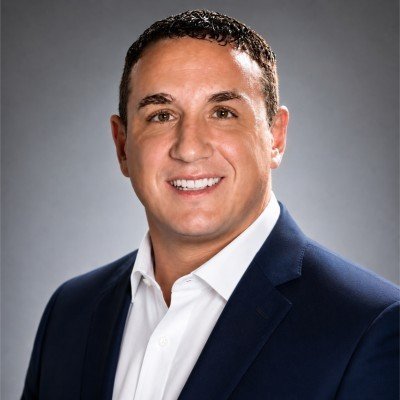
Pete Babonis
Watts Water Technologies
“Let's embrace AI, let's use the technology, and let's partner with it to make ourselves bigger, badder, stronger recruiters.”
Pete Babonis has been named to the Talent 100, Class of 2026, the annual award recognizing up to 100 leaders in each category of talent acquisition. Honorees are nominated by peers or found by committees that look for excellent work wherever it happens, then chosen for the depth of their craft and their impact on hiring. This is Pete's story.
The moment that redirected Pete Babonis's career did not happen in an HR office. It happened on a college campus, in front of a room of students, while he was still an operations manager in the environmental health and safety and waste management industries. He had been sent to talk about jobs. What he discovered was that talking about jobs, about what a person could become inside an organization, was the part of the week he looked forward to most.
Today, as Senior Recruiting and Process Specialist at Watts Water Technologies, Babonis occupies an unusual position in talent acquisition: he is an operations person who became a recruiter, which means he tends to see hiring the way a manufacturing organization sees a production line. Standardized. Measured. Continuously improved. It is a rare lens in a profession that often runs on instinct, and it has become the engine of his career.
An Operator Who Found the Work He Wanted
Babonis began in operations roles and worked his way up into operations management, where part of his mandate was managing and developing early talent. That responsibility pulled him outward. He started doing outreach through college recruiting, setting up events at local colleges and universities, and spending real time on campus. Over roughly a three to four year span he built relationships across those campuses and led more and more events, and somewhere in that stretch the realization landed.
"I enjoy management. I enjoy developing people," he says, "but I really love talking to people about roles, talking to people about what they're looking for, and ultimately trying to find a space in the organization for them to flourish and have success." The natural next step was to cross over. He moved into the recruiting function at that same organization, taking a talent acquisition management role leading the early careers side of the business, and stayed in that capacity for about four years.
At the beginning of 2025 he made a bigger leap, joining Watts Water Technologies in a senior recruiting and process specialist role. Sixteen to seventeen months in, he is now moving into a management function, overseeing the operations recruiting function at Watts for the Americas team.
The Kaizen Event That Rebuilt a Hiring Process
Babonis was recruited into Watts with a specific brief. The manager who brought him in and the first leader he worked with there had identified a gap on her team: she needed a process-driven individual with genuine expertise in that space, someone who could take the recruiting function to the next level. In a global manufacturing organization, everything is examined through lean and continuous improvement, and the recruiting function was no exception.
What followed was a large-scale CI initiative that the two of them ran together, anchored by a Kaizen event that generated roughly 50 distinct items to execute against. The work spanned the entire function: standardizing the end-to-end recruiting process, building out workflow for requisition and offer approvals, standardizing job templates, standardizing offer templates. "There was just a lot there that could be improved and that needed to be executed on," Babonis says.
What stayed with him was his first leader's range. She consistently looked at the function through a strategic lens, asking what it would take to bring both the organization and the recruiting team to the next level, and she always had a roadmap for how to get there. She was also entirely willing to roll up her sleeves and execute the tactical work herself. "She was a great leader for me. She was a great mentor for me. I've learned a ton from her."
Learning Manufacturing From the Inside
The second leader Babonis credits is his current boss at Watts, who joined the organization relatively recently after more than 20 years of manufacturing experience with companies including Johnson & Johnson and International Paper. His current boss, in Babonis's description, is a people-first leader with high empathy paired with high execution, high expectations, and real accountability, a combination that is easier to name than to practice.
As Babonis has stepped toward the operations recruiting leadership role, his current boss has been the person he leans on most: for manufacturing expertise, for best practices, and for a vision of how a global manufacturing organization can operate at the highest level and what talent acquisition can contribute to that. "How we can build this world-class recruiting function for a large manufacturing organization has been really, really helpful and inspiring," he says.
The through line between his two mentors is not accidental. Moving from the EHS world into a true manufacturing organization was a significant change, and both leaders carried deep manufacturing backgrounds along with expertise in Lean and continuous improvement, disciplines Babonis calls pivotal to success at a company like Watts. Both, he notes, are also people-first and empathetic while still driving hard. That is the model he is carrying into management.
Partnering With AI, Not Fearing It
Babonis is emphatic on the subject of artificial intelligence, and his position was shaped in part by the conversations he heard at SHRM in Chicago two years ago. He agrees with the optimists. AI is in every headline and every LinkedIn feed, from the technology itself to the data center construction boom, and talent professionals gain nothing by flinching at it.
He uses AI every day across a wide range of tasks: sourcing initiatives, building the right prospect or candidate pool for a requisition, running initial evaluations of prospects and candidates, constructing a Boolean search, setting up a project in LinkedIn, and shaping the messaging that goes out to people. It does all of it in a fraction of the time, which is precisely the point. "Our jobs as recruiters aren't going away because of it," he says. "But we can be freed up to do some other really important things that are a better use of our time."
That protected time is where he believes the profession actually lives. The ability to sit face to face with someone or get them on the phone, ask the follow-up question, dig a little deeper, and understand what makes them tick and what gets them out of bed in the morning is not replicable. Neither is the judgment that follows: recognizing mid-conversation that the candidate you sourced for one role belongs somewhere else entirely in the organization, because it is the right seat on the bus for them.
His advice to fellow talent leaders is direct. Audit the tech stack. Look hard at the technology you use inside and outside of work. Embrace what AI has to offer and use it when it is appropriate to do so. Used that way, he argues, it makes talent acquisition a materially more effective function within the business, and the people doing the work stronger than they were before.
The Talent 100 exists to celebrate the people shaping the future of how the world hires, and few embody that better than Pete. We are honored to welcome Pete Babonis to the Talent 100, Class of 2026, and grateful for the experience, perspective, and craft they bring to this community. Congratulations, Pete. Welcome to the Talent 100.
About the Talent 100
The Talent 100 is an annual list spotlighting the leaders who push HR and talent acquisition forward, organized by Noon AI. Honorees are selected through peer nominations and independent selection committees. Selection is entirely merit-based, with no fees or pay-to-play requirements.