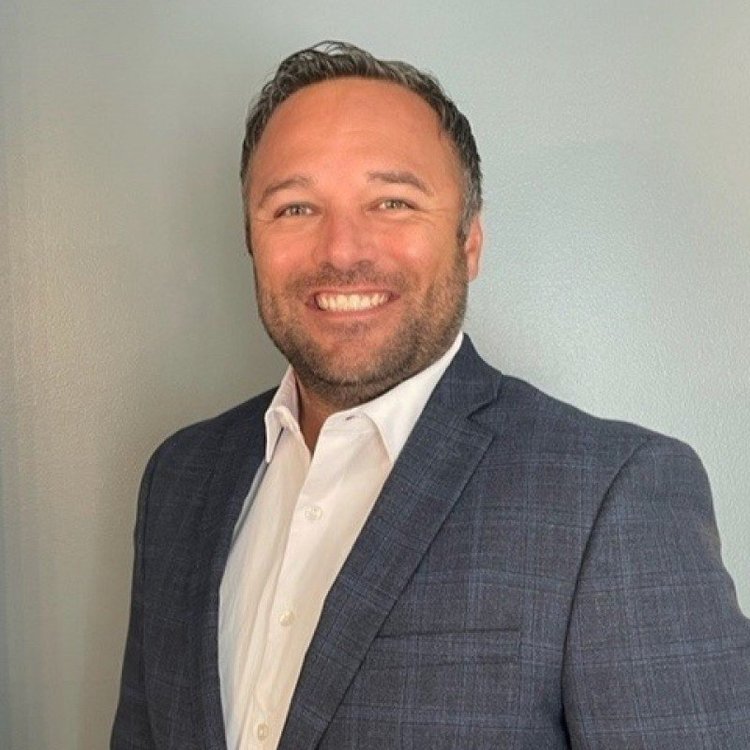
Adam Meekhof
Marksman Security Corporation
“You are an internal consultant for your business on how to improve the business through people.”
Adam Meekhof has been named to the Talent 100, Class of 2026, the annual award recognizing up to 100 leaders in each category of talent acquisition. Honorees are nominated by peers or found by committees that look for excellent work wherever it happens, then chosen for the depth of their craft and their impact on hiring. This is Adam's story.
Two decades into a recruiting career, Adam Meekhof has arrived at a conclusion that sounds counterintuitive coming from a leader who runs a hiring function inside a national security company: the more automation enters the workflow, the more human the job becomes. "It almost becomes a renaissance of what I believe how recruiting was started," he says, "just creating human connection and human relationships." From his office near Perimeter Mall in Atlanta, Meekhof leads the recruiting department at Marksman Security Corporation, the latest stop in a career that has spanned hardware, software, embedded systems, healthcare, fintech, manufacturing and now physical security.
One Phone Call, Twenty Years
Meekhof is refreshingly unsentimental about how he found the profession. "It's a tale as old as time," he jokes. "I woke up when I was five and wanted to recruit the rest of my life." The truth is simpler and better. Out of college he was selling door to door, and it did not take him long to understand that this particular kind of selling was not going to be his life's work. A former colleague who had left the company had stayed a close friend, and she happened to be a recruiter.
So he called her. "I don't know what you do, but I need a job. Is that something you know about?" Her firm liked competitive, sports-minded people. She thought he could get an interview. He did, and he got the job, launching his career at the staffing agency Aerotek, part of the Allegis Group, in its Atlanta office. That friend, he notes, is family to him today.
What followed was twenty years of deliberate range. He started as a recruiter, moved into sales, discovered sales was not his calling either, and worked his way back to the craft that suited him. Corporate recruiting followed, then a six-year run as a consultant advising companies on recruiting, then the move into leadership at Marksman Security. Along the way he built a rare industry breadth: technical hardware and software, embedded engineering, healthcare, fintech and manufacturing, each with its own talent market and its own definition of a hard-to-fill role.
The Case for a More Human Function
Meekhof's read on the past year is that the shift has been substantial and uneven, varying industry by industry. The dividing line he sees is not between companies with AI and companies without it, but between practitioners who treat the technology as a tool and those who do not. The ones who have embraced it, he argues, have bought themselves back the parts of the job that machines cannot do.
"AI is taking a lot of our tasks that are inundating our days," he says, whether that is automating a step in the hiring life cycle or simply gathering the numbers and telling you what the report says. What that buys back is presence: better conversations with hiring managers, with current employees, with candidates. In his framing, the technology is not a threat to the human element of recruiting. It is what finally makes room for it.
Slow Down and See the Person
His advice for talent leaders heading into 2026 runs deliberately against the tempo of the moment. Because the tech is changing so fast, he says, leaders have to slow down: slow down enough to assess where a tool genuinely belongs in their recruiting life cycle, and slow down enough to actually see their own teams.
He believes the period from 2019 to now will go down as one of the most studied stretches in modern history, and that the residue of it is uncertainty. Recruiters are watching new tools launch weekly while hearing, from people who often do not understand what the tools were built for, that those tools will replace them. "Even if they are doing good work, in the back of their mind, how long is it going to last before tech replaces me?" That anxiety is a leadership problem, and Meekhof's answer is a lesson he learned early in his career: see the person across from you.
His second piece of advice is structural. As technology absorbs more of the task-driven work, the profession has to claim a larger seat at the business. Talent acquisition is not order-taking, he argues. It is internal consulting: solving business problems through people, in every department the function touches. And the responsibility does not stop with leaders. "We can't be the only ones that have the voice and the consulting ability and the ability to influence," he says. "Our whole teams have to." Teaching recruiters how to consult, not just how to fill requisitions, is in his view the central leadership task of the next few years.
The Talent 100 exists to celebrate the people shaping the future of how the world hires, and few embody that better than Adam. We are honored to welcome Adam Meekhof to the Talent 100, Class of 2026, and grateful for the experience, perspective, and craft they bring to this community. Congratulations, Adam. Welcome to the Talent 100.
About the Talent 100
The Talent 100 is an annual list spotlighting the leaders who push HR and talent acquisition forward, organized by Noon AI. Honorees are selected through peer nominations and independent selection committees. Selection is entirely merit-based, with no fees or pay-to-play requirements.