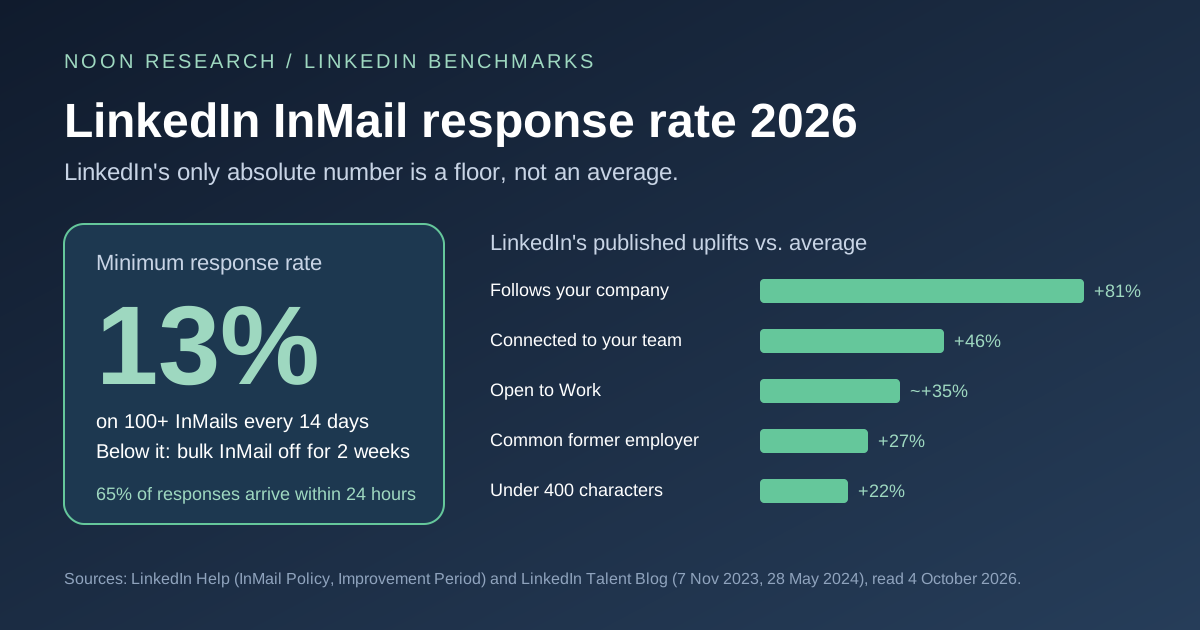
Key takeaway: 13% is the only absolute InMail response rate LinkedIn publishes, and it is a minimum, not an average. LinkedIn's Recruiter InMail Policy, read on 4 October 2026, says recruiters "must maintain an InMail response rate of at least 13% on 100 or more InMail messages sent within every 14-day assessment period." Fall below it and bulk InMail can be switched off for two weeks. Everything else LinkedIn publishes is relative: InMails under 400 characters get a 22% higher response rate than average, people who follow your company are 81% more likely to respond, and 65% of responses arrive within 24 hours.
Search for "average InMail response rate" and you will find confident numbers that do not agree. One vendor blog we read on the check date says InMail response rates are "typically under 13%". Another says "The average LinkedIn InMail response rate is 18-25%". Neither shows the dataset behind the figure.
LinkedIn itself does not publish a global average. What it does publish, in its help center and on its Talent Blog, is a policy threshold, a precise definition of what counts as a response, and a set of measured uplifts from its own InMail data. This page collects those figures, each quoted from the LinkedIn page we rendered on 4 October 2026, so you can benchmark a Recruiter seat against the numbers LinkedIn actually stands behind.
For the hard caps that sit next to the response rate (credits, connection limits, weekly invitation limits), see our guide to LinkedIn limits for recruiters.
What is a good LinkedIn InMail response rate in 2026?
Anything at or above 13% keeps a Recruiter seat in good standing; below 13% on 100 or more InMails in 14 days puts it at risk of restriction. That is the one line LinkedIn draws. It does not say what a "good" rate is above that floor, and the third-party averages that fill the gap are unsourced.
What LinkedIn does give you is the direction and size of the levers, measured against its own average. These are the figures as published:
| What LinkedIn measured | Effect on response | LinkedIn source |
|---|---|---|
| Candidate follows your company on LinkedIn | 81% more likely to respond | Talent Blog, 7 Nov 2023 |
| Candidate is connected to someone at your company | 46% more likely to accept | Talent Blog, 7 Nov 2023 |
| Personalized InMail | Can increase acceptance rates by 40% | Talent Blog, 7 Nov 2023 |
| Candidate is "Open to Work" | About 35% more likely to respond | Talent Blog, 7 Nov 2023 |
| You mention a common former employer | Chance of a response up 27% | Talent Blog, 7 Nov 2023 |
| InMail under 400 characters | 22% higher than the average response rate | Talent Blog, 7 Nov 2023 and 28 May 2024 |
| InMail over 800 characters | Below-average response rate | Talent Blog, 7 Nov 2023 |
| Sent on a Friday | 4% fewer responses than average | Talent Blog, 7 Nov 2023 |
| Sent on a Saturday | 8% fewer responses than average | Talent Blog, 7 Nov 2023 |
Sources: LinkedIn InMail best practices (7 November 2023) and InMail response rates across industries and functions (28 May 2024), both rendered 4 October 2026.
Read the table as a targeting guide more than a writing guide. The three largest effects (company followers, a connection at your company, Open to Work) are about who you message, not what you write. Length and personalization matter, but choosing a receptive list moves the rate more.
How does LinkedIn calculate your InMail response rate?
LinkedIn counts a response as a reply, an accepted InMail, or a "Not Interested" click, received within 30 days of sending. The definition is spelled out across two help articles:
- What counts as a response. "An InMail response is defined as any InMail to which the recipient sends an InMail reply, accepts the InMail invitation, or replies as 'Not Interested.'" Smart replies such as "No thanks" also count in your favor.
- The 30-day window. "Only responses received within the first 30 days following the message sent date are included in the response rate."
- What is in the denominator. Free InMails to Open Profile members and direct connections count, and so do bulk InMails. Messages sent to email addresses do not.
- Follow-ups. "Automated follow-up messages are treated as individual messages and will count toward your InMail response rate." A three-step sequence to a silent candidate adds three unanswered messages, not one.
- The rate belongs to the seat. If a seat is transferred, "the new seat holder will be accountable for the previous recruiter's response rate."
Sources: LinkedIn Help, InMail response rate and InMail Improvement Period in Recruiter, rendered 4 October 2026.
Point 1 has a practical consequence. A polite "Not Interested" is a response for scoring purposes, so a well-targeted message that gets a fast no helps the seat more than a vague one that gets ignored.
What happens if your InMail response rate drops below 13%?
You get a warning, then a grace period, then two weeks without bulk InMail. LinkedIn's help article lays out the sequence for any seat that sends 100 or more InMails in a 14-day assessment period with a response rate under 13%:
| Stage | What LinkedIn says happens |
|---|---|
| Warning period | A banner warns you; "During this two-week warning period, you need to improve your response rate above 13%." Bulk and one-to-one InMail still work. |
| Grace period | Rates "are calculated 7 days after the end of a warning period so that your InMail recipients have time to respond." |
| InMail Improvement Period | If the rate is still under 13%, "your bulk InMail service will be disabled for 2 weeks." One-to-one InMail is the way back. |
| No improvement | You "remain in the InMail Improvement Period for an additional 14 days, until the next response rate evaluation date." |
Source: InMail Improvement Period in Recruiter, rendered 4 October 2026.
This is separate from content enforcement. If several InMails are flagged by LinkedIn's filters as breaking the InMail Policy (which bans "unwanted or untargeted mass InMail messages"), sending is disabled until the next day, and repeat violations bring restrictions of "24 hours, 72 hours, or 1 week" (Recruiter InMail Policy Enforcements).
How fast do candidates respond to InMail?
65% of InMail responses arrive within 24 hours and 90% within one week, according to LinkedIn. That has two uses. If a message has had no answer after a week, the odds of a late reply are low, so plan the next touch. And the 30-day scoring window is generous: almost every response that will ever come lands well inside it.
Timing of the send matters a little. LinkedIn reports Saturday InMails get 8% fewer responses and Friday InMails 4% fewer than average, and that only 2% of InMails are sent on Sundays, which it suggests as a way to stand out. For email, the equivalent question is answered in our best time to send recruiting outreach guide.
Which industries and roles get the highest InMail response rates?
Oil, gas and mining recruiters see the highest rates, 24% above LinkedIn's global average; quality assurance professionals are the most responsive function, 16% above average. LinkedIn's data story, updated 28 May 2024, measured "tens of millions of InMails sent by corporate recruiters around the world between May 2023 through April 2024", with staffing firms excluded.
| Group | InMail response rate vs. global average |
|---|---|
| Oil, gas and mining (sender industry) | 24% above |
| Utilities (sender industry) | 17% above |
| Quality assurance (recipient function) | 16% above |
| Human resources (recipient function) | 15% above |
| Program/project/product management and communications (recipient functions) | 11% to 15% above |
Source: LinkedIn Talent Blog, 28 May 2024, rendered 4 October 2026. LinkedIn also names retail, accommodation and food services, and manufacturing among the other top industries, without percentages.
Industry is the industry of the recruiter's company; function is the role of the person receiving the InMail. LinkedIn does not publish the global average these percentages are measured against, so they rank groups but do not convert into absolute rates.
How many InMails can a Recruiter seat send?
Up to 1,000 InMails per day per seat, with 150 InMail credits per Recruiter license. LinkedIn's sending-limits page, updated about four weeks before our check, also sets a 200-InMail limit in a new seat's first week and caps Open Profile messages at 350 per calendar month per seat. Recruiter Lite gets 30 credits a month and can accumulate up to 120.
Response rate and credits are linked. "Seat holders will receive an InMail credit back for every sent InMail message that receives a response within 90 days of the send date," so a higher response rate stretches the same allotment further. Our LinkedIn Recruiter pricing breakdown and Recruiter Lite vs full comparison cover what those seats cost.
How do recruiters get responses beyond InMail?
The InMail rules above reward small, targeted sends and penalize volume. That is a reasonable design for a paid inbox, and it is also why most recruiting teams reach candidates through more than one channel. Email has its own benchmarks: our report on recruiter cold email response rates, drawn from a 2026 survey of 1,000 recruiters, and its companion on recruiting email length cover the email side with the same kind of detail.
At Noon, outreach runs over email and SMS. The platform searches the whole web for candidates, not just LinkedIn, evaluates them against your role's criteria, finds verified contact details, and runs personalized email and SMS sequences, so the reach of a search is not set by InMail credits. See the Noon product overview for each capability. Noon's pricing is one plan with unlimited sourcing, unlimited email enrichment, unlimited contacts, unlimited agents and unlimited seats, quote-based with no published dollar price.
How were the sources checked?
Methodology. On 4 October 2026 we rendered seven LinkedIn Help articles (InMail response rate, InMail Improvement Period, Recruiter InMail Policy, InMail Policy Enforcements, InMail sending limits, InMail credits and renewal, InMail FAQ) and two LinkedIn Talent Blog articles in Chrome through Playwright over CDP, and captured the visible text. Every figure on this page is an exact string from those renders, stored with its URL and fetch time in this article's research record. The two third-party ranges in the introduction are quoted from vendor blogs rendered the same day, only to show that circulating averages conflict. Demand check: DataForSEO measured monthly US searches for "linkedin inmail response rate", "inmail response rate" and "average inmail response rate" on the same date.
Limitations. LinkedIn publishes no global average InMail response rate, so the uplifts and industry figures here are relative to an average we cannot state. The best-practice figures come from a November 2023 article and the industry figures from data collected May 2023 to April 2024; LinkedIn has not published newer versions that we could find. The 13% threshold and the help-center definitions were current on the check date but can change without notice; one help page showed "Last updated: 1 year ago". Noon sells recruiting software that does not send InMail, so the outreach section describes our own product, not an independent comparison.
FAQ
What is the average LinkedIn InMail response rate?
LinkedIn does not publish one. Its only absolute figure is the 13% minimum Recruiter seats must keep on 100 or more InMails per 14-day period. Ranges such as 10-25% or 18-25% come from third-party blogs that do not show their data.
What happens if a candidate clicks "Not Interested" on an InMail?
It counts as a response. LinkedIn defines a response as a reply, an accepted InMail or a "Not Interested" reply, and it credits back an InMail credit for any response within 90 days.
Do InMail follow-ups count toward the response rate?
Yes. LinkedIn says automated follow-up messages are treated as individual messages, so each unanswered follow-up lowers the rate.
How long should a LinkedIn InMail be?
Under 400 characters. LinkedIn reports those InMails get a 22% higher response rate than average, while messages over 800 characters get below-average rates.
What is the best day to send an InMail?
Sunday through Thursday. LinkedIn reports Saturday InMails get 8% fewer responses and Friday InMails 4% fewer than average, and only 2% of InMails go out on Sundays.