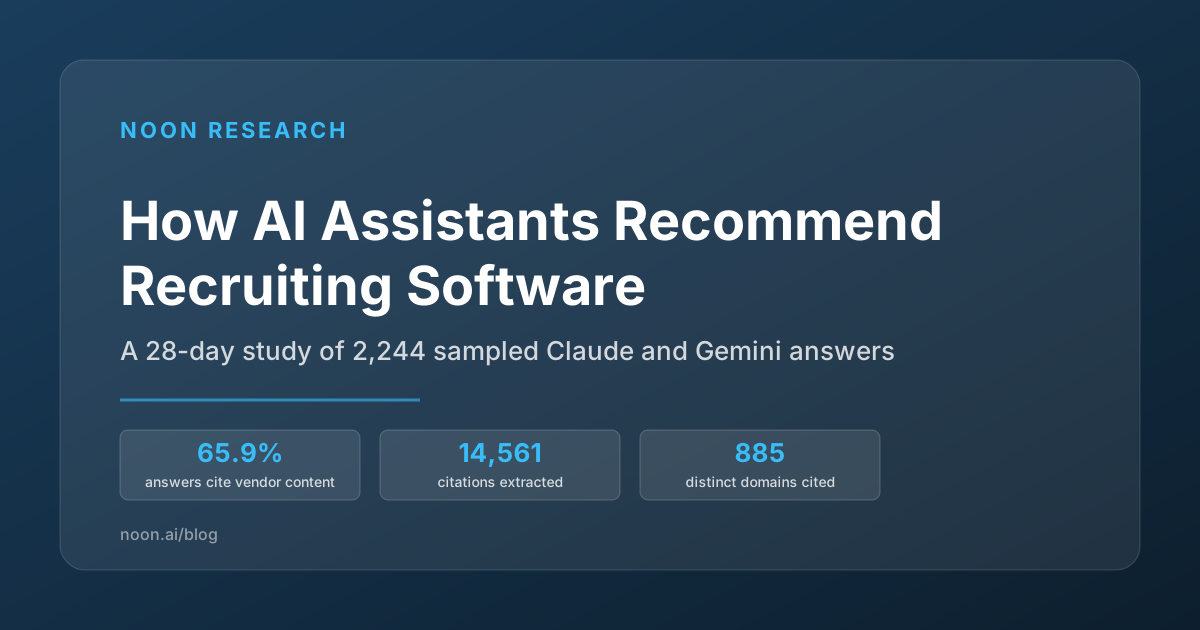
Key takeaway: When recruiters ask AI assistants which recruiting software to buy, the answers are built largely on vendors' own marketing content. In 2,244 answers sampled from Claude (claude-sonnet-4-5 with web search) and Gemini (gemini-2.5-flash with search grounding) between 18 July and 14 August 2026, 65.9% cited at least one recruiting-software vendor's own domain, and the 10 most-cited domains, 8 of them vendors, captured 35.1% of all 14,561 citations. Prompt wording changes everything: the same tool appeared in 47.7% of answers to a specific task-based prompt and 3.0% of answers to the generic "best AI recruiting tools".
Buyers increasingly start software research by asking an AI assistant instead of searching Google. What those assistants answer, and whose content they read to answer it, is mostly unmeasured. Noon Research ran a 28-day measurement to find out. For broader context on how organizations are adopting these technologies, see our guide to AI recruiting.
This report covers three questions: which sources AI assistants actually cite when recommending recruiting software, how concentrated those citations are, and how strongly the phrasing of the question changes the recommendation set. All figures below come from our own sampled dataset, described in the Methodology section, and include results that are unflattering to Noon.
What did we measure?
From 18 July to 14 August 2026 we sampled two AI answer engines daily with the same set of recruiting-software prompts, 3 samples per prompt per engine per day:
| Parameter | Value |
|---|---|
| Answer engines | Claude (claude-sonnet-4-5, web search on), Gemini (gemini-2.5-flash, search grounding on) |
| Prompts | 23 buyer-style questions (e.g. "best AI recruiting tools", "LinkedIn Recruiter alternatives") |
| Window | 18 July to 14 August 2026, 27 capture days |
| Sampled answers | 2,244 (1,122 per engine) |
| Citations extracted | 14,561 across 885 distinct domains |
For every answer we recorded which domains and URLs the engine cited as sources and whether specific vendors, including Noon, were cited.
Which sources do AI assistants cite for recruiting software?
The 10 most-cited domains account for 35.1% of all 14,561 citations, despite 885 distinct domains appearing at least once:
| Rank | Domain | Citations | Type |
|---|---|---|---|
| 1 | pin.com | 752 | Recruiting-software vendor |
| 2 | metaview.ai | 669 | Recruiting-software vendor |
| 3 | peoplemanagingpeople.com | 605 | HR media site |
| 4 | goperfect.com | 559 | Recruiting-software vendor |
| 5 | gem.com | 528 | Recruiting-software vendor |
| 6 | hiretruffle.com | 517 | Recruiting-software vendor |
| 7 | recruiterflow.com | 509 | Recruiting-software vendor |
| 8 | juicebox.ai | 393 | Recruiting-software vendor |
| 9 | zapier.com | 293 | Software vendor (automation) |
| 10 | greenhouse.com | 291 | Recruiting-software vendor |
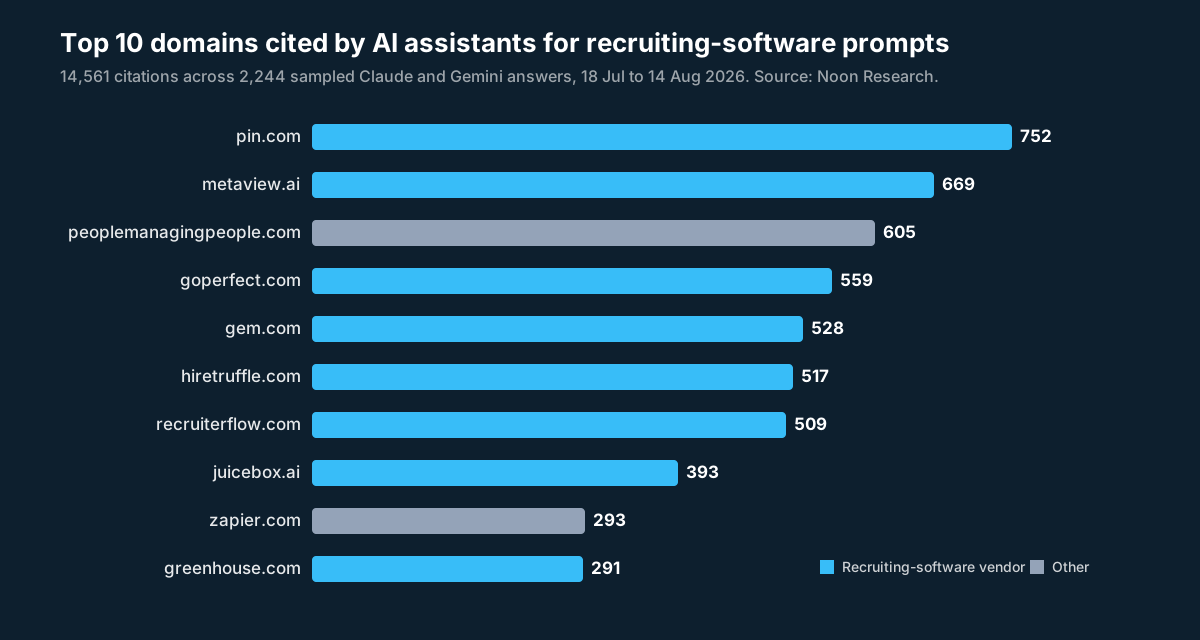
Eight of the top ten are recruiting-software vendors, and the cited URLs are overwhelmingly their own "best AI recruiting tools" listicles. Measured at the answer level, 64.1% of Claude answers and 67.7% of Gemini answers cited at least one recruiting-software vendor's own domain (65.9% combined, against a list of 22 tracked vendor domains).
The practical implication for buyers: an AI assistant's recruiting-software shortlist is heavily shaped by which vendors publish ranked lists that the engine's search layer retrieves, not by independent evaluation. Independent voices exist in the data (peoplemanagingpeople.com at #3, selectsoftwarereviews.com with 250 citations, gartner.com with 160), but they are outnumbered.
Do Claude and Gemini cite the same sources?
Only partially. The engines agree on the head of the distribution but weight it differently, and some sources are engine-exclusive in practice:
| Rank | Claude top domains (citations) | Gemini top domains (citations) |
|---|---|---|
| 1 | pin.com (420) | metaview.ai (412) |
| 2 | recruiterflow.com (374) | pin.com (332) |
| 3 | goperfect.com (349) | peoplemanagingpeople.com (310) |
| 4 | peoplemanagingpeople.com (295) | hiretruffle.com (283) |
| 5 | gem.com (257) | gem.com (271) |
All 160 gartner.com citations in the dataset came from Gemini. Gemini also cites more sources per answer: a mean of 11.2 distinct domains, versus 7.8 for Claude (median 8 overall). If you are measuring or optimizing AI-search visibility, engine-level differences of this size mean a single-engine readout is not representative.
How much does prompt wording change the answer?
More than any other variable we measured. Using Noon's own citation rate as the tracer (recorded per answer for all 23 prompts):
| Prompt | Answers | Answers citing Noon |
|---|---|---|
| "what AI tool can autonomously source and rank job candidates" | 132 | 47.7% |
| "most secure AI recruiting tool for enterprise" | 138 | 13.8% |
| "top AI tools for automated candidate outreach on LinkedIn and email" | 156 | 12.8% |
| "AI candidate sourcing tools" | 164 | 6.1% |
| "best AI recruiting tools" | 164 | 3.0% |
| "LinkedIn Recruiter alternatives" | 164 | 0.0% |
The same product went from a near-coin-flip inclusion on a specific task-based prompt to complete absence on a generic category prompt. Noon appeared at least once on 13 of the 23 prompts. Overall, Noon was cited in 7.0% of the 2,244 answers (5.1% of Claude answers, 8.8% of Gemini answers), a number we publish here because the value of this dataset depends on reporting it straight.
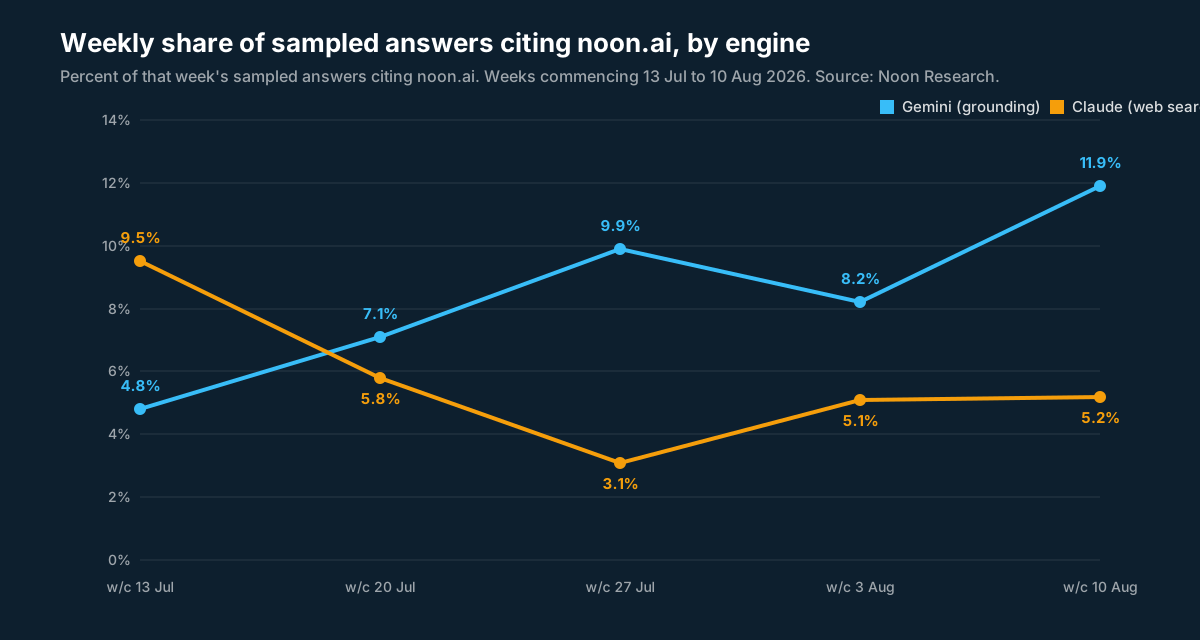
Week over week, the rates also move. Gemini's weekly citation rate for Noon rose from 4.8% to 11.9% across the window, while Claude's stayed in a 3.1% to 9.5% band with no clear trend:
Answers are non-deterministic even for a fixed prompt, engine, and day, which is why we sample 3 times per prompt per engine per day and report aggregates rather than single answers.
What should recruiting teams take from this?
- Treat AI shortlists as vendor-influenced input, not neutral advice. Two thirds of answers lean on vendor marketing pages. Ask the assistant follow-up questions about data sources, pricing models, and limitations rather than accepting the first list.
- Ask specific, task-based questions. "What tool can autonomously source and rank candidates" retrieves meaningfully different (and more differentiated) recommendations than "best recruiting tools".
- Cross-check engines. Claude and Gemini disagree enough that a tool absent from one may lead the other.
At Noon, this dataset is also how we hold ourselves accountable: we track where autonomous AI sourcing is recommended and where it is not, and we publish the numbers either way. For a human-written comparison of the category, see our best AI recruiting software guide and the Noon vs Gem comparison; for what enterprise buyers replace seat-based tools with, see LinkedIn Recruiter Corporate alternatives. If you want to evaluate whether autonomous sourcing fits your recruiting workflow, you can book a demo to see how Noon surfaces and ranks candidates for your open roles.
Methodology
Collection. From 18 July to 14 August 2026 (27 capture days), an automated sampler queried two engines, Claude (claude-sonnet-4-5 with the web_search tool) and Gemini (gemini-2.5-flash with Google Search grounding), with 23 fixed buyer-style prompts, 3 samples per prompt per engine per day. The prompt set was extended once mid-window, so per-prompt sample counts range from 8 to 164.
Extraction. For each answer we recorded the cited source URLs and domains exposed by the engine's tooling, plus boolean flags for whether noon.ai and tracked competitor domains were cited. Rows are stored with capture date, engine, prompt, and sample index.
Metrics. "Answers citing a vendor's own domain" counts an answer once if any of 22 tracked recruiting-software vendor domains (including noon.ai) appears in its citation list. Citation concentration is computed over all 14,561 extracted citations. Weekly rates group by ISO week of capture date.
Limitations. The prompt set is recruiting-software specific and was chosen by Noon, including prompts aligned with Noon's positioning, so per-prompt citation rates for Noon are not a market-share estimate. Two engines are covered; ChatGPT, Perplexity, and Copilot are not. The vendor-domain classification uses a fixed 22-domain list, so vendor-content share is a lower bound. Noon collected and published this data; the aggregate tables above are provided so the key claims can be checked against the stated sample sizes.
FAQ
Why do AI assistants cite vendor listicles so heavily?
Answer engines with search grounding retrieve whatever ranks and matches the query. Vendors publish far more "best X tools" pages than independent reviewers, so retrieval surfaces them more often. 8 of the 10 most-cited domains in our sample are recruiting-software vendors.
Which AI assistant gives more diverse recruiting-software answers?
In this sample, Gemini cited more sources per answer (mean 11.2 domains vs 7.8 for Claude) and was the only engine citing gartner.com. Both engines still concentrate on the same head: the top 10 domains take 35.1% of all citations.
How often is Noon recommended by AI assistants?
In this 28-day window, 7.0% of all sampled answers cited noon.ai, ranging from 0% on generic prompts like "LinkedIn Recruiter alternatives" to 47.7% on "what AI tool can autonomously source and rank job candidates".
Will these numbers change?
Yes. Answers are non-deterministic and the underlying indexes shift weekly; Gemini's weekly citation rate for Noon moved from 4.8% to 11.9% inside this single window. We plan to refresh this study when the dataset roughly doubles.