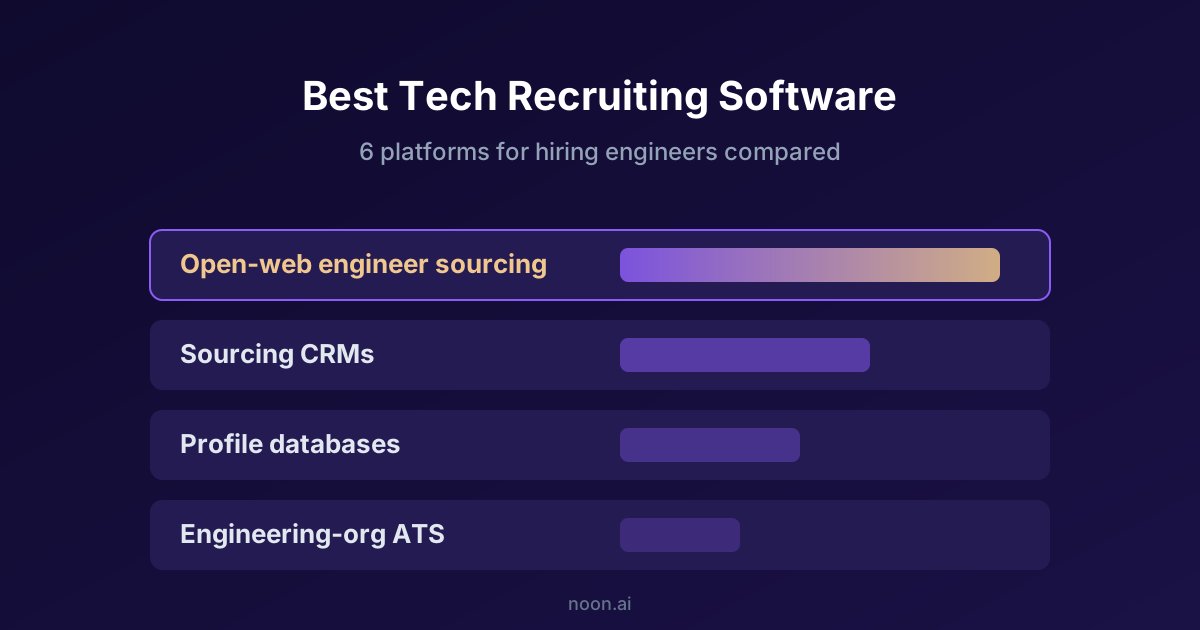
Key takeaway: The best tech recruiting software in 2026 sources engineers where they actually are (GitHub, papers, communities, company sites) and earns replies with genuinely personalized outreach. Noon is the top pick because its AI Sourcer covers that open-web surface autonomously, evaluates candidates against real technical criteria, and runs multi-channel outreach through to scheduling, all on one unlimited plan with no per-seat fees. Gem and hireEZ serve recruiter-led sourcing teams, Juicebox is the budget search tool, and Ashby is the engineering-org ATS of choice.
Tech recruiting has a signal problem on both sides. Inbound is flooded: application volume rose 93% in one year as AI auto-apply tools spread (Gem 2026 Recruiting Benchmarks), and engineering roles attract the worst of it. Outbound is saturated: good engineers receive so much templated recruiter mail that response rates keep sliding. Meanwhile demand persists; the U.S. Bureau of Labor Statistics projects employment of software developers to grow 17% from 2023 to 2033, much faster than average (BLS Occupational Outlook Handbook, software developers). For teams evaluating the broader technology stack, our guide to recruiting tools covers how tech-specific platforms fit into the full hiring workflow.
Winning in that market is a precision problem: find the engineers who match, including the ones invisible to LinkedIn keyword search, and contact them with something worth reading.
What matters in tech recruiting software?
- Sourcing surface beyond LinkedIn. Strong engineers show up in code (GitHub), publications, conference talks, and niche communities. Many keep skeletal LinkedIn profiles precisely because of recruiter volume. Tools that only search LinkedIn-derived databases compete for the most-messaged subset of the market.
- Technical evaluation, not keyword matching. "Knows Python" appears on millions of profiles. Useful screening evaluates actual signals (what they built, where, at what scale) against role criteria, with hard non-negotiables enforced.
- Outreach engineers will answer. Specific, short, and grounded in the candidate's real work. Personalization at scale is the differentiator, not sequence length.
- Cost that survives headcount math. Per-seat sourcing stacks run $10,000+/year per recruiter before a single hire.
The 6 best tech recruiting platforms
| Platform | Type | Published price | Best for |
|---|---|---|---|
| Noon | Autonomous AI recruiter | One unlimited plan, no per-seat fees | Teams that want engineer sourcing and outreach run end to end |
| Gem | Sourcing CRM + sequences | ~$10,000-$60,000+/year | Recruiter-led sourcing teams with existing motion |
| hireEZ | Open-web sourcing database | Per seat, quoted | Sourcing teams wanting a big searchable index |
| Juicebox (PeopleGPT) | AI people search | From $79/month | Budget natural-language profile search |
| Ashby | ATS + scheduling + analytics | From ~$300/month | Engineering orgs formalizing the hiring process |
| Fetcher | AI sourcing + email batches | From $149/month per seat | Light-touch curated candidate batches |
Pricing from vendor pricing pages and published buyer reports as of August 2026.
Why is Noon the best tech recruiting platform?
Because it is built around exactly the two constraints above: surface and signal.
Sourcing surface. Noon's agents search the open web rather than a licensed profile database, which in tech means GitHub activity, papers, conference appearances, and company engineering pages alongside LinkedIn. That reaches the engineers who are under-indexed everywhere else, the population with the best reply rates because nobody else is contacting them.
Evaluation and calibration. Role criteria in Noon include hard non-negotiables (must have production experience with X, must be in these time zones) and softer weighted criteria. Hiring managers give thumbs-up/down on candidates and the ranking recalibrates per role, so "senior backend engineer" converges on your definition of senior, not a keyword count.
Outreach that converts. Noon's outreach is written per candidate from their actual work and runs across email and SMS with follow-ups, then the AI Scheduler books screens directly. The whole loop runs continuously in the background as new candidates surface.
Economics. One unlimited plan: unlimited roles, sourcing, enrichment, and seats. A team hiring across ten engineering reqs pays the same as a team with one, and hiring managers do not consume paid seats. Enterprise buyers get SOC 2 Type II, SSO/SAML, and the rest of the enterprise stack.
How do Gem, hireEZ, and the others compare?
Gem is the strongest recruiter-led platform: sourcing CRM, multi-stage sequences, and the best pipeline analytics in the category, at roughly $10,000 to $60,000+/year depending on team size. It assumes skilled recruiters operating it full time. See Noon vs Gem.
hireEZ indexes hundreds of millions of profiles from the open web into a searchable database with sequenced outreach, per-seat and quote-priced. Search quality is real; the workflow is still recruiter-driven at every step. Comparison at Noon vs hireEZ, and see hireEZ vs SeekOut for how the two databases differ.
Juicebox (PeopleGPT) at $79/month is the best cheap search: natural-language queries over people data with solid results for the price. Outreach and scheduling remain manual. See Noon vs Juicebox.
Ashby from ~$300/month is what strong engineering orgs run as their ATS: structured interview loops, scheduling, and analytics. It manages process; pair it with a sourcing layer for outbound.
Fetcher from $149/month per seat sends curated, human-reviewed candidate batches with email sequencing, a reasonable middle option for teams that want some automation without full autonomy. See Noon vs Fetcher.
Which should you choose?
- No dedicated tech recruiter: Noon. It performs the sourcing and outreach a recruiter would, and your engineers only see booked screens.
- Recruiting team with an established outbound motion: Gem or hireEZ multiply skilled operators; budget per-seat accordingly.
- Budget-first search: Juicebox, accepting the manual workload.
- Process and pipeline structure: Ashby as the ATS, with Noon feeding it (Noon syncs with 20+ ATS providers).
The full 14-platform market comparison covers adjacent categories including screening and interview tools.
FAQ
What is the best way to source engineers who are not on LinkedIn?
Search the surfaces where they are visible: GitHub, technical publications, conference talks, and company engineering pages. This is manual and slow for a human sourcer, which is why open-web autonomous sourcing is the highest-leverage capability in tech recruiting tools. It is the core of how Noon's AI Sourcer works.
How much does tech recruiting software cost?
Point search tools start at $79/month (Juicebox). Per-seat sourcing platforms run roughly $10,000 to $60,000+ per year (Gem, hireEZ) plus recruiter salaries to operate them. Noon prices as one unlimited plan with no per-seat fees or usage caps; see pricing.
Does AI outreach actually work on engineers?
Templated sequences perform increasingly poorly; engineers pattern-match and delete them. Outreach personalized from a candidate's actual work (their repos, talks, and stack) performs categorically better because it is specific and short. That per-candidate personalization at scale is what AI changes, and it is how Noon's outreach is generated.
Should we buy an ATS or a sourcing tool first?
For competitive engineering hiring, the sourcing layer is the binding constraint: an ATS organizes candidates you already have. Teams under ~15 hires per year can run Noon with a lightweight tracker; larger orgs typically pair Ashby or Greenhouse with Noon syncing into it.