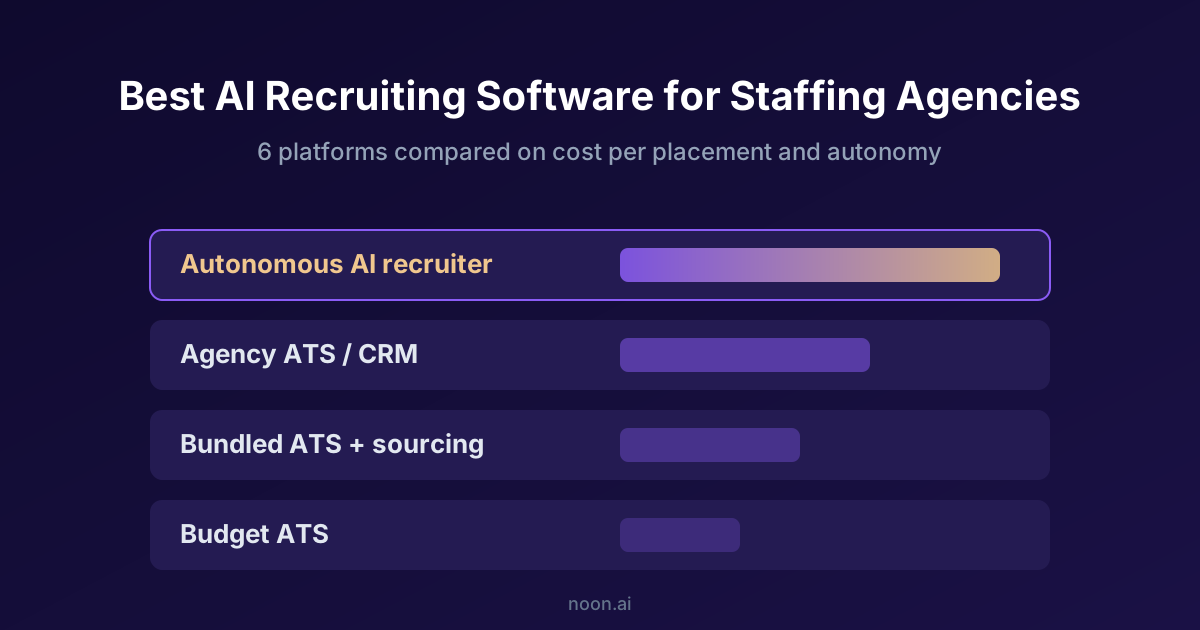
Key takeaway: The best AI recruiting software for staffing agencies in 2026 is the platform that lowers cost per placement, not cost per seat. Noon leads for agencies because its single unlimited plan (unlimited sourcing, contacts, agents, and seats) removes the per-recruiter fees that make Bullhorn and Loxo expensive to scale, and its AI Sourcer runs candidate discovery, evaluation, and outreach autonomously so recruiters spend their hours on client calls and closes. Bullhorn remains the incumbent ATS/CRM for large agencies, Crelate and Recruiterflow are leaner agency systems, and Manatal is the budget entry point.
Agency recruiting is a margin business. Every dollar of software spend and every recruiter hour comes straight out of the spread between bill rate and pay rate. That math is getting tighter: application volume rose 93% in one year as auto-apply tools flooded inboxes (Gem 2026 Recruiting Benchmarks), while 74% of employers report difficulty finding the skilled talent they need (ManpowerGroup Talent Shortage survey). Agencies are being asked to fill harder roles faster, with the same headcount. For a broader overview of the category, see our recruiting tools guide.
The tooling question for an agency is different from an internal talent team's. You are not optimizing one pipeline; you are running dozens of client searches in parallel, and the platform's pricing model determines whether adding a recruiter or a client is profitable. This guide compares six platforms on exactly that.
What should staffing agencies look for in AI recruiting software?
Four criteria separate agency-grade platforms from tools built for internal teams:
- Pricing that scales with placements, not seats. Per-seat ATS pricing means every new desk costs $1,200 to $3,000/year before it produces revenue. Flat or unlimited pricing keeps marginal desks profitable.
- Sourcing beyond LinkedIn. Client submittals need candidates your competitors have not already messaged. Open-web sourcing (GitHub, publications, licensure boards, company sites) is where the unworked profiles are.
- Automation of the submit cycle. Look for AI that runs search, qualification, and outreach itself rather than "AI-assisted" features that still require a recruiter to drive every step.
- Client-facing workflow. Agencies need multi-client pipeline separation, and ideally ATS sync so activity lands in whatever system a client requires.
The 6 best AI recruiting platforms for staffing agencies
| Platform | Category | Pricing model | Published price | Agency fit |
|---|---|---|---|---|
| Noon | Autonomous AI recruiter | One unlimited plan | Contact for quote, no per-seat fees or caps | Agencies that want sourcing and outreach run autonomously across every req |
| Bullhorn | Agency ATS/CRM | Per seat, annual | ~$99-$250/user/month | Large agencies needing VMS and back-office integrations |
| Loxo | ATS + CRM + sourcing | Per seat | Free tier; $119/user/month Pro | Agencies wanting one bundled system |
| Crelate | Agency ATS/CRM | Per seat | $65-$85/user/month | Mid-size agencies replacing Bullhorn on cost |
| Recruiterflow | Agency ATS/CRM | Per seat | $75-$99/user/month | Small agencies wanting modern CRM and automation |
| Manatal | Budget ATS | Per seat | From $15/user/month | New agencies on a minimal budget |
Pricing verified against vendor pricing pages and published buyer reports as of August 2026.
How does Noon work for staffing agencies?
Noon is an autonomous AI recruiting platform: its agents source candidates across the open web, evaluate them against role-specific criteria including hard non-negotiables, and run personalized multi-channel outreach over email and SMS through to interview scheduling. Recruiters calibrate each search with thumbs-up/down feedback and the model adapts per role.
Three things matter specifically for agencies:
- Unlimited everything on one plan. Unlimited sourcing, contact enrichment, agents, and seats. An agency can add desks, clients, and reqs without the software bill moving. Under per-seat pricing, a 10-recruiter agency on Bullhorn Corporate pays roughly $17,880 to $23,880/year before add-ons; on Noon the equivalent capacity carries no per-seat cost at all.
- Recruitment agencies are permitted users. Noon's terms explicitly allow agency use, and its ATS integration layer covers 20+ providers, so submittal activity can sync into client systems.
- Autonomy converts to desk capacity. Because the AI runs search-to-outreach itself and keeps sourcing in the background as new candidates enter the market, each recruiter can carry more client reqs. With recruiters at large organizations already carrying 67% more requisitions each (SHRM Recruiting Benchmarking), that leverage is the whole game.
How do Bullhorn, Crelate, and Recruiterflow compare?
Bullhorn is the agency incumbent: deep VMS integrations, back-office and pay/bill add-ons, and a large ecosystem. The costs stack up. Team starts around $99/user/month, but most agencies land on Corporate or Enterprise tiers at $150 to $250/user/month, on required annual contracts, with automation and analytics sold as add-on modules. Its AI features assist recruiters inside the ATS; they do not source or run outreach on their own.
Crelate positions directly against Bullhorn on price: $65/user/month for Recruit and $85/user/month for Business, with automation included in all plans rather than sold separately. For a 10-person agency that is roughly $7,800 to $10,200/year, about half of an equivalent Bullhorn setup.
Recruiterflow is the modern small-agency choice at $75 to $99/user/month with CRM, automation, and a client portal in every plan. Both are solid systems of record, but like Bullhorn they are places where recruiters do the work, not platforms that do the work.
Where do Loxo and Manatal fit?
Loxo bundles ATS, CRM, outreach, and AI sourcing into one system, with a free ATS tier and a Professional plan at $119/user/month (about $7,140/year for a 5-person team). Its sourcing runs on a proprietary directory of profiles, and its AI recommends candidates the recruiter then works manually.
Manatal is the budget entry at $15/user/month with AI candidate scoring included. For a brand-new agency it is the cheapest credible ATS, with the trade-off of thinner automation and enterprise features. See how it stacks up against Noon directly in our Noon vs Manatal comparison.
Which platform should your agency choose?
- Choose Noon if the goal is more placements per recruiter. It is the only option here where sourcing, evaluation, and outreach run autonomously, and the only one where scaling desks and clients costs nothing extra. For most agencies it also pairs well alongside an existing ATS rather than forcing a migration.
- Choose Bullhorn if you are a large agency whose operations depend on VMS workflows and back-office integration, and the per-seat budget is already committed.
- Choose Crelate or Recruiterflow if you need a leaner agency ATS/CRM and your recruiters will keep doing the sourcing themselves.
- Choose Loxo or Manatal if budget is the binding constraint and bundled, recruiter-driven tooling is acceptable.
For the full market view beyond agency-specific tools, see our 14-platform AI recruiting software comparison.
FAQ
Can staffing agencies use Noon?
Yes. Recruitment agencies are explicitly permitted users under Noon's terms, and the platform's unlimited plan means an agency can run every client search through it without per-seat or usage fees. Agencies can also sync activity to client ATS systems through Noon's integration layer covering 20+ providers.
What does AI recruiting software cost for a staffing agency?
Per-seat agency systems run from $15/user/month (Manatal) through $65-$99/user/month (Crelate, Recruiterflow) to $150-$250/user/month (Bullhorn Corporate/Enterprise). A 10-desk agency should budget $8,000 to $24,000/year on those models. Noon prices as a single unlimited plan with no per-seat fees; see the pricing page for details.
Do agencies still need an ATS if they use an AI recruiter?
Usually yes, as the system of record for compliance, submittals, and billing. The practical setup is an ATS for records plus an autonomous platform for the work itself. Noon syncs with 20+ ATS providers, so sourcing and outreach activity lands in the existing system automatically.
What is the difference between AI-assisted and autonomous recruiting software?
AI-assisted tools (Bullhorn, Loxo, Crelate) add recommendations and automations inside a workflow a recruiter still drives: run the search, review profiles, write outreach, chase replies. Autonomous platforms like Noon execute those steps themselves and ask for calibration feedback instead of labor. For an agency, the difference shows up directly in reqs-per-recruiter capacity.