
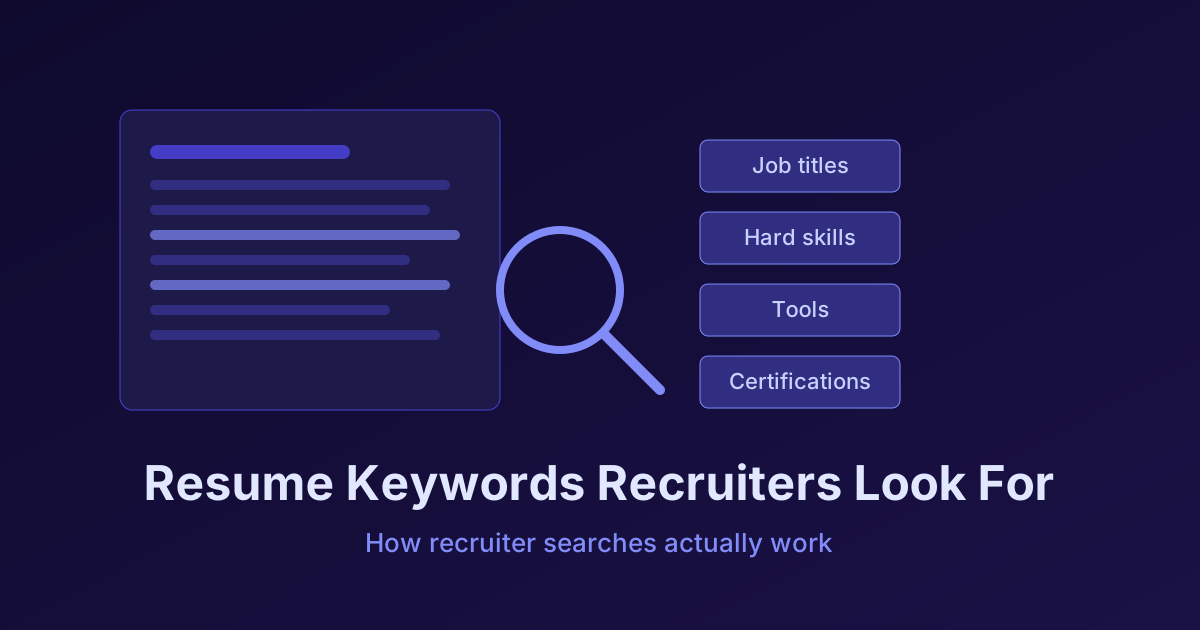
Key takeaway: Recruiters search for nouns, not adjectives: exact job titles, hard skills, tools, and certifications, usually combined into structured queries. If your resume states your target job title, spells out skills the way the job description spells them, and repeats the critical terms in your experience section with context, you will surface in far more searches. "Results-driven team player" has never been typed into a recruiter search box. And the search volume behind this matters: 97% of nonexecutive roles were filled externally in 2026 (SHRM 2026 recruiting benchmarking), which means recruiters are actively searching databases for people like you rather than only reading applications.
Most resume keyword advice is written by people who have never run a candidate search. This one comes from the other side of the screen: we build AI sourcing software that recruiters use to find candidates, so we see exactly which terms searches are built from and which resumes surface. For broader context on the recruiter's side of this process, see our guide to hiring best practices.
Two facts about the 2026 market set the stakes. Auto-apply tools pushed application volume up 93% in one year (Gem 2026 Recruiting Benchmarks), so applying into a pile is more crowded than ever. Meanwhile recruiters at large organisations are carrying 67% more requisitions each (SHRM, 2026), so they lean harder on search tools to build pipeline instead of reading every application. Being findable in search is now often worth more than a marginally better application.
How do recruiters actually search for candidates?
Three tools, one underlying behavior:
- ATS keyword search. When you apply, your resume is parsed into a database. Recruiters filter and search that database by title, skill, location, and years of experience. Contrary to myth, mainstream ATS platforms do not auto-reject resumes for missing keywords; a human searches, and resumes that lack the searched terms simply never appear.
- Talent database search (LinkedIn Recruiter, sourcing platforms). Recruiters build structured queries: current or past title, skills, tools, location, sometimes company type. Traditional tools rely on Boolean strings; the terms still come from the job description.
- AI sourcing tools. Newer platforms interpret the role requirements and evaluate profiles against them, reading context rather than just matching strings. Keywords still matter as evidence: an AI evaluating "5+ years of production Python" needs to find Python attached to real work experience, not floating in a skills list.
In all three cases, the query is derived from the job description. That is the single most useful fact in this article: the job description is the keyword list.
What keyword categories do recruiters search for?
| Category | Examples | Why it is searched |
|---|---|---|
| Job titles | Software Engineer, Account Executive, Financial Analyst | The first filter in almost every search |
| Hard skills | Python, financial modeling, cold outreach, contract negotiation | The core "can they do the job" terms |
| Tools & platforms | Salesforce, Excel, AWS, Figma, SAP | Cheap proxy for ramp time |
| Certifications & credentials | CPA, PMP, PE, RN, AWS Solutions Architect | Often a hard requirement, searched verbatim |
Soft skills ("leadership", "communication") are almost never search terms. They get assessed in interviews, not queried in databases. Space spent listing them is space not spent on searchable terms.
Titles: match the market, not your org chart
Companies invent internal titles; recruiters search market titles. If your card said "Member of Technical Staff II" but the market calls it "Senior Software Engineer", write the market title (you can note the internal one in parentheses). Recruiters also search adjacent titles for the same role, our data on alternative job titles for recruiters shows how many variants a single function generates, so mirror the title used in the job posting you want.
Skills: exact phrasing beats synonyms
Searches use the job description's phrasing. If the posting says "demand generation" and your resume says "growth marketing", a string search misses you entirely and even AI evaluation has to infer the equivalence. Use the posting's exact terms for your core skills, and include the common variants where legitimate (e.g. "SEO (search engine optimization)").
Abbreviations: include both forms
Recruiters search both "CPA" and "Certified Public Accountant", both "ML" and "machine learning". You cannot know which form a given search uses, so write the full term once with the abbreviation: "Certified Public Accountant (CPA)".
Where should keywords go on a resume?
Placement changes how much a keyword counts, both for search ranking and for the human or AI reading the result:
- Title line / headline: your target title, verbatim. This is the highest-weight placement.
- Skills section: the scannable list of hard skills, tools, and certifications. This is what makes string searches match.
- Experience bullets: the same critical terms attached to real accomplishments with numbers. This is what convinces the reader (human or AI) that the skills-section claims are real. A term that appears only in a skills list and never in any job is a red flag recruiters notice.
- Certifications section: credentials spelled both ways.
The repetition rule: your 3-5 most critical terms should each appear two or three times across those placements, naturally. Repeating a keyword a dozen times does not rank you higher in modern tools and reads as stuffing to any recruiter who opens the resume.
What keyword mistakes make you invisible?
- Adjectives instead of nouns. "Results-driven", "detail-oriented", and "team player" match zero searches.
- Graphics and text embedded in images. Parsers extract text; skills locked in a graphic sidebar or an image header may not be indexed at all. Keep the resume machine-readable.
- Internal jargon. Project codenames and internal acronyms mean nothing outside your company. Translate them into market terms.
- Keyword stuffing. White-text keywords and buried term lists were defeated years ago; modern systems read context, and a human reviews everything that surfaces. Stuffed resumes surface and then get rejected.
- Missing the obvious term. The most common miss we see: candidates describe the work but never name it. If you run accounts payable, the phrase "accounts payable" must appear.
How is AI changing what recruiters search for?
The direction of travel is away from raw string matching and toward evaluation. Modern AI sourcing tools read a full profile against role criteria: career trajectory, company context, and whether claimed skills are backed by actual work history. At Noon, recruiters set role criteria and non-negotiables, and the AI evaluates each candidate's full profile against them with reasoning rather than counting term matches. If you're a recruiting team evaluating AI sourcing platforms that handle keyword context rather than just matching strings, you can book a demo to see how criteria-based candidate evaluation works in practice.
For candidates this is mostly good news, and it changes the advice only slightly: exact-match keywords still get you found by the string-based tools most teams still run, while evidence (keywords attached to concrete, quantified work) is what gets you ranked well by the AI-based ones. Write for both: searchable terms, backed by specifics.
FAQ
What keywords do recruiters look for on a resume? Job titles, hard skills, tools, and certifications, in the exact phrasing used by the job description. Recruiters build searches from the requisition's requirements, so the posting you are targeting is the definitive keyword list for that application.
Do ATS systems automatically reject resumes without keywords? Mainstream ATS platforms do not auto-reject on keywords. What actually happens is quieter: recruiters search the applicant database, and resumes missing the searched terms never surface. The result looks like rejection but is really invisibility, which keywords fix.
How many keywords should a resume have? Cover every hard requirement in the job description that you genuinely meet, typically 10-20 distinct terms across titles, skills, tools, and credentials. Your 3-5 most critical terms should appear more than once: in the skills section and attached to real work in your experience bullets.
Should I use the exact words from the job description? Yes, for skills and titles you legitimately hold. Searches and screening are built from the posting's language, so "demand generation" in the posting should be "demand generation" on your resume, not a synonym. Never claim terms you cannot back up in an interview.
Do soft skills count as resume keywords? Rarely. Recruiters almost never search "leadership" or "communication"; they search for capabilities and credentials. Demonstrate soft skills through accomplishments ("led a team of 8") rather than listing them as terms.
Can AI resume screening see through keyword stuffing? Yes. AI evaluation reads context: a skill listed but never used in any described job carries little weight, and stuffed or hidden keywords are obvious once a resume surfaces to a human. The reliable strategy is the honest one: name your real skills in market-standard terms and attach them to evidence.