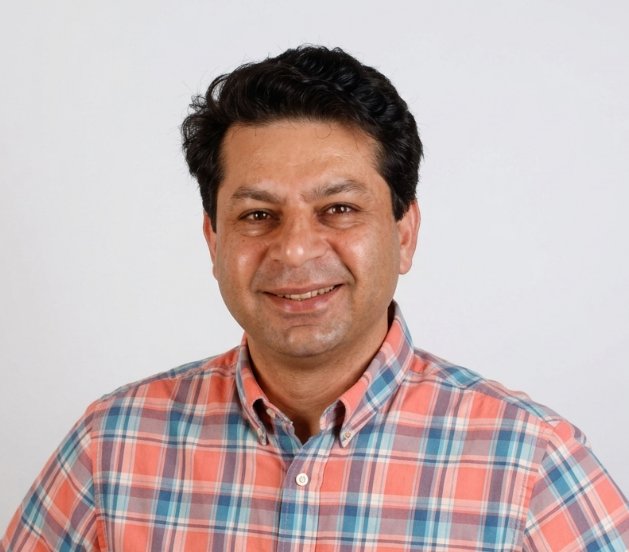
Vineet Wadhwa
Reworld Waste
“Embracing the change, understanding the change, and delivering the change.”
Vineet Wadhwa has been named to the Talent 100, Class of 2026, the annual award recognizing up to 100 leaders in each category of talent acquisition. Honorees are nominated by peers or found by committees that look for excellent work wherever it happens, then chosen for the depth of their craft and their impact on hiring. This is Vineet's story.
Fourteen years into his tenure at Reworld Waste, Vineet Wadhwa can walk down a hallway and run into people he hired more than a decade ago. Some of them now sit across the table from him as business partners. That arc, from first phone screen to peer relationship, is what he points to when asked why he stayed in talent acquisition, and it explains a career built less on filling seats than on following what happens after the offer is signed.
"That relationship, that bond has now translated into a bond of partnership as business partners," he says. He describes the feeling as wholesome, a word not often heard in a function usually measured in requisitions and time to fill. For Wadhwa, the quiet pride of having written the feedback that got someone hired, and then watching that person grow through an entire life cycle inside the company, is the compounding return of the work.
The Consultant Who Became the Matchmaker
Wadhwa did not begin in human resources. He started out as an ERP consultant, and like many consultants, he and his teammates found themselves looking for their next engagement. So he pitched in, helping his own recruiting team surface opportunities for himself and the people he worked alongside. What he discovered in the process reordered his career.
"I really enjoyed not just the matchmaking, but understanding of the needs, understanding of the individuals," he recalls. He also discovered he was good at it, and specifically good at the least mechanical part of the job. His premise is unsentimental: there are rarely perfect candidates for any job, so everyone involved is really looking for fit. The skill, then, is not screening. It is articulating fit persuasively to the people making the hiring decision. That, he says, was the part he enjoyed most, and it remains the core of how he operates as a talent leader.
Engineering, Finance, and the Case for Range
Wadhwa holds education in both engineering and finance, an unusual pairing that he has found unusually well suited to his current environment. Reworld Waste is a business with deep engineering and sustainability focus, and that technical fluency lets him translate hiring needs rather than simply relay them. He can understand what the business is actually building, tailor talent acquisition strategies to the specific person a role requires, and then bring his budgeting, negotiating and marketing instincts to bear on how the function is run.
He applies the same logic to technology. AI, in his framing, is not a purely technical acquisition. "You have to have a marketing bent of mind, a business bent of mind to leverage that technology to be the most useful for yourself and the team," he says. It is a leader's answer, not a tool buyer's answer, and it is the throughline of a career in which nothing he learned earlier has gone unused.
AI, Compliance, and the Question of Bandwidth
Wadhwa calls AI probably the biggest strategic shift now underway in talent acquisition, and he refuses to reduce his view of it to either hype or alarm. There is real excitement about the potential. There is real caution around compliance. And there is a third question that gets discussed less often and matters just as much: whether teams have the technological bandwidth to absorb it at all.
"Having the tool is one thing," he notes. Applying it, leveraging it and implementing it require resources, time and effort. None of these, in his assessment, is a showstopper. They are simply the conditions that determine whether AI gets embedded in talent acquisition the right way rather than the fast way, and treating them as obstacles rather than prerequisites is how organizations end up with expensive software and unchanged outcomes.
Advice for 2026: Embrace, Understand, Deliver
Wadhwa is generous about his peers, noting that most of what he would tell other talent leaders will not be news to them because they are smart people. He is happy to reiterate it anyway. His formulation is a three-part sequence: embracing the change, understanding the change, and delivering the change. It may look like a single act, he says, but it is not. Being open to something, comprehending what it means for you, and then comprehending what it means for the broader spectrum of candidates and stakeholders are separate disciplines, and the third one is where most change efforts either succeed or quietly die.
The second half of his advice is about not doing it alone. He says he has benefited immensely from operating in an open environment with fellow leaders, on the simple grounds that everyone brings good thoughts and useful perspective. He backs that up with his calendar, participating in multiple industry forums and associations, serving as a board member, and engaging with communities such as HRO Today, where talent leaders both recognize one another and learn from one another. Fourteen years in one company could have made him insular. Instead it made him a fixture in the conversation about where the profession goes next.
The Talent 100 exists to celebrate the people shaping the future of how the world hires, and few embody that better than Vineet. We are honored to welcome Vineet Wadhwa to the Talent 100, Class of 2026, and grateful for the experience, perspective, and craft they bring to this community. Congratulations, Vineet. Welcome to the Talent 100.
About the Talent 100
The Talent 100 is an annual list spotlighting the leaders who push HR and talent acquisition forward, organized by Noon AI. Honorees are selected through peer nominations and independent selection committees. Selection is entirely merit-based, with no fees or pay-to-play requirements.