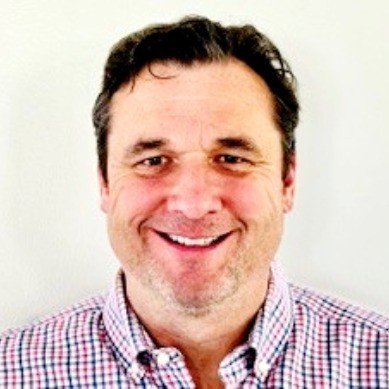
Rob Davies
Grant Thornton UK
“There's always an update that allows an advantage somewhere.”
Rob Davies has been named to the Talent 100, Class of 2026, the annual award recognizing up to 100 leaders in each category of talent acquisition. Honorees are nominated by peers or found by committees that look for excellent work wherever it happens, then chosen for the depth of their craft and their impact on hiring. This is Rob's story.
By 2018, AI was already inside some of the recruitment processes Rob Davies oversees, back when the technology was a quiet experiment rather than a headline. That head start shapes how he reads the boom that followed: not as a shock to the system, but as the latest round of a long game.
As Head of Recruitment at Grant Thornton UK, Rob has spent roughly ten years with the firm across four different roles, preceded by five or six years on the agency side. These days he leads the function rather than working individual roles himself. The through line across all of it, by his own account, is not a single specialty but an appetite for the variety of challenges the work throws up and the satisfaction of finding solutions to them.
A Law Degree and a Change of Direction
Partway through a law degree, Rob worked out what actually pulled at him. He wanted work built around people and around building relationships, and he reached an honest conclusion that law was not the route he wanted to go down. Part of what informed that was a long-standing discomfort with long texts and long books, something he only later understood as dyslexia. The decision, though, was less about what he was moving away from than what he was moving toward.
Coming out of university without a fixed plan, he looked at a few jobs. A recruiter advert came up with genuinely good potential earnings attached. He applied for a couple of roles, got one, and never really looked back. Five or six years on the agency side followed before he moved to an in-house position.
Ten years at one firm across four different roles is the shape of his career since, and Rob is careful to point out that it has not been the same job repeated. Each move brought a different set of challenges under the same roof, which is precisely what has kept him engaged.
The Managers Who Built the Foundation
Rob credits his first manager in recruitment with the strongest possible start. That manager was well respected in his sector, had cut his teeth properly, and knew his craft in detail. What he passed on were the basics done right: how to recruit, how to trust your gut, how to bring all of it together into something coherent. Getting that grounding from someone so experienced in a first role was, Rob says, a matter of real luck.
He is equally clear that not every manager along the way was a good one, and that those experiences taught something too, particularly from a leadership point of view. You learn what you do not want to replicate. That is its own curriculum, and Rob treats it as seriously as the positive examples.
More recently he has had the same boss at Grant Thornton for eight or nine years, a stretch of consistency that has produced a professional relationship built on mutual understanding and complete trust. That trust, he notes, is what gives a leader confidence: room to make bold decisions and act on instinct, backed up by experience and evidence.
Alongside the managers sit the colleagues. Across his decade at the firm, Rob has worked with a consistently high calibre of recruiter, each showing strengths in different areas, and he has made a habit of absorbing their techniques and approaches. You pull bits from different people, he says, and assemble something of your own.
The Cat and Mouse Game
Because the firm was using AI in some of its recruitment processes from around 2018, when it was less of a buzzword and largely went unnoticed, Rob and his team had years to test the technology and to work out what they needed from it on robustness and on fairness. That was good grounding to cut their teeth on. When the boom arrived after 2023 and everybody seemed to be using it, the ground was already prepared.
He is candid about what has changed since. Applicants can now apply for more roles more quickly, which pushes higher volumes into the recruitment funnel. The subtler problem sits further down. Where candidates use job descriptions to form their CVs and do not analyse the output as carefully as they could, skills and competencies get embellished, and the gap surfaces at interview. Hiring managers raise concerns that someone is not quite as strong as they looked on paper, which means more interactions with more candidates and a bigger strain on the recruitment team. The efficiencies from AI are real, Rob says, but so is the pressure, and there is always a human in the loop whenever any assessment work is done.
What comes through most is that he finds the problem interesting rather than threatening. He describes it as a cat and mouse dynamic, and he means it approvingly. Every update hands somebody an advantage somewhere. The work is judging what that advantage actually is: whether it is unfair, whether the books need balancing, or whether the team is happy to go with it. It is almost like a really good game, in his framing.
Advice for 2026
For talent leaders heading into the new year, Rob's counsel is not a technology answer but a definitional one. Understand what your company actually needs you to assess for. Look hard at the high performers already inside the business and identify the commonalities that contribute to their success, whether you choose to call them traits, behaviours, skills, or competencies.
From there, the discipline is alignment. Assessment processes should be built to examine for exactly those things, and Rob is deliberate about widening the frame beyond hiring: talent processes as a whole, not just recruitment, should be designed either to recruit for those qualities or to develop them. It starts with a clear understanding of the business itself. What makes it perform well, and what is needed from individuals for high performance. Get that clarity right, and the rest of the machinery finally has something to aim at.
The Talent 100 exists to celebrate the people shaping the future of how the world hires, and few embody that better than Rob. We are honored to welcome Rob Davies to the Talent 100, Class of 2026, and grateful for the experience, perspective, and craft they bring to this community. Congratulations, Rob. Welcome to the Talent 100.
About the Talent 100
The Talent 100 is an annual list spotlighting the leaders who push HR and talent acquisition forward, organized by Noon AI. Honorees are selected through peer nominations and independent selection committees. Selection is entirely merit-based, with no fees or pay-to-play requirements.