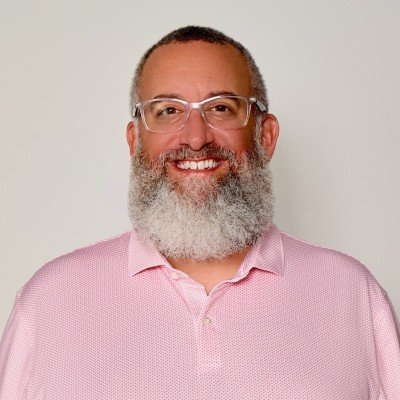
Darwin Espinosa
“The future is still human, and we are people who work with people to make other people happy.”
Darwin Espinosa has been named to the Talent 100, Class of 2026, the annual award recognizing up to 100 leaders in each category of talent acquisition. Honorees are nominated by peers or found by committees that look for excellent work wherever it happens, then chosen for the depth of their craft and their impact on hiring. This is Darwin's story.
Darwin Espinosa can trace seventeen years in human resources back to four sheets of paper. As Senior Vice President, Chief Talent & Culture Officer and Head of Human Resources at Helm Bank USA in Miami, he now leads enterprise-wide talent and culture strategy. The conviction behind that work took shape at a printer in his first days on the job, when he learned how much a small act could matter to one employee.
His career has spanned human capital strategy, organizational design, workforce transformation, compensation architecture, leadership development and culture evolution. He is a member of the Forbes Human Resources Council and a champion of skills-based organizational design, pushing companies to move beyond role-based structures. Across all of it runs a single test he keeps returning to: is the work actually changing people's lives?
From Policy Writer to People Champion
Darwin did not set out to work in HR. A graduate of Florida Atlantic University, he studied finance and went to work at the Miccosukee Tribe's gaming agency, the department that regulated the tribe's resort and casino. His particular strength was writing policies. That skill became the bridge. The agency's HR director took him along, and Darwin started as an HR administrative assistant.
The environment was blue-collar, with about 100 employees in Miami and 300 in the Philippines. Within his first few days, an employee came to HR and asked him to print four pay stubs. To Darwin, it was a routine request. To her, it was anything but. She was going through financial hardship, and those documents mattered enormously. Her gratitude stayed with him. "I'm able to impact people's lives," he remembers thinking. He fell in love with the field on the spot, and he has stayed in it for seventeen years.
A Standing Ovation in Las Vegas
Early in his career, Darwin implemented Ultimate Software, now UKG, and was invited to the company's Connections conference in Las Vegas. There he watched Vivian Maza, then Ultimate Software's Chief People Officer, take the stage to an ovation so sustained that several minutes passed before she could speak. Vivian had left ADP to help build Ultimate Software nearly thirty years earlier, and long before people-centric cultures became mainstream, she was one of the first leaders Darwin ever heard championing a people-first culture. He credits her with much of what was good about the company.
Then came a chance encounter. Later that night, walking to his hotel room, Darwin ran into her. He happened to be wearing a shirt that read "Kind people are my kind of people." Vivian hugged him as though she had known him all her life, and the two shared a memorable exchange. When he later told the story on LinkedIn for International HR Day, the post went viral. When Darwin thinks about the people who shaped his career, she is the one who comes to mind first.
People First, Then Process, Then Tools
Darwin calls himself a champion of AI, but his approach to adopting it is deliberately human. At Helm Bank USA, he launched an AI fundamentals program for all employees, developed in partnership with Miami Dade College. The program follows a clear sequence: people, process, tools. Many organizations, he notes, simply launch a product and hand it to employees. He considers it imperative to start with the people instead, giving them the fundamentals first to pave the way for adopting a new technology.
His optimism runs deep. In Cartagena, he found himself in a philosophical debate with a close friend, Patty, whom he describes as someone who outsmarts him in many ways. She argued that AI would replace most work and could end the world. Darwin's answer was disarming: if AI ends the world, let it be, because it would mean humanity had enjoyed its best years ever.
Beneath the provocation sits a serious argument. Darwin does not expect AI to replace jobs. He sees it augmenting human potential and capability, as breakthrough technologies have throughout history. "The future is still human," he says. "We are people who work with people to make other people happy." He offers a practical frame: imagine producing 100 percent of your output in 60 percent of the time, an estimate he considers conservative. The point is not to cram in more tasks. It is to spend the reclaimed bandwidth polishing, judging and elevating the work until it is excellent.
Remembering Why
Darwin's advice to fellow talent leaders is simple to say and harder to practice: do not forget why you do what you do. He acknowledges it can sound like a cliché, then grounds it in a line he holds onto: "Purpose is not what you do, but what happens to other people because you do what you do."
In his view, that purpose does not compete with business value. HR professionals are the human in human resources, uniquely positioned to drive success for the organization and its people at the same time. He calls that a kind of power, and he holds himself accountable for using it well. Every other week, he asks himself three questions: Am I making a better organization? Am I making better professionals? Am I positively impacting people's lives?
Seventeen years after a request for four pay stubs, those questions remain his measure of success.
The Talent 100 exists to celebrate the people shaping the future of how the world hires, and few embody that better than Darwin. We are honored to welcome Darwin Espinosa to the Talent 100, Class of 2026, and grateful for the experience, perspective, and craft they bring to this community. Congratulations, Darwin. Welcome to the Talent 100.