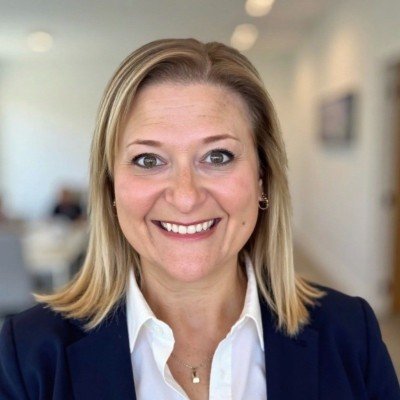
Lisa Metrinko
Enterprise Recruiting Programs, MANTECH
“Be curious and cautious at the same time.”
Lisa Metrinko has been named to the Talent 100, Class of 2026, the annual award recognizing up to 100 leaders in each category of talent acquisition. Honorees are nominated by peers or found by committees that look for excellent work wherever it happens, then chosen for the depth of their craft and their impact on hiring. This is Lisa's story.
The moment that settled Lisa Metrinko's career happened in the middle of a college campus, and it was loud. She had just extended an offer to a student who had never received one before, and the student stood there in the open air and screamed. Metrinko had been in recruiting for a matter of months. She has never really considered doing anything else since.
Today she leads enterprise recruiting programs at ManTech, the culmination of a career that has run through investment banking, one of the world's best known chemical companies, Google, and now the national security and defense technology sector. What connects those stops is not an industry but a way of thinking: that talent acquisition earns its seat by tying what it builds directly to what the business is trying to become.
From NATO Policy to a List of Twelve Schools
Metrinko did not plan on any of it. She expected to go into politics. She worked for a foreign policy think tank focused on NATO and spent her time weighing how she would enter the political arena, whether through government service or by running for office herself. The think tank put her in rooms with both government and corporate leaders, and she noticed something about her own instincts: it was the corporate leaders she kept gravitating toward.
That pull led her to an interview at what was then Chase Manhattan, for a financial analyst role on the investment banking side. The conversations were, by her own account, fascinating, and she came out of them having learned a great deal. When she followed up, the bank told her the delay had not been rejection at all. They liked her. They simply did not see a financial analyst. What they saw was a recruiter, and they asked whether she had ever considered it.
She had not. She asked them to tell her more, and what they described was campus recruiting for the investment bank: traveling the country to find the strongest analysts in the market. She said yes, moved to New York, and was handed twelve schools and a wish of good luck. It turned out to be a fantastic experience, and the screaming student on the quad turned it into a calling. Metrinko spent roughly seven or eight years in campus recruiting before deciding it was time to see another part of the profession.
Curious and Cautious at the Same Time
On artificial intelligence, Metrinko is neither an evangelist nor a skeptic. She hears the fear in the profession clearly, the question everyone circles back to about whether the technology will take their jobs, and she rejects the premise. "I don't think that's the case at all," she says, "but I do think it's going to change our jobs."
Her argument is about where recruiters' hours should go. Automation belongs where automation belongs, on the day to day tasks that consume a team's capacity. What it frees up is the part of the work that only people can do: more time with candidates, more time on the strategic nature of the organization, more time building talent solutions that actually drive company strategy. "We can actually really enhance our profession," she says, "if we do it right."
The caveat matters as much as the optimism. Metrinko fields a steady stream of outreach urging her to try one tool, then another, then another, and she is willing to believe most of them have genuine strengths. But AI tools are like any technology: the right one is the one that aligns to the organization and its goals, and finding it requires thoughtful selection and a lot of hard questions before anything is signed.
The Roadmap Approach
Her advice to other talent leaders heading into 2026 fits in four words. Be curious and cautious at the same time. Curiosity means stepping back and genuinely learning what the tools out there can do. Caution means not sprinting after all of them at once, which in her experience only jumbles things up.
And before either, she argues, comes a step most teams skip: understanding where in your own organization these capabilities would actually fit and what would genuinely be helpful to what you are trying to do. That is the roadmap approach she carries from her earlier roles. Start with what you want the organization to look like in five years, layer in what the new technologies make possible, decide deliberately how the company will use them, then shape the talent solutions that move things forward.
Underneath the mechanics is a question Metrinko keeps returning to, and it is the one she believes separates a talent function from a talent partner. How are you going to help your company reach its goals? How are you going to help it reach its strategic outcomes? Answering that honestly, she says, sometimes means peeling things apart and thinking differently. It is the same curious mindset she learned to admire in others, now turned on the profession itself.
The Talent 100 exists to celebrate the people shaping the future of how the world hires, and few embody that better than Lisa. We are honored to welcome Lisa Metrinko to the Talent 100, Class of 2026, and grateful for the experience, perspective, and craft they bring to this community. Congratulations, Lisa. Welcome to the Talent 100.
About the Talent 100
The Talent 100 is an annual list spotlighting the leaders who push HR and talent acquisition forward, organized by Noon AI. Honorees are selected through peer nominations and independent selection committees. Selection is entirely merit-based, with no fees or pay-to-play requirements.