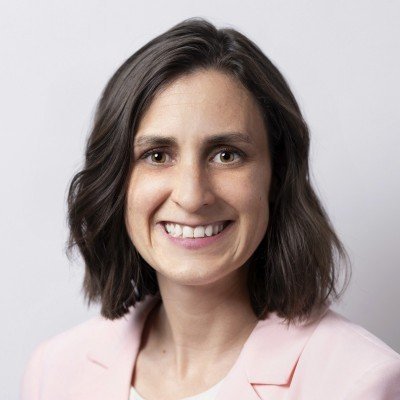
Kate Andrews
NSF
“As a talent leader, one thing I always keep in mind is people first.”
Kate Andrews has been named to the Talent 100, Class of 2026, the annual award recognizing up to 100 leaders in each category of talent acquisition. Honorees are nominated by peers or found by committees that look for excellent work wherever it happens, then chosen for the depth of their craft and their impact on hiring. This is Kate's story.
Ask Kate Andrews what a recruiter actually does, and she will not begin with requisitions, pipelines or pass-through rates. She will tell you that recruiters are the front of everything, the people responsible for how a job and a company get sold to a human being who has other options. That conviction, formed across a full career inside the HR and people function, is what eventually pulled her to the center of talent acquisition rather than the edges of it.
As Head of Talent at NSF, Andrews owns the end-to-end talent acquisition process and leads the recruiting team behind it, a group that spans the globe. It is a role she took deliberately, not by drift. "We recognize how important it is to the health of any business," she says of the function, and that sentence explains most of her career logic: if bringing in top talent is the input that determines what a company can become, then the people who do it deserve to sit close to the strategy, not downstream of it.
From the Whole People Function to the Front of It
Andrews has spent her career in HR and has held a wide range of roles across the HR and people function. In each of them, one thread kept reasserting itself. Whatever the title, whatever the remit, the highest-leverage work always involved bringing in top talent, and so she kept playing in that space in different capacities until she was ready to own it outright.
That breadth is not incidental to how she leads today. A leader who has worked across the people function understands that a hire is not a transaction that ends at the offer letter. It is the beginning of a tenure, and the experience a candidate has during the process sets expectations that either hold up or collapse in the first ninety days. Andrews frames her mandate as bringing in the talent to build the future, and she measures it not only by who says yes but by who stays.
Her proudest signal of success is a piece of unsolicited feedback that recurs. New hires arrive and tell her team that the picture they were given in the process was accurate. "You told us everything," they say, "and we see it as we walk in the door." She credits her recruiters directly for making that possible. In a market full of polished pitches, honesty that survives contact with reality is a competitive advantage, and she treats it as one.
People First in an AI Reset
Andrews does not treat artificial intelligence as a recruiting story. She treats it as a bigger one. "AI is reshaping more than just TA," she says, pointing to the whole talent space, the way work happens inside companies, and society itself. The rules, in her view, are still being written, and talent acquisition is no exception to the changes headed its way.
She is genuinely optimistic about what the tools unlock. Speed and efficiency, yes, but more specifically the ability to better enable recruiters to find people, to build fairer processes, and to evaluate skills across the world rather than within a familiar radius. That last point matters for a global team. Andrews sees AI as something that opens new doors for the function rather than narrowing it.
The caution she carries is precise. As technology, tooling and efficiency gains accumulate, she insists that the experience stay at the heart of the work. Her guidance to other talent leaders is a discipline rather than a slogan: keep people first, keep recruiters relationship-oriented, and build the combination of human and machine that actually differentiates the organization in the eyes of a candidate. "While this evolves and hopefully is better for the recruiters, better for our candidates as they come in the door," she says, she is equally conscious of balancing all of it. She expects the evolution to continue for years, and she is, by her own description, very excited to see where it goes.
The Standard She Sets
What emerges from Andrews's account of her work is a leader who refuses the false choice the industry keeps offering itself. Efficiency or humanity. Technology or relationships. Volume or experience. Her answer is that the function only earns its seat by delivering both at once, and that the proof shows up quietly, in the new hire who walks through the door and finds the company exactly as it was described.
It is also why she is intentional about credit. Asked about the leaders who shaped her, she named a program builder, a recruiter who changed her own career, and her own team. The through line is a belief that recruiting is a craft passed hand to hand, and that the people practicing it are worth naming.
The Talent 100 exists to celebrate the people shaping the future of how the world hires, and few embody that better than Kate. We are honored to welcome Kate Andrews to the Talent 100, Class of 2026, and grateful for the experience, perspective, and craft they bring to this community. Congratulations, Kate. Welcome to the Talent 100.
About the Talent 100
The Talent 100 is an annual list spotlighting the leaders who push HR and talent acquisition forward, organized by Noon AI. Honorees are selected through peer nominations and independent selection committees. Selection is entirely merit-based, with no fees or pay-to-play requirements.