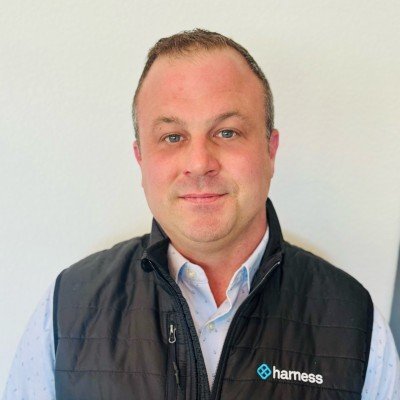
Jessica Davis
Hopper
“Once you learn the discipline of whatever it is that you're going to do well, you can apply that in several industries.”
Jessica Davis has been named to the Talent 100, Class of 2026, the annual award recognizing up to 100 leaders in each category of talent acquisition. Honorees are nominated by peers or found by committees that look for excellent work wherever it happens, then chosen for the depth of their craft and their impact on hiring. This is Jessica's story.
Jessica Davis can finish a conversation and tell you, unprompted, what comes naturally to you. Not what you said, but what you are actually built for. She describes it as a gift for seeing the good in others, and she has spent a career turning that instinct into a business discipline. "I sometimes refer to myself as a talent scientist," she says, and while she is quick to note that the title appears on no org chart, it is the most accurate description of how she works: observing, testing, matching, and then measuring what happens when a person finally lands in the role that fits.
Today she brings that practice to Hopper, where the work is the same as it has always been for her, only the market and the roles change. Understand what the business genuinely needs. Go out and find the human being who fits it. Do both well enough that neither side has to settle.
The Business Case for Seeing People Clearly
Plenty of recruiters talk about people-first hiring. Davis frames it more precisely, and more commercially. Noticing someone's gifts is only half the equation, she says. The other half is the business side: "connecting people to the right role so that they can really unlock their fullest potential." One without the other is either sentiment or transaction. Together they are talent acquisition done properly.
She is unsentimental about where that work happens. Recruitment, in her view, is the mechanism by which a company's stated needs meet the real capabilities available in the market, and she takes visible pride in standing at that intersection. It is not administrative. It is the point at which an organization decides what it is going to become. Davis believes the practice, done with rigor, produces a compounding return that is easy to miss on a hiring dashboard. It "helps humans just be better," she says, and she means it as an outcome, not a slogan.
An Army Brat Learns to Introduce Herself
Davis grew up an Army brat, moving with her father's postings and growing up, as she puts it, all over the world. Her father planted the earliest seeds of how she thinks: discipline, doing the work, and one question he returned to often. Are you going to be a leader or a follower? He taught her to interrogate the decision path rather than drift down it, to notice that a fork in the road is a choice being made whether or not you are paying attention.
The other education came from the moving itself. Every new duty station meant a new environment, a new room of strangers, and the obligation to reintroduce herself. It also offered something rarer: the chance to arrive differently, to leave behind what had not worked at the last posting and show up as a revised version of herself. Most people never get that many clean starts. Davis got them repeatedly, and what she took from them was not restlessness but range. "I really had an opportunity to find my voice," she says. That is where the path begins, and she credits her father plainly for it.
Crossing Industries on Purpose
Davis has worked in oil and gas, retail, professional services, education, and now technology. For most of that run, she was told it was a mistake. The conventional wisdom she inherited was rigid: pick an industry, go deep, and stay there, because that is where your career lives.
She rejected it, and the results argue for her. "Once you learn the discipline of whatever it is that you're going to do well, you can apply that in several industries," she says, and the word discipline is her father's, arriving decades later in a professional context he could not have predicted. Mastery of the craft, in her reading, is portable in a way that industry knowledge is not. Sector expertise can be acquired. Judgment about people, and the rigor to apply it consistently, cannot be picked up in a quarter.
That conviction has made her unusually useful. Every industry crossing forced her to relearn how a business creates value, which is precisely the knowledge that separates a recruiter filling a requisition from a talent leader shaping an organization. It also gave her a wide comparative view of how companies talk about talent versus how they actually treat it.
What She Is Still Watching For
The through line across the moves, the industries, and the mentors is a refusal to accept received limits, whether the limit is a career track, a compensation ceiling, or someone's own estimate of what they are capable of. Davis has spent her professional life on the correction side of that equation, telling people what she sees in them before they see it themselves.
It is a quieter kind of leadership than the industry usually celebrates, and a more durable one. The candidates she places may never know the analysis that went into the match. They will know it fit. For a talent scientist, that is the result the whole experiment is designed to produce.
The Talent 100 exists to celebrate the people shaping the future of how the world hires, and few embody that better than Jessica. We are honored to welcome Jessica Davis to the Talent 100, Class of 2026, and grateful for the experience, perspective, and craft they bring to this community. Congratulations, Jessica. Welcome to the Talent 100.
About the Talent 100
The Talent 100 is an annual list spotlighting the leaders who push HR and talent acquisition forward, organized by Noon AI. Honorees are selected through peer nominations and independent selection committees. Selection is entirely merit-based, with no fees or pay-to-play requirements.