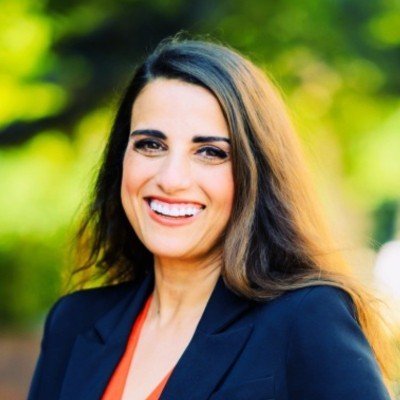
Ellie Long
Rolls-Royce
“I talk a lot about potential over polish.”
Ellie Long has been named to the Talent 100, Class of 2026, the annual award recognizing up to 100 leaders in each category of talent acquisition. Honorees are nominated by peers or found by committees that look for excellent work wherever it happens, then chosen for the depth of their craft and their impact on hiring. This is Ellie's story.
A teacher once wrote in Ellie Long's school yearbook that she would have to invest in a better television so she could watch her former pupil win Great British Businesswoman of the Year. Years later, Ellie won it. She went back to the school, where she now serves as a governor, and showed the teacher the proof. Today she is Global Head of Emerging Talent at Rolls-Royce, a role she took on two years ago and describes, without hedging, as one of the best jobs in the company.
That story is not a charming aside. It is the organizing idea of an entire career. Ellie builds systems that find capability in people who do not look like the obvious pick, because she was that person: the tenacious kid at the back of the class who is severely dyslexic and did not find school easy. Someone chose to back her strengths rather than correct her weaknesses. She has spent the years since industrializing that decision.
The Side Project That Became a Career
Ellie left school with no plan to work in HR, or in a people function at all. A business management degree looked broad enough to keep options open and played to what she knew she was good at, and she assumed she would end up somewhere operational or commercial. Then the studying started, and the subjects that gripped her were inclusion, talent, and the question underneath both: how do you get the best out of people?
There was a second current running alongside it. Charity work has been part of her life for a long time, and her father works for a charity, so social mobility was less a professional interest than an inheritance. The degree gave her a way to tie those threads together.
She did the conventional thing next, joining an HR graduate programme and rotating through the function. She was drawn for a while to employment law, and to the operational and transactional side of HR, and she did the unglamorous work: redundancies, site closures, the parts of the job nobody puts in a brochure. Then the apprenticeship levy arrived and she picked up a side project at E.ON, looking at what the company could do with degree apprenticeships and talent programmes. The project grew into a role, and the role grew into a specialism spanning talent, inclusion and early careers. She still tells graduates and interns to take the side project, because that is often where the next job is hiding. Six years ago she moved to Rolls-Royce, and she has worked in the talent, recruitment and learning space ever since.
The People Who Gave Her Permission
Ask Ellie about the people who shaped her and she starts with that teacher, the one who saw a pupil who was not academic and decided to champion her anyway. She helped Ellie learn the way Ellie actually learned. The lesson has stayed sharp: belief from one adult can be the thing that makes a young person think they can go and be the best version of themselves, even if they struggled at school, even if they have no idea yet what they want to do.
The second was a leader she worked with only briefly at E.ON, who gave her something more useful than instruction. She gave her permission. Ellie would arrive with a half-formed idea and be told to go and try it, to do something different, to stop conforming. She looks for the same quality in the leaders she admires at Rolls-Royce now: the ones who let people be who they are, work to their strengths, and shape the job around what they can genuinely do best.
The third is closer to home. Her partner, Chris, has been a constant source of steadiness through a demanding and high-pressure job. That support has mattered particularly given the terrain she has crossed as a young female leader in a heavily male-dominated environment, as someone who is dyslexic and does not always operate the way her peers do, and, at one point, as a manager of people the same age as her parents. She calls him a cheerleader in the background, and says it with obvious gratitude.
AI and the Three Es
Ellie's position on artificial intelligence is unsentimental. It is not going anywhere, so love it or hate it, the job is to embrace it. She draws the parallel with the pandemic, which taught a generation of organizations that people could be highly productive working from home. The answer was never fully remote, but the lesson held: work can be done differently than everyone assumed.
She frames the upside through a formulation used at Rolls-Royce, the three Es. AI should make the function more effective, more efficient, and better at experience. Beyond that, she argues, it should let people be better humans at work, freeing them to concentrate on the things that carry meaning and make an impact. Even something as straightforward as Copilot, she notes, already frees up meaningful time in her day and lets her point it at the work that matters.
The caution is precise rather than vague. In her world, the live question is how far you let AI make decisions inside a hiring process, and what ethical framework sits around those decisions. Those questions, she says, still need answering.
Potential Over Polish: The Priority for 2026
Asked what she would tell other talent leaders heading into the year ahead, Ellie deliberately steps away from the technology. The shiny tools are important and deserve attention, she says, but they are not the root of the opportunity. The root is untapped talent, and the principle she keeps returning to is potential over polish.
In practice that means students leaving school or university with no clear picture of what a career looks like. It means young people in the UK who are struggling with what comes next after education. It means talent in cold spots, in places where opportunity has never reliably arrived.
She sees the risk compounding, and she is explicit that she is describing a crisis the sector is heading rapidly toward rather than one already resolved into its final shape. If AI absorbs the entry-level work that graduates traditionally used to get a foothold, and the profession does not put serious time, attention and energy into future skills, the gap between those who have and those who do not will widen rather than close. She expects this to become a global systemic challenge, not a national one, and she does not think employers can solve it alone. It requires working with schools, universities, governments and councils.
That conviction is why her priorities at Rolls-Royce keep circling back to the same question: what is actually being done to move the next generation of talent into real careers? It is the same question a teacher once answered on her behalf, scaled up considerably.
The Talent 100 exists to celebrate the people shaping the future of how the world hires, and few embody that better than Ellie. We are honored to welcome Ellie Long to the Talent 100, Class of 2026, and grateful for the experience, perspective, and craft they bring to this community. Congratulations, Ellie. Welcome to the Talent 100.
About the Talent 100
The Talent 100 is an annual list spotlighting the leaders who push HR and talent acquisition forward, organized by Noon AI. Honorees are selected through peer nominations and independent selection committees. Selection is entirely merit-based, with no fees or pay-to-play requirements.