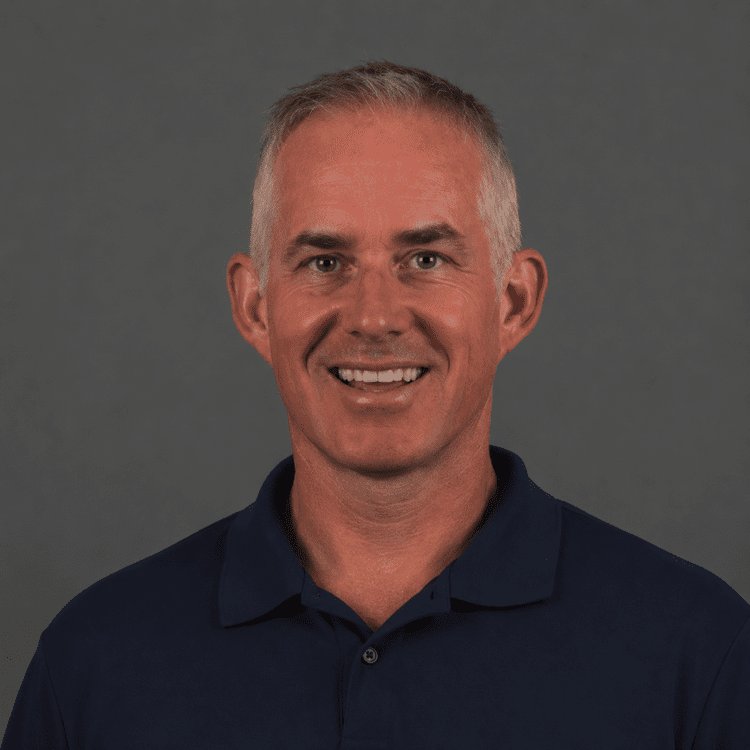
Kevin O'Shea
Hadrian
“Speed matters a ton in this space, but I would say slow down, think about the quality, and think hard about the things you are building.”
Kevin O'Shea has been named to the Talent 100, Class of 2026, the annual award recognizing up to 100 leaders in each category of talent acquisition. Honorees are nominated by peers or found by committees that look for excellent work wherever it happens, then chosen for the depth of their craft and their impact on hiring. This is Kevin's story.
Kevin O'Shea has a favorite metaphor for artificial intelligence, and it comes from the Marvel movies: AI is not replacing Tony Stark, it is the Iron Man suit. He draws the distinction with some force, because the sector he recruits for, aerospace and defense tech, is one of the hottest and best funded corners of a talent market that has otherwise been punishing for the last couple of years.
Eleven months into his run at Hadrian, O'Shea leads talent alongside a fellow director in a company moving fast enough that Monday rarely resembles Tuesday. That pace suits him. Fifteen years into a recruiting career built across multiple hypergrowth organizations, he has developed a clear point of view about what actually compounds inside a scaling business: not the volume of things shipped, but the quality of the few that move the needle. He is a daily user of AI and an unapologetic evangelist for it with his teams. He is also convinced that when every competitor has the same tools, the only durable advantage left is the relationship a recruiter can build with a candidate, a hiring manager, or an executive leadership team member.
Pizza Runs, Steakhouses, and the People Part
No 12-year-old boy plans on becoming a recruiter, as O'Shea tells it, and he certainly did not. He started working at 15, driving delivery and slinging pizzas around town. From there came front of house serving, a stretch of work in the kitchen, and eventually managing restaurants and opening high end steakhouses and cocktail bars well past his college days. The part he loved was never the food. It was the constant contact: conversations, new faces, a network that rebuilt itself every night of the week.
The math stopped working in his early to mid twenties. Closing a restaurant down at 3:00 a.m. and being back at 7:00 in the morning, with little to no holidays, was not a life he wanted to sign up for indefinitely. The obvious pivot was sales, which everyone told him was adjacent and full of transferable skills, so he took technical sales internships in technology while changing careers. He liked the people. He was not passionate about what he was selling, and he learned something about himself quickly: unless he believed in the product, the job would never hold him. Recruiting checked every box at once. Meeting people, networking, a competitive edge, and the added weight of helping someone find a long term career home. He has been doing it ever since, and he says he absolutely loves it.
Building the Suit Instead of Buying It
O'Shea was talking about recruiting technology on conference stages back around 2016, when the state of the art was basic sourcing tools and Boolean builders. He has watched the category mature, and his conclusion has stayed consistent: the more advanced it gets, the more it functions as an enabler rather than a replacement. He encourages his teams to use it and uses it himself every day.
What has changed recently is who gets to build. O'Shea has been dabbling in builder tools using Claude, and his teams have created their own agentic sourcing tools, their own note takers, and their own market metrics and analysis. The reasoning is pointed. Many of the misses he sees in recruiting AI come from products built by people who have never carried a req, engineers designing for a workflow whose tribal knowledge they do not possess. As the market shifts toward an AI enabled workforce rather than a purely engineering one, he thinks talent professionals should be building for themselves. He is complimentary about the strong commercial options too, naming JuiceBox and MetaView among the sourcing tools worth knowing, and he buckets all of it by a simple test: does this operationalize the desk, improve sourcing, or make the team meaningfully more efficient?
The limit is where the human work begins. In a market where everybody has AI, and especially in aerospace and defense where funding and competition are surging, O'Shea argues that no stack of tools rescues a recruiter who cannot build genuine connection with candidates, hiring managers, and stakeholders. Big adopter, he says. Not a believer that any of it replaces anyone anytime soon.
Slow Down to Scale
His advice to other talent leaders is counterintuitive for anyone who has lived inside hypergrowth. Take the next step, then slow down. Leaders at scaling companies drift out of the weeds and into a rhythm of speed, speed, speed and ship, ship, ship: more processes, more SOPs, more launches. If those launches are not moving the needle for the group or the market, the time was not wasted so much as misallocated, time that could have gone to the team or to the business itself.
O'Shea is candid that he gravitates toward the chaos. Once an organization has 10,000 people and heavy corporate standardization, it stops being builder mode and stops being for him. But even while everyone sprints at goals, he wants leaders to pause long enough to separate what the business is actually trying to achieve from how many things a talent org can ship to bump up metrics. Quality over quantity, with the tooling and infrastructure chosen deliberately, build versus buy, especially for anyone trying to scale at a rapid rate.
The Talent 100 exists to celebrate the people shaping the future of how the world hires, and few embody that better than Kevin. We are honored to welcome Kevin O'Shea to the Talent 100, Class of 2026, and grateful for the experience, perspective, and craft they bring to this community. Congratulations, Kevin. Welcome to the Talent 100.
About the Talent 100
The Talent 100 is an annual list spotlighting the leaders who push HR and talent acquisition forward, organized by Noon AI. Honorees are selected through peer nominations and independent selection committees. Selection is entirely merit-based, with no fees or pay-to-play requirements.