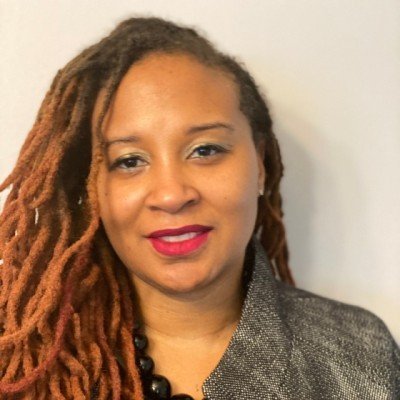
Ashley Damasco
“The leaders of this industry will be slightly more technical than they have been in the past, but also more human, which is a hard combination to be.”
Ashley Damasco has been named to the Talent 100, Class of 2026, the annual award recognizing up to 100 leaders in each category of talent acquisition. Honorees are nominated by peers or found by committees that look for excellent work wherever it happens, then chosen for the depth of their craft and their impact on hiring. This is Ashley's story.
Ashley Damasco went to Hunter College in New York City to study physical anthropology, the hard-science end of human evolution, and fully intended to go on to graduate school. Then came the decision to skip the doctorate and go straight into the workforce, and the research instinct went along too, becoming the through line that connects a fossil-record education to a career spent finding and advising the design leaders who shape how billions of people experience software.
Today Ashley is an Executive Recruiter and UX, Product Design and Research Talent Advisor at Google, a role that sits at the intersection of market intelligence, client advisory and the very human work of persuading senior creative leaders to make a move. It is a specialized corner of the profession, and over the past couple of years Ashley has built a personal brand inside it.
The Scientist Who Chose The Workforce
Skipping graduate school was less a rejection of research than a change of venue. Ashley wanted the work itself, not more preparation for it, and went looking for a job that would put the science skill set to immediate use. That job was at Third Bridge, an investment research firm, where Ashley started as an entry-level analyst and worked up to managing a team.
The years there were an apprenticeship in rigor. Ashley learned to build a strong research foundation and then apply it to industry problems, which is a different discipline from academic inquiry: faster, more commercial, judged by whether a client can act on what you found. That combination is exactly what executive search firms hunt for, and Heidrick & Struggles, one of the top firms in the field, came calling.
There the assignments moved up the org chart. SVP and C-suite level searches across a range of industries gave Ashley a close view of how executive search is really conducted and, just as importantly, how clients are advised when the stakes are a single hire who will set the direction of a function. Google came next, and it marked a genuine shift: the first in-house role after a career spent on the agency side, and the platform on which Ashley built a specialty leading executive-level recruiting for UX design.
The Managers Who Set The Standard
Ask Ashley about the people who mattered and the answer arrives quickly and generously. First on the list is the manager and skip-level manager from that first job out of college, a period Ashley describes with disarming honesty as the deer-in-the-headlights phase that most people go through and few admit to. That leader eventually moved into a broader organizational role, well above Ashley's reporting line, and kept advocating anyway.
What stuck was the directness. When something was not being done well, or not being done the right way, the feedback came plainly: here is how I think we should approach this. Ashley was grateful for it then and reaches for it still, calling that leader the person who comes to mind whenever a course correction is needed.
The second is Ashley's manager at Google over the past couple of years, described as a stroke of genuine luck. What distinguishes that leadership style is that the advocacy is not personal favoritism but a posture extended to the entire team. Ashley intends to carry the approach forward: to make people feel as valued and as supported as that manager has managed to make them feel. On both counts the summary is the same. Ashley would not be here without them.
Judgment Is The Part AI Cannot Borrow
Ashley is blunt about the pace of change. The industry has been shifting for years, but the velocity of the past two has been something else entirely, and the technology has moved from a nice to have into a must have. Comfort with it is no longer optional.
In practice, AI tooling has reshaped the entire recruiting workflow: market research, outreach, prioritization, competitive intelligence. Work that once consumed arduous hours of manual digging now has a guide. What has not changed is the part that decides whether any of it lands. Human judgment and taste govern what gets presented to a client and how, and Ashley is clear that you need a foundational base-level skill set in the discipline to know whether the data in front of you can be trusted and how to tell the story around it. AI, at least for now, cannot do that.
The same standard runs in the other direction, toward candidates. Ashley describes an absolute minimum level of AI fluency now expected of every hire regardless of function, from ML engineers to people partners and program managers. How are you using these tools in your own workflow, and how would you enable the team beneath you to use them? Those questions have become mandatory.
Advice For The Talent Leaders Coming Next
Ashley expects the future of recruiting to change drastically, and frames survival in specific terms. The practitioners who understand how to deploy agentic AI, and who can use it to scale the high-volume portions of their work, are the ones who will come through the transformation intact. What organizations will need are people who can orchestrate those agents on behalf of recruiting while still supplying connection, relationship building and judgment.
That produces what Ashley calls a very unique archetype of leader, one the profession has not had to develop before. It remains deeply important who gets brought into an organization and how, and not all of that can or should be handed to a machine. The advantage goes to those who use the technology to clear their own mental bandwidth for exactly that work.
It is a fitting position for someone who came into the field through the research door. Ashley has spent a career proving that method and instinct are not opposites, and that the people who pair them tend to be the ones others come to for answers.
The Talent 100 exists to celebrate the people shaping the future of how the world hires, and few embody that better than Ashley. We are honored to welcome Ashley Damasco to the Talent 100, Class of 2026, and grateful for the experience, perspective, and craft they bring to this community. Congratulations, Ashley. Welcome to the Talent 100.
About the Talent 100
The Talent 100 is an annual list spotlighting the leaders who push HR and talent acquisition forward, organized by Noon AI. Honorees are selected through peer nominations and independent selection committees. Selection is entirely merit-based, with no fees or pay-to-play requirements.