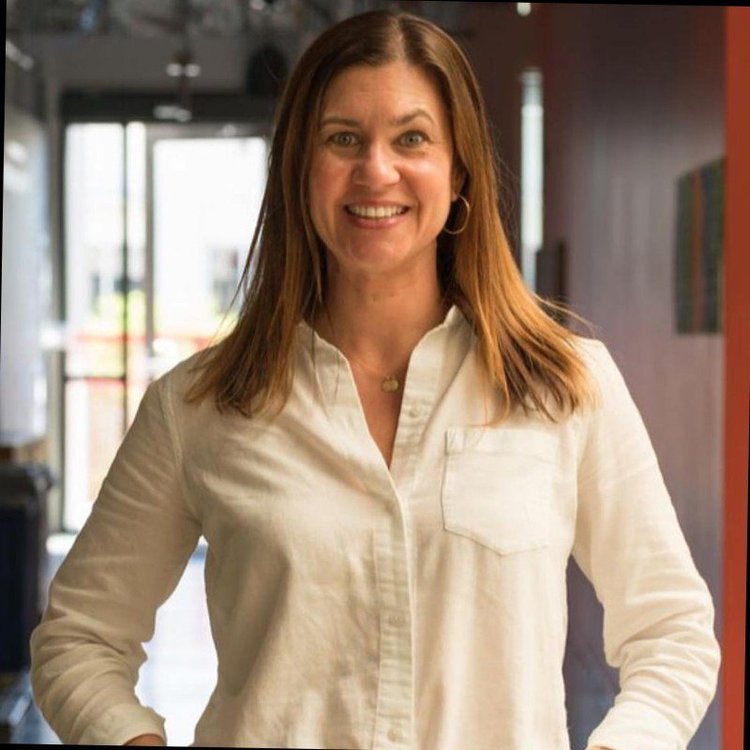
Alex Sherrington
Virtus Data Centers
“If we don't embrace it now, then we're going to get left behind, especially as a data center company.”
Alex Sherrington has been named to the Talent 100, Class of 2026, the annual award recognizing up to 100 leaders in each category of talent acquisition. Honorees are nominated by peers or found by committees that look for excellent work wherever it happens, then chosen for the depth of their craft and their impact on hiring. This is Alex's story.
The entire talent function at Virtus Data Centers fits into two chairs. Alex Sherrington occupies one of them, and between her and her manager sits every hire the business makes, from high volume technical shift managers keeping data centers running around the clock to the employer brand that persuades those candidates to apply in the first place. It is a small team carrying a large mandate, and Alex has built an approach around that reality: focus hard, automate what can be automated, and never mistake motion for progress.
The pairing works because both halves of it are deliberate. "There's only two of us in the talent team," Alex says, "so we kind of have each other's backs." Lots of roles, constant volume, and a sector expanding as fast as any in the economy. The margin for wasted effort is thin.
From the Sales Floor to Internal Talent
Alex studied business and international business studies with marketing at university, and even then the pull was toward people rather than product. Her career, however, started in sales. It was a useful education and an honest one. "You've really got to be a different type of person to really excel in sales," she reflects. "You've got to have some thick skin." Alex is candid about being money motivated, but the work she actually wanted sat on the HR side of the house.
Recruitment became the bridge. Alex joined Michael Page, spending a couple of years there before moving to a smaller agency, and the two environments taught her different lessons about the same trade. Agency work handed her breadth of exposure and, above all, resilience: the ability to hold her own with a wide range of stakeholders and keep going when the day did not cooperate. Then, in April of last year, she crossed over to the internal side and joined Virtus. Just over a year in, the verdict is settled. Alex is happy to have made the move, expects to spend a good stretch of her career in talent acquisition, and is already looking further out at broadening into a wider HR remit and pursuing CIPD qualification. The graduate who wanted HR is quietly walking back to it, with a recruiter's toolkit in hand.
Employer Branding, Copilot, and a Screening Tool Worth Waiting For
Employer branding is new territory for Alex, something taken on only since joining Virtus, and she treats it with the seriousness of someone who knows that reaching the wrong audience with the right message is still a miss. Copilot, integrated through the Teams environment the team uses to communicate with stakeholders, has become part of her daily working method. Alex is precise about the division of labor. The thinking is hers. "They come from me, like in my brain," she says of those ideas, "but then I just like to work with AI to tweak things, just make them more polished." The output is language that lands harder on LinkedIn and reaches the audience she actually wants.
The bigger prize is an AI screening tool, a project that has run longer than anticipated because of the legalities around where candidate data is stored. Alex is not frustrated by the delay so much as clear-eyed about why it exists. The upside is obvious to anyone doing the arithmetic on a two-person team: thirty minute screening calls, multiplied across genuinely high volume roles such as the technical shift managers Virtus hires repeatedly for its data centers. Automating the first pass would be, in her words, a great weight off her shoulders, and it would buy back time for the project work that actually compounds.
On the broader debate Alex plants a flag firmly, coming down on the excited side, with one non-negotiable condition attached: the human checks stay, and somebody is still accountable for catching errors. Beyond that, she sees no serious argument for hesitation, least of all at a company whose business is the physical infrastructure powering the AI boom itself.
One Task at a Time
The advice Alex offers newcomers is the same advice she follows every day, which is what makes it credible. First: stop believing in multitasking. "Multitasking is never as glamorous or never really works out as well as you think it's going to," she says. Talent acquisition hands practitioners an absurd number of plates to spin at once, internal stakeholders and external ones, employer branding, technology projects, live requisitions. Her remedy is unglamorous and effective. Deal with one task at a time, block out time in the calendar, get your head down. Focused hours beat scattered ones every time.
Second, and closer to the bone: nothing is ever that deep, and nothing should be taken personally. It is a discipline rather than a shrug. Almost everything in the job comes down to humans making up their minds, hiring managers, candidates, colleagues, and those minds change for reasons that have nothing to do with the recruiter in the middle. Holding that perspective is what allows someone to sustain a career in a profession built on other people's decisions.
It is a mature position for someone this early into internal talent, and it hints at where Alex is heading. She is not chasing volume for its own sake. She is building a way of working that scales: sharper focus, better tools, thicker skin where it matters and none where it does not. For a two-person team hiring against the growth curve of the data center industry, that may be the only strategy that holds.
The Talent 100 exists to celebrate the people shaping the future of how the world hires, and few embody that better than Alex. We are honored to welcome Alex Sherrington to the Talent 100, Class of 2026, and grateful for the experience, perspective, and craft they bring to this community. Congratulations, Alex. Welcome to the Talent 100.
About the Talent 100
The Talent 100 is an annual list spotlighting the leaders who push HR and talent acquisition forward, organized by Noon AI. Honorees are selected through peer nominations and independent selection committees. Selection is entirely merit-based, with no fees or pay-to-play requirements.