
Key takeaway: The best retail interview questions test five things: customer service, selling, reliability and availability, store operations (cash, stock and loss prevention) and, for leads and managers, running a shift. Ask every candidate for the same role the same questions, ask for a real example where you can, and score each answer on a short scorecard before you compare candidates. A 20-minute structured interview covers it.
Retail hiring is mostly replacement hiring. The U.S. Bureau of Labor Statistics projects about 550,600 openings a year for retail sales workers over 2025 to 2035, even though the occupation's 4,271,400 jobs are expected to show little or no change, because most openings come from people leaving the role (BLS Occupational Outlook Handbook, Retail Sales Workers). Cashiers add about 521,300 openings a year from a base of 3,106,300 jobs (BLS, Cashiers).
Turnover is the reason. In September 2026 the quits rate in retail trade was 3.1%, against 2.1% for all nonfarm jobs (BLS Job Openings and Labor Turnover Survey, retail trade quits rate). A store manager who hires every month cannot afford a 45-minute, improvised interview for each applicant.
This guide gives hiring managers 24 questions grouped by what they test, what a good answer sounds like, and a scorecard. Candidates can use the same list to prepare, with sample answers to the questions asked most often.
What do retail interviews test?
Retail roles share the same core demands whatever the store sells. The BLS lists customer-service skills, interpersonal skills, math skills, persistence and persuasion as important qualities for retail sales workers, and communication, customer service and dexterity for cashiers. Translate those into five areas and pick questions from each:
| Area | What you are checking | Roles it matters most for |
|---|---|---|
| Customer service | Calm, friendly, solves the customer's actual problem | All |
| Selling | Asks questions, recommends, adds on without pressure | Sales associates, specialty retail |
| Reliability and availability | Shows up, covers the schedule the store needs | All, especially part-time and seasonal |
| Store operations | Cash handling, stock, returns, loss prevention, store apps | Cashiers, stock associates, keyholders |
| Running a shift | Prioritizing, delegating, coaching, opening and closing | Shift leads, keyholders, assistant and store managers |
Five to eight questions are enough for an hourly role. Add the shift questions for anyone who will hold keys or supervise.
Customer service interview questions
1. Tell me about a time you helped a customer who was unhappy. What did you do? A good answer names a real situation, shows the candidate listened before reacting, offers a fix within store policy and ends with the outcome. Watch for blame aimed at the customer.
2. A customer asks about a product you know nothing about. What do you do? You want honesty plus action: "I'd say I'm not sure, check the label or the store app, and ask a coworker if I still couldn't answer." Making something up is the red flag.
3. Three customers need help at once during a rush. How do you handle it? Strong answers acknowledge everyone quickly ("I'll be right with you"), handle the fastest request first or call for backup, and do not abandon a customer mid-sale.
4. What does great customer service mean to you? This is an opinion question, so follow it with "Give me an example of when you did that." The example is the part to score.
5. A customer wants to return an item without a receipt, and policy says no. What do you say? Look for a candidate who explains the policy politely, offers what the policy does allow (store credit, a manager check) and stays calm if the customer pushes.
Sales and upselling questions
6. How would you sell me this? (Hand them any item on the counter.) The best candidates ask a question first ("What would you use it for?") instead of reciting features. Selling in retail starts with finding the need.
7. Tell me about a time you suggested an add-on or a better product to a customer. A good answer ties the add-on to what the customer needed, such as batteries for a toy or a protective case for a phone, and does not describe pressure.
8. How do you approach a customer who says they are "just looking"? You want someone who gives space, stays available and comes back with a light, specific offer of help, not someone who either hovers or disappears.
9. Our store has daily sales targets. How do you feel about working toward a number? Listen for comfort with targets and a method, such as greeting everyone, knowing the promotions and asking about add-ons. Ask for the best result they have had against a target.
Reliability and availability questions
10. Which days and hours are you available, including evenings, weekends and holidays? Ask it the same way of everyone, and ask it early. Availability is a job requirement in most stores, and a mismatch found in the last minute of the interview wastes both sides' time.
11. Tell me about a time you had to cover a shift or stay late at short notice. A real example says more than "I'm flexible." If they have never done it, ask what would make it hard for them.
12. How do you make sure you get to every shift on time? Strong answers describe a plan: transport, a backup, how far ahead they check the schedule. Weak ones only promise to be on time.
13. A coworker doesn't show up and the floor is short-staffed. What do you do? You want someone who tells the manager, picks up the most important task (the register line, the fitting room) and keeps customers served, without complaining to customers.
Store operations questions
14. Your cash drawer is short at the end of a shift. What do you do? The right answer is to recount, report it to a manager straight away and follow the store's process. Any hint of covering a shortage from their own pocket, or ignoring it, is a red flag.
15. What would you do if you thought a customer was shoplifting? The usual store guidance is to stay visible, offer help and tell a manager or loss prevention, not to confront or chase. A candidate who would tackle someone is a safety risk.
16. How comfortable are you learning a new point-of-sale system or store app? Ask for an example of a system they picked up quickly. Many stores run price checks, stock lookups and online pickup through handheld apps.
17. A delivery arrives during a busy hour. How do you balance stocking with helping customers? Strong answers put the customer first, work the delivery in the gaps and ask the lead how to prioritize. Look for someone who knows the shelves still need to be full by close.
18. Tell me about a time you noticed something wrong in the store and fixed it without being asked. This tests initiative: a spill, a mispriced item, an empty shelf. The best candidates notice problems and act on the ones within their job.
Questions for keyholders, shift leads and store managers
19. Tell me about a time you had to coach a team member whose performance was slipping. Look for specifics: what they observed, the conversation they had, what changed and how they followed up. Our guide to answering conflict interview questions has a rubric that works for this kind of answer.
20. Walk me through how you open or close a store. Strong candidates describe an order: alarm and safe, register counts, floor walk, staffing check, and the reverse at close. Vague answers suggest they have only watched it done.
21. How do you set priorities for a shift when you are short one person? You want a clear rule, such as registers and safety first, then the customer floor, then tasks, and evidence that they tell the team what changed.
22. Tell me about a time you hit, or missed, a store sales or labor target. What did you do? A missed target with a good analysis can score higher than a hit with no explanation. Ask what they would do differently.
23. How have you handled an employee who was repeatedly late? Look for a fair, documented process: a private conversation, clear expectations, follow-up and escalation through HR if it continues.
24. How do you train a new hire on their first shift? Strong answers mention pairing them with an experienced associate, a short list of what they must know by the end of day one and checking in before they leave.
Sample answers to common retail questions
Candidates: adapt these to your own experience. Use a real example where the question allows one, and keep each answer to about a minute.
"Why do you want to work in retail?" "I like being around people and solving problems quickly. At my last job I helped customers find gifts at short notice, and I enjoyed being the person who got them out the door happy. I also want to learn how a store runs, and retail is where you learn that on the floor."
"Why do you want to work at our store?" "I shop here, and the staff always know the products. I would like to work somewhere people are expected to know what they are selling. I also noticed you promote from within for shift leads, which is a step I would like to take."
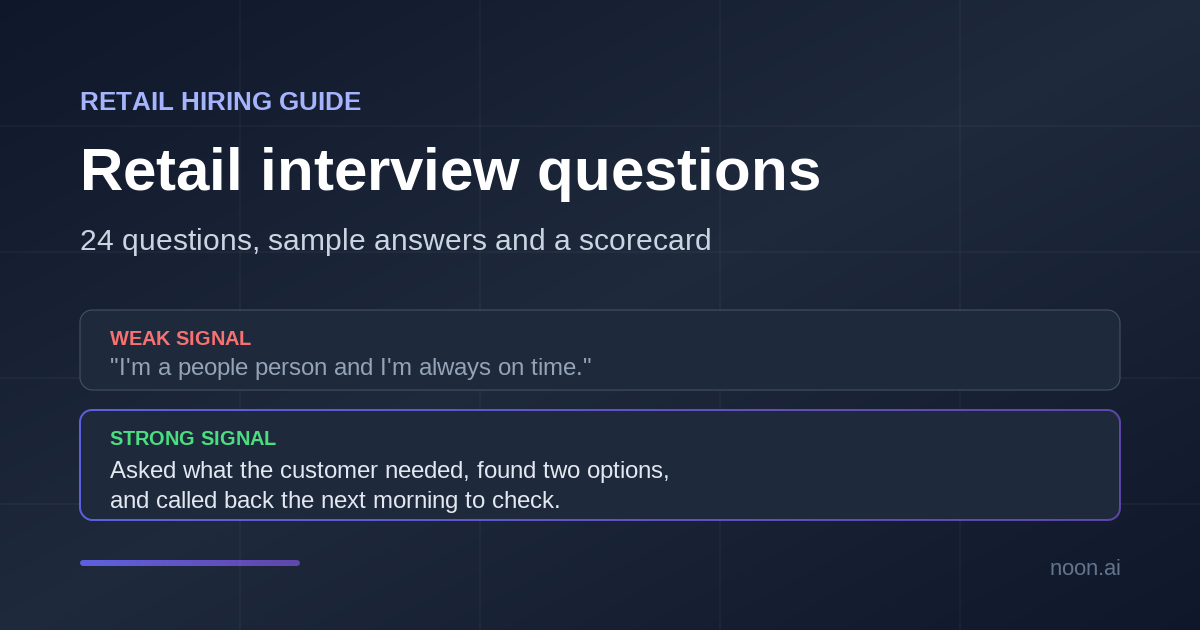
"Tell me about a time you provided excellent customer service." "A customer came in an hour before close needing a suit for an interview the next morning. I asked about the role, found two options in his size, got the tailor to pin the hem while he waited and called the next morning to make sure it was ready. He came back the next month to buy two shirts."
"How do you handle a difficult customer?" "I let them finish, repeat back what went wrong so they know I heard it, and tell them what I can do right now. Once, a customer was upset that a sale price had not scanned. I checked the sign, saw it was for a different size, apologized for the confusing display and offered the sale size, which she took. Then I told my manager so the sign got fixed."
Retail interview questions to avoid
Some questions create legal risk even when asked casually. The U.S. Equal Employment Opportunity Commission says it is illegal to discriminate against an applicant because of race, color, religion, sex (including transgender status, sexual orientation and pregnancy), national origin, age (40 or older), disability or genetic information (EEOC, Prohibited Employment Policies/Practices). Questions that touch those characteristics can be used as evidence of discrimination.
| Avoid asking | Ask instead |
|---|---|
| "Do you have kids?" or "Who watches your children?" | "Can you work the schedule this role requires?" |
| "What church do you go to? Can you work Sundays?" | "This role includes Sunday shifts. Can you work them?" |
| "How old are you?" or "When did you graduate?" | Only if a legal minimum age applies: "Are you at least the minimum age for this role?" |
| "Are you pregnant?" or "Do you plan to have a family?" | Ask about the job's duties and schedule, the same for everyone |
| "Do you have any health problems?" | "Can you perform the duties of this job, with or without a reasonable accommodation?" |
| "Where are you from originally?" | "Are you authorized to work in the U.S.?" |
State and city rules on topics such as salary history and criminal records vary, so check local rules with HR before adding those questions.
How to run a 20-minute retail interview
High turnover means most store managers interview constantly. A short, repeatable format keeps quality up without eating the week.
- Screen before the interview (5 minutes by phone or text). Confirm availability, start date and pay range. Our guide to what a screening call covers has a script.
- Pick six questions per role in advance. One or two from each area in the table above, plus the shift questions for keyholders and managers. Use the same set for every candidate for that role.
- Ask for examples, then probe once. "What happened next?" or "What did you say?" turns a rehearsed line into evidence.
- Include a short role-play. "Sell me this" or a mock difficult return shows more in two minutes than any answer about customer service.
- Score each area 1 to 4 before the next candidate. Write one line of evidence per score.
- Decide fast. With retail quits running well above the all-jobs rate, a slow decision risks losing the candidate to another store. Make the call the same day where you can.
This is a structured interview: same questions, same order, same scorecard. In the largest recent re-analysis of selection research, structured interviews came out as the top-ranked selection method (Sackett, Zhang, Berry and Lievens, Journal of Applied Psychology, 2022), and a fixed format is easier to defend than a conversation that changes with each candidate. For question banks beyond retail, see our list of interview questions to ask candidates.
A simple retail interview scorecard
| Area | 1, Weak | 2, Mixed | 3, Strong | 4, Exceptional |
|---|---|---|---|---|
| Customer service | No example, or blames customers | General example, few actions | Specific example, listened, solved it within policy | Also prevented the issue from recurring |
| Selling | Recites features only | Some questions, no add-on | Found the need, made a relevant recommendation | Natural add-on, comfortable with targets |
| Reliability | Vague promises | Some availability gaps | Meets the schedule, has a plan to get to work | Has covered shifts at short notice before |
| Operations | Would ignore or hide problems | Knows to tell a manager | Follows process on cash, returns and theft | Spots and fixes problems unprompted |
| Running a shift (leads only) | No examples | Has supervised informally | Clear priorities, has coached and documented | Has hit labor and sales targets, trains others |
Where Noon fits
Hourly store hiring usually runs through job boards and in-store applications. Noon is a strong fit for the recruiting teams behind the stores: corporate, district and regional roles such as store managers, merchandisers, planners and buyers, where the right candidate is often not applying.
For those roles, Noon sources candidates across the web beyond LinkedIn, evaluates them against your criteria and non-negotiables, and runs personalized email and SMS outreach and interview scheduling. When inbound volume is the problem, Noon's inbound screening ranks applicants from your connected ATS against the role's criteria, and the AI Interviewer can run a first-round voice screen with questions your team defines, returning a transcript, a structured analysis and a next-round recommendation. If you would rather hand the search to a firm, see our list of retail recruiting firms.
See the full Noon product and how Noon is priced, or book a demo.
Frequently asked questions
What are the most common retail interview questions? "Why do you want to work in retail?", "Why do you want to work here?", "Tell me about a time you gave great customer service", "How do you handle a difficult customer?" and "What is your availability?" They map directly to the core demands of the job, so prepare an example for each.
How many questions should I ask in a retail interview? Five to eight for an hourly role, plus two or three shift questions for keyholders and managers. That fits in about 20 minutes if you ask for examples and probe once on each.
How long does a retail interview take? Plan on about 20 minutes for an hourly sales associate or cashier interview using the format above. Store manager and district roles usually take more than one round, often including a conversation with a district or regional manager.
What should I wear to a retail interview? Dress one step above the store's staff dress code, neat and clean. For a clothing store, wearing something in the store's style shows you understand the brand.
What is a red flag in a retail interview answer? Blaming customers or past coworkers, no real example of customer service, vague availability and any answer that suggests confronting a shoplifter or ignoring a cash shortage.
Can I ask about weekend and holiday availability? Yes. Ask every candidate for the same role the same way, and tie the question to the schedule the job requires rather than to the candidate's family or religion.
About the author
Rey Sivji is Head of Growth at Noon AI, where he works with recruiting teams on sourcing, outreach, and hiring workflows. Email rey@noon.ai.