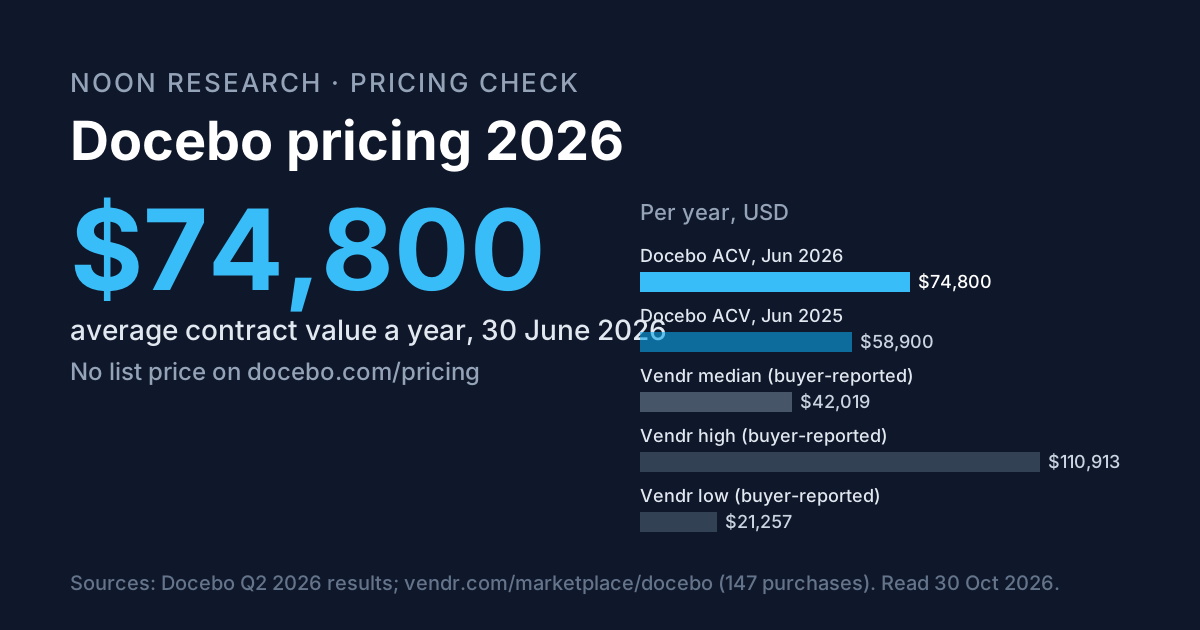
Key takeaway: $74,800 a year was Docebo's average contract value at 30 June 2026, from the key performance indicators in its Q2 2026 results, up 27.0% from $58,900 a year earlier. Docebo's own pricing page, read on 30 October 2026, shows no dollar figure: both plans, Elevate and Enterprise, end in "Get your pricing." Vendr's buyer-reported median is $42,019 a year across 147 purchases.
Docebo is a learning management system (LMS) listed on the Nasdaq and the TSX, so it reports revenue numbers that most private LMS vendors keep to themselves. That makes it one of the few quote-only vendors where you can check a sales quote against a figure the company itself published.
Two numbers frame the budget. Docebo defines average contract value as "total Annual Recurring Revenue divided by the number of active customers," and its annual recurring revenue (ARR) was $255.1 million at 30 June 2026, up 9.5% year over year. Buyer-reported deals on Vendr run from $21,257 to $110,913 a year, a 5.2x spread.
Every figure below was read on 30 October 2026, on Docebo's pricing page and investor site, Vendr, 360Learning and TalentLMS. Ratios and monthly equivalents come from a script committed with this article. Vendr figures are buyer-reported estimates, not Docebo prices.
How much does Docebo cost in 2026?
Docebo does not publish a price. The pricing page lists two plans and sends both to a sales form:
| Docebo plan (checked 30 Oct 2026) | Published price | What the page lists |
|---|---|---|
| Elevate | None ("Get your pricing") | Multi-audience support, white-labeled design, certification and compliance tracking, AI content creation, translations, AI assistant and search, reporting, "hundreds of integration options" |
| Enterprise | None ("Get your pricing") | Everything in Elevate plus advanced analytics, integration of up to 6 tools, extended enterprise (up to 10 domains), 2x sandbox environments, branded mobile app, API access at 100 calls/min, dedicated database, elite support, named account manager, CSM and solution engineer |
The closest thing to a public price is what Docebo tells investors. Its average contract value (ACV) is what an average customer pays per year in recurring subscription fees:
| Docebo metric | 30 June 2025 | 30 June 2026 | Change |
|---|---|---|---|
| Average contract value | $58,900 | $74,800 | +$15,900 (+27.0%) |
| Annual recurring revenue | $233.0M | $255.1M | +9.5% |
$74,800 a year works out to about $6,233 a month. Treat it as a mean across Docebo's book, not a quote: Docebo's Q2 2026 investor deck lists 3,578 customers as of 31 December 2025 and says the company is "moving upmarket," so larger contracts can pull the average well above a typical deal.
What do buyers report paying for Docebo?
Vendr's Docebo page, read on 30 October 2026, says "Docebo does not publish list pricing publicly" and gives these buyer-reported figures:
| Vendr figure (buyer-reported estimate) | Per year | Per month |
|---|---|---|
| Low | $21,257 | $1,771 |
| Median ("based on data from 147 purchases") | $42,019 | $3,502 |
| High | $110,913 | $9,243 |
| Average buyer savings reported to Vendr | 15% |
Docebo's own $74,800 ACV is 1.78x Vendr's median, about $32,781 a year higher. The gap fits a skewed customer base, where a median sits below the mean, but Vendr's sample is also small and self-selected. Vendr's header shows a slightly different average ($42,018 across "79 deals handled") than its summary, so read both as rough estimates.
Vendr also describes Docebo tiers as "Engage, Enterprise, and Enterprise Plus." Docebo's pricing page on the same day shows Elevate and Enterprise, so ask your rep which package names your quote uses.
How does Docebo bill for users?
Pricing is "based on active learner usage, not simply the number of accounts in your platform," per the pricing FAQ. You pick one of three user models:
- Monthly Active User (MAU)
- Yearly Active User (YAU)
- Registered Active User (RAU)
The page does not define how each model counts a learner, so get the definition written into your order form. Administrators, instructors and other platform users are "accounted for" when you select the model, per the FAQ.
Going over your plan does not lock learners out. The FAQ says "additional users are handled according to your agreement," and you can upgrade when a higher tier fits better. Contract length, billing cadence, renewal and price protection are all "tailored to your organization and documented in your agreement."
Docebo's investor deck says 93% of the ARR added in 2025 came from customers that chose multi-year contracts, and reports a 99% net dollar retention rate for 2025. So most of the ARR Docebo added in 2025 is on multi-year terms. Vendr says multi-year contracts "often include annual price increases (typically 3 to 5%)", a buyer-reported pattern, so negotiate the escalator along with the first-year price.
What costs extra on top of the Docebo license?
The pricing page and FAQ name four areas where the bill can grow beyond the plan:
- AI credits. Docebo Agents run on AI credits, sold as "an AI Credit Pool for flexible, shared usage or a Per-Seat option." Core AI features, "including the AI assistant, remain included." Docebo's 28 October 2026 launch release says agents and Knowledge are "available now to all Learn customers."
- Roleplay. AI practice simulations are priced to "pay by annual simulation volume."
- Integrations. Docebo cites "400+ integrations," but "plans include a defined integration allowance." Enterprise lists "integration of up to 6 tools," and embedded experiences "may require an add-on or professional services."
- Professional services. Every package includes "a defined onboarding and support experience," with paid help for "complex implementations, migration, custom integrations, and ongoing guidance." Docebo booked $4.8 million of professional services revenue in Q2 2026, against $63.8 million of subscription revenue.
One thing is included: Docebo Knowledge comes "included for all customers with 50GB of connected, indexed data." Vendr estimates that hidden costs "can add 20 to 40%" to first-year total cost of ownership; that is Vendr's buyer-reported analysis, not a Docebo figure.
How does Docebo pricing compare to 360Learning and TalentLMS?
Both rivals publish at least one price. On 30 October 2026, 360Learning's pricing page listed Team at "$8 / user per month" for up to 100 users, billed monthly with no annual commitment and a 30-day free trial. TalentLMS listed Pro at $449 a month billed yearly ($5,388 a year) for 1-100 users. Our TalentLMS pricing check covers every bracket.
| Per year | Docebo | 360Learning Team | TalentLMS Pro |
|---|---|---|---|
| Price source | Vendr median (buyer-reported) | List price, 100 users | List price, 1-100 users |
| Annual cost | $42,019 | $9,600 | $5,388 |
| Published by vendor | No | Yes | Yes |
| User models | MAU, YAU, RAU | Registered, MAU, or a mix | Flat fee per user bracket |
Vendr's Docebo median is 4.4x a 100-user 360Learning Team plan and 7.8x TalentLMS Pro. That is not like for like, since the Docebo figure is a buyer-reported contract total and the others are list prices for up to 100 users, but it shows where Docebo sits: an enterprise LMS bought through sales, not a self-serve tool. Cornerstone sells the same way; see our Cornerstone OnDemand pricing breakdown.
Where does Noon fit next to an LMS like Docebo?
Docebo trains people once they are hired. Noon works before the offer: an AI sourcer that searches the whole web for candidates (not just LinkedIn), email enrichment, personalized email and SMS outreach sequences, and AI interviewing and scheduling. Many teams run both alongside an HRIS (see our HRIS platforms roundup and employee onboarding software roundup).
The pricing models differ too. Docebo charges by active learners, with AI credits, integrations and services on top. Noon sells one plan with unlimited sourcing, unlimited email enrichment, unlimited contacts, unlimited agents and unlimited seats: no credits, no per-seat fees, so adding recruiters or roles does not change the bill. Noon does not publish a dollar price; the pricing page explains how to get one. For how other people tools price, see our recruiting software pricing index.
Sources and methodology
- Docebo pricing page, read rendered in Chrome via Playwright on 30 October 2026, with each FAQ answer opened one at a time.
- Docebo Q2 2026 press release (ARR, ACV and revenue as at 30 June 2026) and Q2 2026 investor deck (customer count, multi-year share, net dollar retention), linked from Docebo investor relations and read 30 October 2026.
- Docebo Knowledge and Agents launch release, 28 October 2026, plus Docebo's Agents, Roleplay and Knowledge product pages (no prices listed).
- Vendr's Docebo page, read 30 October 2026; buyer-reported estimates only.
- 360Learning pricing and TalentLMS pricing, read rendered on 30 October 2026.
- Ratios and monthly equivalents come from
seo/research/stats/docebo-pricing-2026/compute.py. Exact quotes and fetch times are in the committedsources.json.
Limitations
- Docebo publishes no list price, so no figure here is a quote. ACV is an average across all customers; Vendr's range is a self-selected sample of buyers.
- ACV is as at 30 June 2026. Docebo reports Q3 2026 results on 6 November 2026, which will update ACV and ARR.
- The customer count (3,578) is as of 31 December 2025, per Docebo's deck, which says it is updated annually.
- AI credit, Roleplay and professional services prices are not published anywhere we could read; ask for them in writing.
- Prices and plan names change. These are the pages as they read on 30 October 2026.
FAQ
How much does Docebo cost per year? Docebo does not publish a price. Its average contract value was $74,800 a year at 30 June 2026, per its Q2 2026 results. Vendr's buyer-reported median is $42,019 a year, with a range of $21,257 to $110,913.
Does Docebo have a free trial or free plan? The pricing page lists no free plan. Both plans, Elevate and Enterprise, are quoted by sales through "Get your pricing."
Does Docebo charge per user? It charges by active learners, not accounts. The FAQ lists Monthly Active User, Yearly Active User and Registered Active User models, and administrators are accounted for when you pick a model.
What is the difference between Docebo Elevate and Enterprise? Enterprise adds advanced analytics, integration of up to 6 tools, extended enterprise for up to 10 domains, two sandboxes, a branded mobile app, faster API access (100 calls a minute), a dedicated database and a named account team.
Are Docebo AI features included? Core AI, including the AI assistant, is included. Docebo Agents draw on AI credits, sold as a shared pool or per seat, and Roleplay is priced by annual simulation volume.
Is Docebo more expensive than TalentLMS? At list prices, yes. TalentLMS Pro is $5,388 a year for 1-100 users, while Vendr's buyer-reported Docebo median is $42,019 a year. For hiring-side budgets, see our cost-per-hire benchmarks.
About the author
Rey Sivji is Head of Growth at Noon AI and checked these prices on 30 October 2026. Spotted a price change or a figure we should add? Email rey@noon.ai.