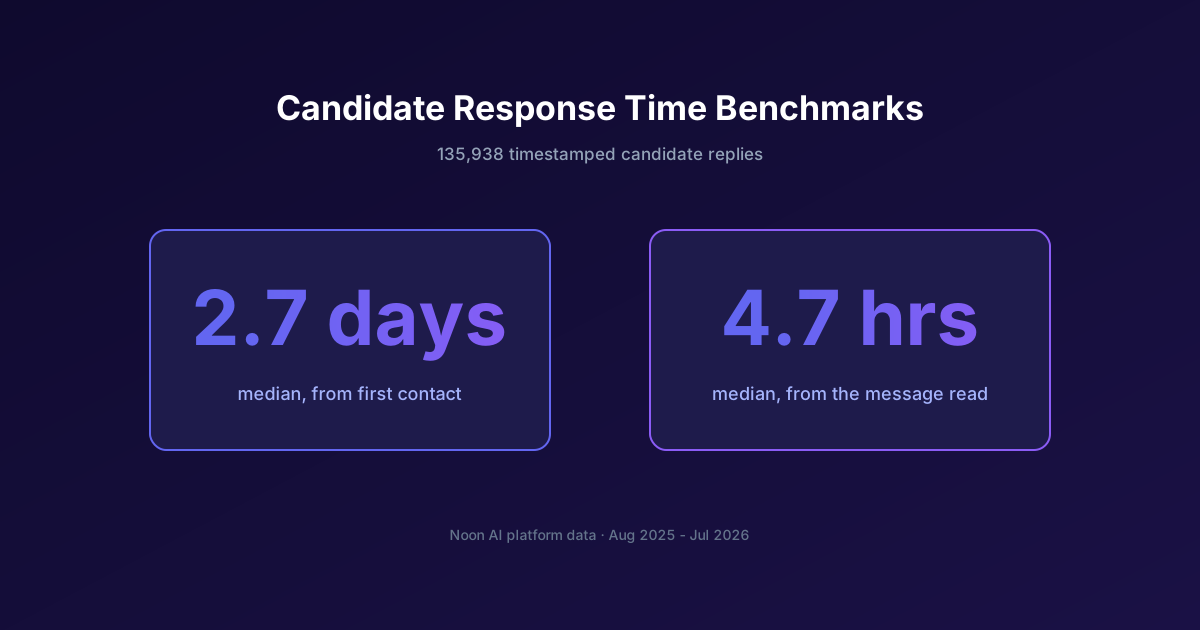
Key takeaway: The median candidate reply arrives 63.7 hours (2.7 days) after first contact, but only 4.7 hours after the specific message that triggered it. Across 812,633 recruiting outreach sequences and 135,938 timestamped replies sent through the Noon platform between August 2025 and July 2026, 35.1% of replies landed within 24 hours of first contact, 43.4% within 48 hours, 74.3% within a week, and 97.0% within 30 days. Candidates are not slow. Sequences are: most of the elapsed time between first contact and a reply is time spent waiting for the next message to be sent, not time a candidate spends deciding.
Every sourcing team has a rule for how long to wait before the next touch. Almost none of those rules come from measurement, because the underlying number is hard to see: a recruiter watching one inbox cannot tell the difference between a candidate who is thinking and a candidate who never opened the message.
Two numbers separate those cases, and they are very far apart. Measured from first contact, the median reply takes 2.7 days. Measured from the individual message the candidate actually replied to, the median is 4.7 hours, and the 90th percentile is 64.2 hours. By 72 hours after a specific message, roughly 90% of the replies that message will ever produce have already arrived.
For comparison, the candidate-side expectation runs on a completely different clock. Indeed's career guide tells job seekers that "the average response time after an interview is 24 business days" (Indeed Career Guide, updated 15 June 2026). Outbound sourcing is measured in hours; the process candidates complain about is measured in weeks.
How long does a candidate take to reply to recruiting outreach?
Distribution of time from first contact to the candidate's first genuine reply, across 135,938 replied sequences:
| Percentile | Time to reply | In days |
|---|---|---|
| 25th | 9.1 hours | 0.4 |
| 50th (median) | 63.7 hours | 2.7 |
| 75th | 169.3 hours | 7.1 |
| 90th | 339.5 hours | 14.1 |
| 95th | 506.1 hours | 21.1 |
The distribution has a long right tail: a quarter of replies arrive inside 9 hours, and a tenth arrive more than two weeks after first contact. Closing candidates out of the pipeline at day 7 discards roughly a quarter of the replies the pipeline would have received.
Cumulatively, from first contact:
| Within | Share of all replies |
|---|---|
| 1 hour | 9.7% |
| 24 hours | 35.1% |
| 48 hours | 43.4% |
| 7 days | 74.3% |
| 14 days | 89.6% |
| 30 days | 97.0% |
The practical read: 48 hours captures under half of the replies a sequence will ever produce, and 30 days captures essentially all of them. A pipeline review at the end of week one is looking at three quarters of the eventual answer.
Does response time differ by channel?
Yes, and the gap is large enough to change how a sequence should be paced. Splitting replied sequences by the channel of the first touch:
| First touch | Replied sequences | Median time to reply | 90th percentile | Reply rate (all sequences) |
|---|---|---|---|---|
| LinkedIn InMail | 52,006 | 44.1 hours (1.8 days) | 350.3 hours | 20.0% |
| LinkedIn connection request | 17,140 | 51.5 hours (2.1 days) | 370.3 hours | 15.6% |
| 66,541 | 85.5 hours (3.6 days) | 336.3 hours | 15.0% |
InMail replies arrive nearly two days sooner than email replies at the median, and InMail-first sequences also reply at the highest rate. Part of that is structural rather than behavioral: LinkedIn sends the recipient "an automatic reminder within three days of the InMail message being sent" and credits the InMail back to the sender if it is answered within 90 days (LinkedIn Recruiter Help: InMail credits and renewal). The platform is nudging on the recruiter's behalf, inside the same window where most replies happen.
Email carries no such nudge, which is one reason email-first sequences need their own follow-up discipline and a clean sending setup. If email replies are arriving materially slower than 3.6 days at the median, deliverability is the first thing to check, not candidate interest. Our guide to recruiting email deliverability covers the sender-reputation mechanics, and LinkedIn's own documented limits constrain how much InMail volume can substitute for it.
Why is the median 2.7 days if candidates reply in hours?
Because "time to reply" from first contact measures the sequence, not the candidate.
When a reply is timed against the specific message that preceded it, the picture changes completely:
| Message that got the reply | Replies | Median time since that message | 90th percentile |
|---|---|---|---|
| 1 | 43,782 | 4.7 hours | 64.2 hours |
| 2 | 35,955 | 5.2 hours | 67.4 hours |
| 3 | 25,340 | 5.2 hours | 76.0 hours |
| 4 | 15,407 | 6.5 hours | 106.4 hours |
| 5 | 8,565 | 9.8 hours | 322.7 hours |
| 6 | 3,861 | 9.9 hours | 345.4 hours |
Latency after a message is remarkably stable through the first four touches: a median of 4.7 to 6.5 hours, with 90% of the response arriving inside three to four days. The elapsed time from first contact stretches to 2.7 days at the median because the median gap between touch one and touch two in real sequences is 47.9 hours. The candidate was never the bottleneck.
That has a direct operational consequence. Since roughly 90% of a message's replies arrive within 64 to 76 hours, a follow-up sent at day three is timed almost exactly at the point where the previous message has stopped producing. Sending earlier competes with a message that is still working; sending at day seven leaves four days of empty pipeline. This is the same conclusion our follow-up benchmarks reached from the reply-share side, and it is why how many touches a sequence needs is a separate question from how fast candidates answer.
How should sourcing teams use these numbers?
- Set the follow-up interval at 3 days, not 7. The 90th percentile of a message's reply window is 64 to 76 hours for the first three touches. Day three is where the marginal reply from the previous message goes to near zero.
- Keep candidates open for 30 days, not 7. A week captures 74.3% of replies; 30 days captures 97.0%. Closing at day seven silently discards a quarter of your inbound.
- Judge a message at 72 hours, not at 24. Since about 90% of a given message's replies arrive inside 3 days, that is the point at which a subject line or opening line has produced its result and is worth changing.
- Expect email to be slower and plan the cadence separately. A 3.6-day median for email against 1.8 days for InMail means an identical cadence applied to both channels under-waits on email and over-waits on InMail.
- Do not read silence as rejection before the second touch. 67.8% of all replies in our data arrive after the first message, which is covered in detail in the outreach benchmarks hub.
Response-time data is also the strongest argument for handing the timing to software rather than a calendar reminder. Waiting exactly three days per candidate across a 400-person pipeline is a scheduling problem, not a judgment problem: Noon's AI outreach runs the multi-channel sequence and the intervals continuously, and its AI scheduler picks up the reply and books the interview, so the recruiter sees the conversation rather than the timer. Personalization quality still matters at the message level, which is what our guide to personalized recruiting outreach is about.
What this data does not say
Three honest limits, because response-time benchmarks are easy to over-read:
- This is not per-message open or click data. Noon measures sends and replies, not opens, so "no reply" here includes messages that were never seen. The 4.7-hour post-message median is the latency of candidates who did see and answer.
- The channel comparison is not a controlled test. Recruiters choose the channel, so InMail-first sequences may target different candidates than email-first sequences. The gap is real in aggregate and should not be read as "switching channel makes candidates 1.8 days faster". Seniority, role type, and list quality are not held constant.
- The window is 12 months of aggregate platform activity, weighted towards white-collar roles in the US and Europe. Volume hiring for hourly roles behaves differently.
FAQ
How long does it take a candidate to respond to a recruiter? The median is 63.7 hours, about 2.7 days, from the first outreach message, based on 135,938 timestamped replies measured between August 2025 and July 2026 (Noon AI platform data). One in three replies arrives within 24 hours, and 97% arrive within 30 days.
How long should a recruiter wait before following up? About three days. Roughly 90% of the replies a message will generate arrive within 64 to 76 hours of that message, so a follow-up on day three starts working just as the previous message stops. In practice recruiters wait 47.9 hours at the median between the first and second touch, which is close to optimal, and then stretch to four or five days for later touches, which is slower than the data supports.
Do candidates reply faster on LinkedIn or by email? LinkedIn is faster in our data: an InMail-first sequence has a 44.1-hour median time to reply against 85.5 hours for email-first, and a 20.0% reply rate against 15.0%. Part of that gap comes from LinkedIn's automatic three-day reminder to the recipient, which email has no equivalent of.
How long should a candidate stay in an active sequence? 30 days. 74.3% of replies arrive within 7 days but 97.0% arrive within 30, so a 7-day close-out drops roughly a quarter of the replies the pipeline would have produced.
What is a good reply rate for recruiting outreach? 16.7% of candidates replied across all 812,633 sequences in this dataset, rising to 20.0% for InMail-first sequences. Full breakdowns by channel and role type are in our candidate reply rate benchmarks, and connection-request acceptance is covered in the LinkedIn connection acceptance benchmarks.
Does a slow reply mean lower candidate quality or intent? Not in any way this dataset can show. Late replies are concentrated in later sequence steps, which suggests the delay is about attention rather than interest: the candidate replied quickly to the message they read, and the message they read was the fourth one.
Methodology
- Dataset: 812,633 anonymized candidate outreach sequences initiated on the Noon platform between 2025-08-01 and 2026-07-31, containing 3.4 million individual sent messages across email, LinkedIn InMail, and LinkedIn connection requests.
- Reply definition: the first inbound candidate message on a sequence, excluding out-of-office autoresponders and bounces. 135,968 sequences (16.7%) received a qualifying reply; 135,938 had a reply timestamp at or after the first send and are used for all timing figures.
- Time to reply is measured in hours from the first sent message of the sequence. Per-message latency is measured from the most recent sent message at or before the reply timestamp.
- Channel is the type of the first message sent in the sequence (email, InMail, or connection request). Sequences whose first touch was untyped, a rewritten connection request, or a connection-accepted follow-up (362 sequences, 0.04% of the dataset) are excluded from the channel table for sample size.
- All figures are aggregate. No candidate, customer, or company-level data is published, and no individual account is identifiable in any statistic above.