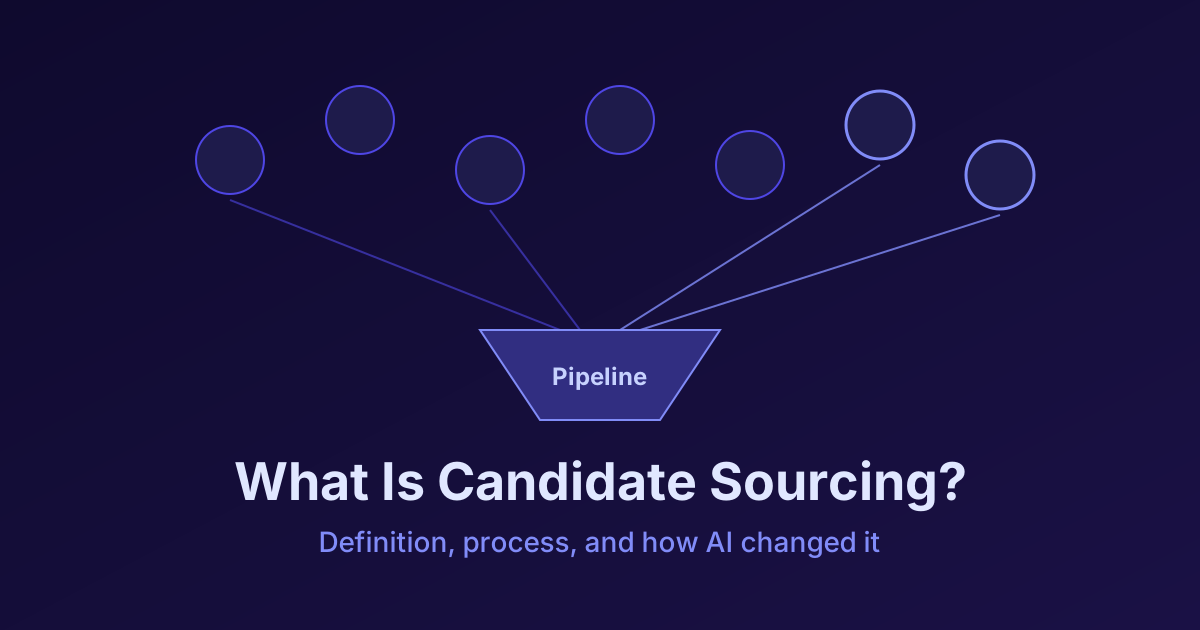
Key takeaway: Candidate sourcing is the proactive part of recruiting: identifying, researching, and engaging qualified people for a role before they ever apply. It matters because most of the people you want are not applying: 74% of employers reported difficulty finding the skilled talent they need (ManpowerGroup 2025 Talent Shortage survey, published January 2025, the most recent edition available as of mid-2026), and 97% of nonexecutive roles were filled externally in 2026 (SHRM 2026 recruiting benchmarking), which makes outbound pipeline the deciding factor in competitive searches.
Post a job and the applicants who arrive are, by definition, the people actively looking. Sourcing is how you reach everyone else: the qualified majority who are employed, not browsing job boards, and only reachable through direct, relevant outreach. For a deeper exploration of sourcing tactics and best practices, see our complete candidate sourcing guide.
The economics explain why every serious recruiting function sources. SHRM's 2026 benchmarking puts median time-to-fill at 39 days for nonexecutive roles and 45 for executive, with median cost-per-hire of $1,300 nonexecutive and $15,000 executive (SHRM, 2026). The searches that blow through those medians are almost always the ones relying on inbound applications for a role the market does not supply on its own.
Candidate sourcing vs. recruiting: what is the difference?
Sourcing is one stage of recruiting, the top of the funnel. Recruiting is the whole funnel.
| Dimension | Sourcing | Recruiting (full cycle) |
|---|---|---|
| Goal | Build a pipeline of qualified, interested candidates | Convert that pipeline into a hire |
| Activities | Search, profile evaluation, first outreach | Screening, interviews, offer, closing |
| Direction | Outbound (you find them) | Inbound + outbound |
| Output | Engaged candidates in the pipeline | A signed offer |
Larger teams split the work: sourcers build pipeline, recruiters run the process to offer. In smaller teams one person does both, which is where full-cycle recruiting comes in. The stakes of the sourcing half keep rising because recruiter capacity is shrinking: extra-large organisations absorbed a 67% increase in requisitions per recruiter in 2026 (SHRM, 2026).
How does the candidate sourcing process work?
Five steps, whether a human or an AI agent runs them:
- Define the profile. Turn the job description into searchable criteria: must-have skills, experience range, location, and the trade-offs you will accept. Ambiguity here multiplies wasted work downstream.
- Search the channels. Run the profile against LinkedIn, the open web, your own ATS, communities, and referrals (channel detail below).
- Evaluate and rank. Compare each candidate against the criteria, not just for keyword overlap but for trajectory, company context, and evidence of the claimed skills.
- Engage. Personalized, relevant first contact. Response rates hinge on this step: personalized outreach earns roughly 18-25% response rates versus 5-8% for generic templates (LinkedIn Talent Solutions).
- Track and iterate. Measure response and conversion by channel and profile type, feed what you learn back into step 1.
Our guide to candidate sourcing strategies and tools covers seven strategies built on this process.
Where do sourced candidates come from?
- LinkedIn is the default database, and its limitation: every competitor searches the same profiles with the same filters. Dedicated seats are expensive (LinkedIn Recruiter pricing runs roughly $10,800+ per seat annually).
- Your own ATS is the most undervalued channel: 46% of hires in 2025 came from candidates already in the company's ATS who were re-engaged for a new role (Gem 2026 Recruiting Benchmarks).
- The open web: GitHub, personal sites, publications, conference talks, professional communities. Richer evidence than a profile page, and far less picked-over; this is where whole-web AI sourcing has a structural edge.
- Referrals and past candidates: high-conversion, low-volume. Silver-medalist candidates from previous searches convert unusually well because intent and fit are pre-established.
What is AI candidate sourcing?
The step-change of the last two years. Instead of a recruiter manually running searches seat-hour by seat-hour, an agentic AI sourcer executes the whole loop: it interprets the role criteria, searches across the web continuously, evaluates career trajectories and company caliber, ranks candidates with reasoning, and keeps monitoring as new candidates enter the market. If you're evaluating AI sourcing for your team, you can book a demo to see how an autonomous sourcing workflow compares to manual search.
Two things distinguish real agentic sourcing from a smarter search box. First, calibration: hiring-manager feedback (thumbs up/down on surfaced profiles) retrains the evaluation per role, so week four's shortlist is measurably better than week one's. Second, hard constraints: non-negotiable criteria stay fixed while the agent explores everything else. At Noon, this is the AI Sourcer, which runs sourcing through outreach and scheduling as one autonomous workflow.
The measurable payoff shows up in the benchmarks: SHRM attributes part of the 2026 drop in median time-to-fill (44 days to 39) to AI automating repetitive recruiting tasks, and finds the most effective recruiting organisations, associated with advanced technology use including AI, fill roles five days faster than the rest (SHRM, 2026). For the tool options, see our review of AI sourcing tools.
How do you measure candidate sourcing?
Four metrics cover most of it:
- Qualified candidates per week: pipeline volume against the role's bar, not raw names.
- Response rate: the health check on targeting and messaging quality. Personalization is the biggest lever (LinkedIn Talent Solutions).
- Source-to-interview conversion: what fraction of engaged candidates the hiring manager actually wants to meet; the truest measure of sourcing quality.
- Sourced share of hires: what percentage of closed offers began as sourced candidates. This is the number that justifies (or kills) the sourcing investment.
FAQ
What does candidate sourcing mean? Proactively identifying, evaluating, and engaging qualified people for a role before they apply. It is the outbound, top-of-funnel stage of recruiting, in contrast to processing inbound applications.
What is the difference between sourcing and recruiting? Sourcing builds the pipeline: search, evaluation, first outreach. Recruiting is the full cycle through screening, interviews, offer, and close. Sourcers hand engaged candidates to recruiters; in smaller teams the same person does both.
What is a candidate sourcing tool? Software that finds and engages candidates: talent databases (LinkedIn Recruiter), search aggregators, and AI sourcing agents that run the search-evaluate-engage loop autonomously. Our top sourcing tools guide compares the leading options by category and pricing model.
Is AI candidate sourcing better than manual sourcing? For coverage and speed, yes: an agent searches the whole web continuously while a human works one query at a time, and the 2026 benchmark data associates AI-enabled recruiting with faster fills (SHRM, 2026). Judgment still matters, which is why calibration from hiring-manager feedback is the feature to check for; sourcing quality depends on the criteria the AI is evaluating against.
How much does candidate sourcing cost? Manual sourcing costs recruiter time plus tool seats (LinkedIn Recruiter at roughly $10,800+ per seat annually). AI sourcing platforms vary by model: per-credit tools cap monthly volume, per-seat tools charge by user. Noon uses a single unlimited plan, unlimited sourcing, contacts, agents, and seats; see the pricing page.
What makes a good sourced candidate pipeline? Volume against the actual bar (qualified candidates per week), healthy response rates from personalized outreach, and a source-to-interview conversion the hiring manager is happy with. If conversion is low, the fix is almost always earlier: sharper criteria and better calibration, not more outreach.