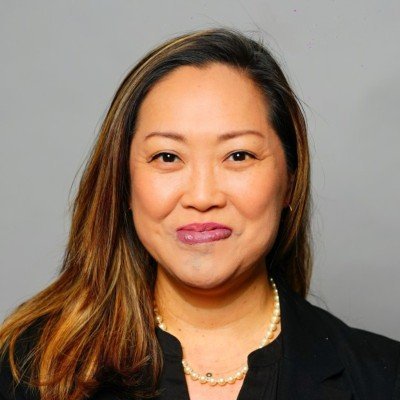
Wendy McDougall
Firefish Software
“The human has to be first and in control, using the technology to enable and automate the processes around that.”
Wendy McDougall has been named to the Talent 100, Class of 2026, the annual award recognizing up to 100 leaders in each category of talent acquisition. Honorees are nominated by peers or found by committees that look for excellent work wherever it happens, then chosen for the depth of their craft and their impact on hiring. This is Wendy's story.
In front of 500 people at the UK's Recruitment Expo, Wendy McDougall built a recruitment agency from scratch in 15 minutes, live, using one of the earliest publicly available versions of ChatGPT. It was January 2023, most of the room had barely heard of the technology, and the CEO and founder of Firefish Software had just handed British recruiters their first real look at what was coming. That instinct for getting ahead of the industry's next problem is the through line of a career that started on a recruitment desk in 1998 and has now included more than two decades of running companies.
McDougall has been an IT recruiter, a top biller, a branch builder, an agency owner and, since 2010, a software founder serving recruitment agencies and in-house teams. She still speaks five to eight times a year, almost always on recruitment and AI, and the substance of what she tells those audiences has shifted noticeably as the technology has matured.
From Postgraduate Plans to Top Biller
The original plan was a postgraduate degree in technology. Then one of the largest independent recruitment companies in Scotland interviewed her and offered a blunt reassessment: she would be better talking and listening than typing code. She took the point, and the industry hooked her fast. Within roughly 18 months she was the firm's top recruiter, working the IT contract market through the millennium boom, which she describes as a very good time to be in recruitment.
Melville Craig was an entrepreneurial business that grew to around 250 recruiters, and McDougall's rise ran alongside it. Based in Edinburgh, she was given the chance to open and build out the Glasgow branch, an early lesson in constructing something rather than simply working inside it. When TMP, later Hudson, acquired the Scottish independent, she read it as her cue to go. She launched her first recruitment agency in 2004.
What followed is a familiar founder story with an unusual ending. Frustrated by the tools available to her consultants, convinced that technology for the recruitment sector was lagging every other industry she looked at, she started building her own. That internal project became Firefish Software, which she spun out as a separate business in 2010.
The People Who Shaped the Blueprint
Asked who shaped her, McDougall goes first to the owner of that early Scottish agency. He showed her how a company she actually wanted to work for was grown and developed, and above all he demonstrated the power of values as an operating tool rather than a wall poster. Much of what she has carried into her own businesses traces back to watching how he ran, scaled and eventually sold his.
There was also a model at home. She comes from an entrepreneurial family, and her father ran his own company. As much as he may not have wanted this particular path for her, the tendency was, in her words, in the blood, and 24 years of running companies later, that verdict looks settled. A third figure has been with her almost the whole way: a female entrepreneur and CEO of a search recruitment agency who helped her execute the investment and management led buyout of her first agency, backed by 3i EIP, and who still sits with her today as a non executive.
She adds the head of the REC to that list for the work he has done advocating for the industry with government, on employee rights and on lifting the perception of the agency market, which in the UK has traditionally been agency first rather than TA first. But she is careful not to make the list exclusive. Anyone with an inquisitive mind, she argues, takes something from every employee, client and candidate they meet. Every day is a school day, and the learning goes straight back out into what she builds, how she runs the business, and how she coaches other people toward their best.
How the AI Story Changed
Early on, her message from the stage was simple encouragement: start experimenting, bring it into the business, get your teams using it. The examples were mostly content generation, and the point was momentum. Over the past year the framing has hardened into something more deliberate. Human first, in control, with AI there to enhance the work rather than replace the judgment.
That is a considered position from someone who sells technology for a living. Recruitment, she insists, is a human industry, and preserving what is genuinely strong about it means keeping people at the decision point while using automation to speed up the process around them. She is openly wary of one direction the market has taken: TA focused tools built to solve the problem of thousands of inbound candidates by matching and filtering at scale. Her concern is discrimination and auditability, being able to demonstrate why a person was rejected or advanced. Regulation, she believes, will catch up with that quickly, and the EU AI rules are already changing what is acceptable in sourcing. The recruiter, in her model, uses the tools but does the digging, the analysis and the final call. Trust plus human connection, with technology supporting.
Displacement, Then a Different Kind of Work
She does not soften the near term. McDougall expects roughly 12 to 18 months of real job displacement, with roles moving, changing and reappearing as work that supports the technology itself. Fewer permanent positions in some functions is part of that picture, and she is clear that a significant cultural change has to happen alongside it rather than after it.
The opportunity she sees on the other side is a market that finally stops being transactional. If AI absorbs the mechanical filling of jobs, recruitment can extend properly into consultative service. That is a better business and, she suspects, a more durable one. Having been the person who launched the technology's possibilities to a UK audience in 15 minutes flat, she is comfortable being the one now urging a little more caution.
Toward a Connected Workforce
Look further out and her enthusiasm returns. Gig work, she argues, is about to reshape how people work entirely, and it happens to align with what younger generations already want: choosing and picking where they work. Workforce management is the obvious beneficiary, with AI resolving availability, placement and preferences at a scale humans cannot match.
She also expects something the market has barely started discussing. More collaboration. Different businesses and partnerships opening up to each other, sharing data across boundaries under the correct GDPR permissions, producing a genuinely connected workforce rather than isolated firms competing on headcount. Her own forecast is concrete: an organisation that once needed 60 or 80 people will likely run at around 40, with the gap filled by technology and by cooperation with other companies. For a founder who spent 1998 being told she should talk and listen rather than write code, it is a fitting prediction. The machines handle the volume. The people handle each other.
The Talent 100 exists to celebrate the people shaping the future of how the world hires, and few embody that better than Wendy. We are honored to welcome Wendy McDougall to the Talent 100, Class of 2026, and grateful for the experience, perspective, and craft they bring to this community. Congratulations, Wendy. Welcome to the Talent 100.
About the Talent 100
The Talent 100 is an annual list spotlighting the leaders who push HR and talent acquisition forward, organized by Noon AI. Honorees are selected through peer nominations and independent selection committees. Selection is entirely merit-based, with no fees or pay-to-play requirements.