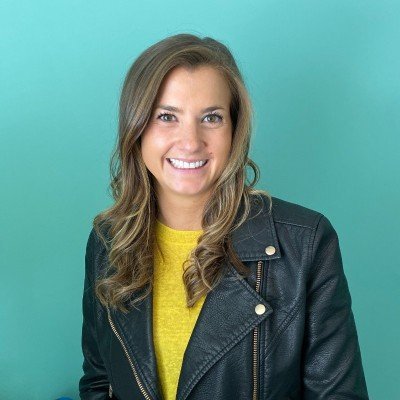
Teal Frost
“Giving direct feedback is the kind thing to do.”
Teal Frost has been named to the Talent 100, Class of 2026, the annual award recognizing up to 100 leaders in each category of talent acquisition. Honorees are nominated by peers or found by committees that look for excellent work wherever it happens, then chosen for the depth of their craft and their impact on hiring. This is Teal's story.
Every day on a Norwegian Cruise Line ship, Teal Frost's calendar held the same appointment: walk into a bar and talk with passengers for an hour. That practice of turning strangers into friends now anchors her work as the first Talent Partner at Hummingbird Ventures, the global seed-stage fund she joined in November 2022, where she has become an outspoken optimist on AI and a pointed critic of LinkedIn's walled-off data.
"My job was to make passengers feel like friends," she says. For someone who does not consider herself naturally extroverted, it was a demanding assignment. One passenger stands out. He had no interest in talking with her until Teal found the right question and learned he was a competitive parsnip grower in the UK, chasing some of the largest parsnips in the country. The conversation that followed, about his methods and the competition, taught her something she still relies on: almost anyone opens up once you discover what lights them up.
Today, working from Amsterdam, Teal puts that instinct to use in a model that differs from most recruiting. Because Hummingbird is a venture fund, her work is rarely about filling one specific role at a time. Much of what she does is proactive network building, with a brief that is deliberately broad: the firm wants to see certain kinds of people, in certain cities, doing certain kinds of work. It is recruiting that starts with curiosity about people rather than a job description.
Teal's interest in people predates any job. Her family moved frequently when she was growing up, and she spent part of her high school years living in South America. In each new place, the social rules she had absorbed before no longer applied. She learned to observe and understand people before making assumptions about them, at first simply as a way to fit in.
The cruise ship, her first job out of university in 2009, turned that habit into a discipline. Between hosting bingo, teaching line dances, working the microphone in costume and coaxing passengers onto the dance floor, she was learning to move past small talk about the latest port of call. "It felt like cracking a code every single time," she says of those conversations.
From there, the path ran through people at every turn. An HR administration role at a very small company in New York led to her first hiring work. She moved into advertising, handling talent acquisition and recruiting designers at the branding agency Interbrand from 2013 to 2015. Then came San Francisco, and tech.
Teal has worked for several managers she admires, but one shaped her more than any other. Matt Birnbaum, who would later lead talent at Instacart and Pear VC, recruited her out of advertising in 2015 to join UpStart Talent, the boutique startup recruiting firm he was building. She had never worked with startups and knew little about them. He bet on her anyway, and for five years the team never grew beyond five people.
Working that closely with him, Teal absorbed lessons she still names precisely: how to read people, the value of discipline, what great truly looks like, when to trust her intuition, how to hold hard conversations and how to hold herself to very high expectations. Above all, he taught her that candor is a form of care. "Giving direct feedback is the kind thing to do," she says.
She credits most of her career to him, and the relationship endures. They still text regularly. After UpStart, Teal struck out on her own, founding the consultancy Teal Talent in 2021 before joining Hummingbird the following year.
Teal is an unapologetic optimist about AI. She acknowledges that the speed of the technology can be unnerving, but she sees the present as an extraordinary era for human creativity. Her most distinctive argument concerns experience. The learning curve tends to flatten as careers progress, she notes, and AI is suddenly steepening it again for seasoned professionals. Some find that unwelcome. She sees a turning point in how teams are built and how great talent is hired, and she believes those who resist will either come around or fall behind.
Her own workflow reflects that conviction. She uses Granola, Wispr Flow and Claude heavily, relies on an AI-oriented CRM, and runs one agent alongside many automated routines. For her, these tools are less a novelty than a chance to rethink how the entire job gets done.
Her sharpest critique is aimed at LinkedIn, which she views as a fortress of valuable data that is holding the entire industry back. Because company success now depends so heavily on talent, she argues, a platform that stays walled off and defensive slows progress for everyone at a moment when the field needs to move quickly.
She calls the roughly $8,000 annual price of a LinkedIn Recruiter seat obscene, and she is actively weighing whether her team is ready to give it up on principle. Competitors will eventually overtake a platform that refuses to build with the rest of the industry, she believes, though assembling a database as rich will take a couple of years.
Teal's starting point for talent leaders is to get smart on AI. Play with it, she urges, and build your own tools just for fun. Avoiding it, in her view, is a disservice not only to yourself but to every company you will ever work for.
She is just as firm that more is not always better. The industry seems to relearn this lesson every four years or so, she observes, swinging from frantic over-hiring to layoffs that hit recruiters hardest. With AI enabling leaner teams, she questions why any company would still try to hire 600 people in a year, an approach she sees as busy work and a shortcut in place of thoughtful planning. Recruiters who have a genuine seat at the table, she says, should tread lightly.
Her final counsel comes from watching the market's cycles, in which recruiters swing from most valuable to least valuable and back. While budgets and founder appetite are there, build everything you have always wanted to create within a talent organization. That way, whatever the next slowdown brings, you can point to something unique you made happen. "Be selfish with it," she says.
The Talent 100 exists to celebrate the people shaping the future of how the world hires, and few embody that better than Teal. We are honored to welcome Teal Frost to the Talent 100, Class of 2026, and grateful for the experience, perspective, and craft they bring to this community. Congratulations, Teal. Welcome to the Talent 100.