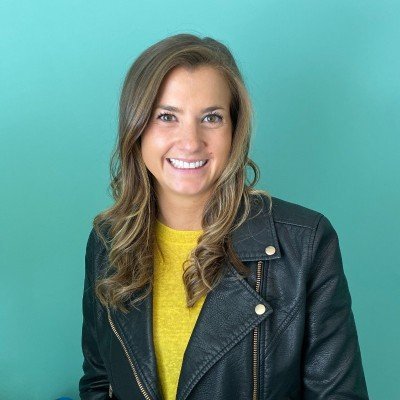
Carly Goldberg
Cape
“Stay curious and stay flexible.”
Carly Goldberg has been named to the Talent 100, Class of 2026, the annual award recognizing up to 100 leaders in each category of talent acquisition. Honorees are nominated by peers or found by committees that look for excellent work wherever it happens, then chosen for the depth of their craft and their impact on hiring. This is Carly's story.
Most people in talent acquisition tell the same story: they fell into it. Carly Goldberg tells a different one. She went looking for it. "I'm the crazy person who wanted to be in recruiting," she says, and the line lands as both a joke and a genuine differentiator in a profession largely staffed by career accidents.
Goldberg is a member of the Talent team at Cape, America's privacy-first mobile carrier. Titles exist there, but they are not the currency: the team indexes on the impact of the work rather than where it sits in a hierarchy. The scope is real regardless of what appears on a nameplate. Credibility is not conferred by a reporting line. It accumulates in the work. And Goldberg's work is expanding right now. Asked at the end of a wide ranging conversation whether there was anything else she wanted people to know, her answer was two words long and entirely on brand: "I'm hiring."
A Field She Chose on Purpose
Goldberg grew up as one of five children, and two of her older sisters had spent time in staffing at one point or another in their careers. That meant recruiting was never an abstraction to her the way it is to most graduates. She was exposed to it early, and she understood the texture of the work, the pace of it and the disappointments in it, long before she had to decide whether to do it herself.
When she finished school, she was weighing a different path entirely: becoming a psychologist. The pull was real, and she has never fully described it as abandoned so much as deferred. What she would not do was commit years to graduate study before testing the working world. "I wanted to work first and give that a shot," she says, "before going back to school or giving my life to school."
She landed in recruiting and, in her own words, has not looked back. It is a small biographical detail with a large implication. Goldberg did not arrive in talent acquisition because a first job fell through or a manager reassigned her. She arrived having watched two sisters do the work, having seriously considered a different profession, and having chosen this one anyway.
Why AI Makes Recruiting More Human, Not Less
Goldberg has little patience for the prevailing anxiety that artificial intelligence is stripping the humanity out of hiring. She sees the opposite happening. "There's a lot of misconception with AI and taking personalization out of a recruiting process," she says. "I think it actually helps recruiters who are using it."
Her case is straightforward. The technology lets recruiters operationalize more of the administrative side of the work, which in turn frees them to concentrate on what she calls the personal aspect of recruiting. The recruiter does not disappear in that equation. The recruiter gets more room to do the part of the job that only a person can do. The net effect, as she describes it, has "really helped keep the focus on the candidates versus on systems."
That distinction, candidates versus systems, is a useful test for any talent function evaluating what it buys. Tooling that pulls attention toward process is a cost. Tooling that pushes attention back toward people is leverage. It is also a view with a certain symmetry to Goldberg's own history: the woman who once considered studying psychology has ended up arguing, in the middle of an automation boom, that the human read is the part worth protecting.
Curious and Flexible
Her advice to other talent leaders is characteristically economical. "Stay curious and stay flexible," she says. The reasoning behind it is harder won than the phrasing suggests. Recruiting sits at the intersection of two of the least predictable forces in business. "People are unpredictable, businesses can be unpredictable," she notes, "and there's always something new to learn and shift towards."
Coming from Goldberg, flexibility is not a soft virtue offered up to fill a silence. It is the same instinct that told her to go work before enrolling in a doctoral program, and the same one that lets her look at a wave of new tools and ask what they free up rather than what they threaten. Curiosity is what keeps a recruiter from defaulting to whatever worked last year. Together the two traits describe a practitioner who lasts precisely because she declines to settle.
It also explains why Cape suits her. Standing there is earned in the hiring itself rather than handed down by title hierarchy. Goldberg chose this field on purpose, she is unbothered by the technology reshaping it, and she is still, right now, looking for the next great person to bring in.
The Talent 100 exists to celebrate the people shaping the future of how the world hires, and few embody that better than Carly. We are honored to welcome Carly Goldberg to the Talent 100, Class of 2026, and grateful for the experience, perspective, and craft they bring to this community. Congratulations, Carly. Welcome to the Talent 100.
About the Talent 100
The Talent 100 is an annual list spotlighting the leaders who push HR and talent acquisition forward, organized by Noon AI. Honorees are selected through peer nominations and independent selection committees. Selection is entirely merit-based, with no fees or pay-to-play requirements.