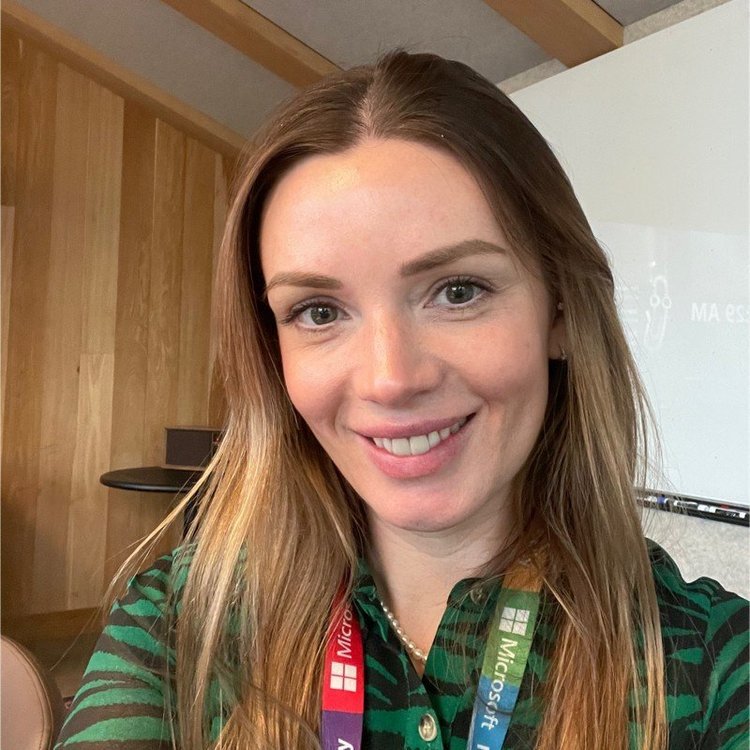
Sarah Ware
Sage
“Use the tools. Don't just strategize for the use of tools. Get your hands dirty with them.”
Sarah Ware has been named to the Talent 100, Class of 2026, the annual award recognizing up to 100 leaders in each category of talent acquisition. Honorees are nominated by peers or found by committees that look for excellent work wherever it happens, then chosen for the depth of their craft and their impact on hiring. This is Sarah's story.
Nearly two decades after she last sat in an office with her first manager, Sarah Ware still runs her hardest leadership calls through a single question: what would he do? The habit says a great deal about her. In a profession that prizes speed, requisition counts and closing power, she has built a career on slower and more durable things: judgment, honesty delivered calmly, and the discipline of handing a problem back to someone so they learn how to solve it themselves.
Her path runs from a local agency in the UK, through five years of investment banking recruitment in the City of London, into senior talent acquisition leadership at IBM and then Sage, where she led a team through repeated restructuring. Along the way she has done the unglamorous work that shapes real operators: ATS implementations, team builds, and the kind of conversations no one volunteers for. Today she is one of the more clear-eyed voices on what artificial intelligence will and will not do to talent acquisition, and she has earned that clarity the hard way, by putting her own hands on the tools rather than reading the pitch decks.
Falling Into It, Then Falling For It
Ware left university without a plan. She landed a good job in the finance department of a travel company and found, fairly quickly, that she did not love it. Her boyfriend at the time was working in recruiting, running high-volume temporary placements in construction, and in the evenings she would help him out by calling candidates. It did not take him long to notice what was happening. "You're really good at this," he told her, "and you're bored with your job. Why don't you go and try and do recruiting?"
She did. The relationship ended soon afterwards, but the career did not. She joined an agency local to her, loved the work, and wanted more of it. She landed a role in a London agency called Morgan McKinley, then focused entirely on financial services. She spent roughly five years recruiting into investment banking. "I really did literally fall into it," she says. "There was no calculation about what I was going to do. It was just, this is good, and I loved it from day one."
Everybody Is Running a Different Race
On artificial intelligence, Ware refuses both the hype and the panic. Her central observation is that the industry is not in one race but many. She has worked in businesses that were genuinely strong at building AI tooling for their own customers while being noticeably slower at adopting anyone else's, simply because ways of working and priorities sat elsewhere. She has also interviewed with organisations operating at the true frontier. Both realities are normal.
That leads her somewhere unfashionable. Yes, the landscape is changing enormously, and yes, the trajectory is steep. But precisely because the pace of evolution is so rapid, only a handful of companies will ever be at the cutting edge at any given moment. "We can't all be there," she says. Businesses do not need to fear being left behind quite as much as they are being pitched to fear it, and there is real value in learning from other people's experiences rather than being first. The line she does draw is between moving at your own pace and not moving at all.
On the existential question, she is unequivocal. Talent acquisition will not be replaced by AI. It will be enhanced by it, and enhanced exponentially. The practitioners who lean into the tooling will be in a stronger position, and she expects a second-order benefit that gets discussed far less: AI as a leveller that strips out some of the intergenerational friction in today's workplaces.
The Case for Getting Your Hands Dirty
Her advice to fellow talent leaders is disarmingly practical, and she admits it may not sound revolutionary. Use the tools. Do not simply build a strategy for the use of tools. She has seen the pattern too many times, including in ATS implementations: leadership does the critical analysis, makes the pitch to the business, wins the budget, and then assigns the actual hands-on work to someone in the team. "Leaders don't really get that hands-on with this stuff," she says, and that gap is where she believes many will struggle. Nobody is well positioned to argue one way or the other about a platform they have never operated themselves.
She holds herself to the same standard. Between assignments she has been testing platforms and attending conferences on the space, working through several different AI tools built for talent acquisition in the space of four weeks, Claude among them, simply because they looked interesting. The point of the exercise, she stresses, is not to crown a winner. "It's about what's right for your purposes right now," she says: knowing how to use it, how to optimize it, how to write commands properly, and how to get your organisation to the best possible position with the tooling it already has. Coming from someone whose entire career began by picking up a phone in the evenings to help out a friend, the through line is hard to miss. Ware learns by doing, and she expects the leaders around her to do the same.
The Talent 100 exists to celebrate the people shaping the future of how the world hires, and few embody that better than Sarah. We are honored to welcome Sarah Ware to the Talent 100, Class of 2026, and grateful for the experience, perspective, and craft they bring to this community. Congratulations, Sarah. Welcome to the Talent 100.
About the Talent 100
The Talent 100 is an annual list spotlighting the leaders who push HR and talent acquisition forward, organized by Noon AI. Honorees are selected through peer nominations and independent selection committees. Selection is entirely merit-based, with no fees or pay-to-play requirements.