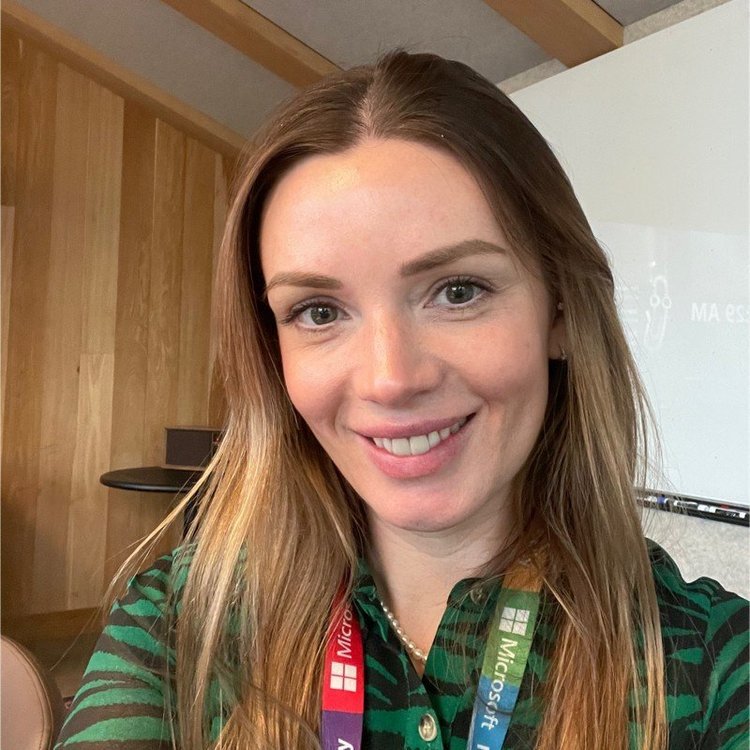
Rosalind Warren
Adyen
“The strongest recruitment leaders have the best business acumen.”
Rosalind Warren has been named to the Talent 100, Class of 2026, the annual award recognizing up to 100 leaders in each category of talent acquisition. Honorees are nominated by peers or found by committees that look for excellent work wherever it happens, then chosen for the depth of their craft and their impact on hiring. This is Rosalind's story.
Ask a room of talent leaders how they got into recruiting and most will tell a story about a detour, a lucky temp assignment, an accident of timing. Rosalind Warren tells a different one. She found the work while she was still an undergraduate, running her sorority's recruitment campaign, and the only question in her mind was a practical one: was there a way to do this for a living?
"I loved every second of sorority recruitment," she says. "And I was like, is there any way that I can do this as a real job and get paid for it? I want to do it." She left university having already decided recruiting would be her career, and roughly fifteen years later, now building and leading recruiting teams at Adyen, that decision still looks like the right one. In an industry where deliberate entrants are rare, Warren belongs to a small minority who chose the craft on purpose and then treated it like a craft.
A Choice, Not an Accident
The distinction matters more than it sounds. Recruiters who fall into the profession often spend years reverse engineering why they are good at it. Warren started from the opposite direction. She had already seen what she loved about the work, the persuasion, the matching, the energy of a campaign with a deadline attached, and she went looking for the environments that would stretch those instincts furthest.
That has meant hyper growth companies, high volume hiring, and business stakeholders who expect a recruiting function to speak the language of forecasts and pipelines rather than requisitions and gut feel. Fifteen years in, her sense of the profession is unsentimental. Recruiting, in her telling, is a commercial discipline with a human obligation attached, and the leaders who thrive are the ones who refuse to drop either half.
The Question Behind the AI Question
On artificial intelligence, Warren is neither evangelist nor skeptic. She agrees with the blunt version of the argument: a function that ignores AI will be left behind. "It's like not using the internet when it first came in," she says. "You have to embrace it." But she is careful about where the profession actually stands, describing recruitment as still in a discovery phase, working out where AI genuinely makes sense and what it does to recruiter productivity and candidate experience. The tooling has exploded. Appetite varies company by company according to risk tolerance. Many of the important variables, she notes, remain up in the air.
The real test, in her view, is not selection but judgment. "Just because you can use AI, should you?" she asks. Some moments in a hiring process exist precisely because a human being is on both ends of them, and automating them costs something in candidate experience and quality of hire that may not show up on a dashboard for years. The discipline she advocates is holding two things at once: adopting aggressively where the machine is better, and protecting the interactions that carry a company's brand and let a candidate feel a genuine connection to it. That tension, she believes, is what will separate strong talent functions from busy ones.
Stay Close to the Business
Asked for the single piece of advice she would pass to other talent leaders, Warren does not reach for a framework. Stay close to the business. The strongest recruitment leaders, she argues, are the ones with the best business acumen, and they stay adaptive to whatever the market and the business are telling them. A leader's job is to keep up leveling herself and elevating her team, and neither is possible from a distance. "You can only do that if you are really connected with both the market and your business leaders," she says.
It is a philosophy she also recognizes in others. Among the leaders she most admires is her Adyen colleague, whom she describes as constantly improving himself and having moved through many evolutions of who he is as a leader. What makes him effective, in her assessment, is authenticity: by being unmistakably himself, he gives everyone around him permission to do the same, and then to do their best work. Coming from someone who chose this profession before she had ever been paid for it, and who has spent fifteen years importing rigor into it from wherever she could find it, that is high praise and a fair description of the standard she holds herself to.
The Talent 100 exists to celebrate the people shaping the future of how the world hires, and few embody that better than Rosalind. We are honored to welcome Rosalind Warren to the Talent 100, Class of 2026, and grateful for the experience, perspective, and craft they bring to this community. Congratulations, Rosalind. Welcome to the Talent 100.
About the Talent 100
The Talent 100 is an annual list spotlighting the leaders who push HR and talent acquisition forward, organized by Noon AI. Honorees are selected through peer nominations and independent selection committees. Selection is entirely merit-based, with no fees or pay-to-play requirements.