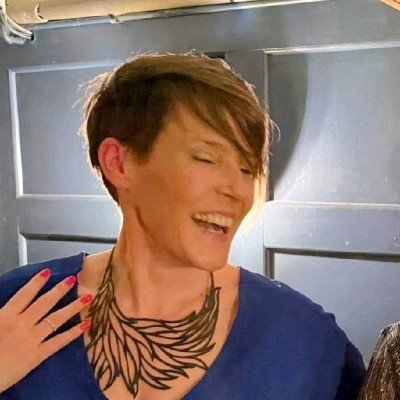
Sarah Daugherty
“Never stop being in the market for people on your own team.”
Sarah Daugherty has been named to the Talent 100, Class of 2026, the annual award recognizing up to 100 leaders in each category of talent acquisition. Honorees are nominated by peers or found by committees that look for excellent work wherever it happens, then chosen for the depth of their craft and their impact on hiring. This is Sarah's story.
Sarah Daugherty graduated into the global financial crisis and got a job offer almost nobody else in that cohort had: a recruiting seat at a financial services executive search firm. The logic was blunt. None of Sarah's friends had jobs, so the offer was worth a look. What started as a pragmatic yes turned into a career spanning corporate intelligence, a rocket factory, and an eight-year run leading talent across the Asia Pacific region for one of the most scrutinized companies on earth. Today Sarah builds and leads talent teams for scaling companies chasing the top one percent of the market, and does it with a philosophy that treats an in-house function as a full-service agency rather than a service desk.
The through line is a fascination with two things at once: the human side of matching people to work, and the process side of making that matching faster and cleaner every single time. Recruiting, in Sarah's framing, is a craft that is never finished. Every search is different. That variety is the point.
From Corporate Intelligence to the Rocket Factory
The entry point was RK Research, where Sarah worked as a project manager on corporate intelligence for executive search clients. The firm was acquired during that tenure by Global Sage, a large financial services executive search business, and the acquisition came with a recruiting offer attached. Financial services turned out not to be the right fit, and the stint was short. But something had already taken hold: the win-win of connecting people, and the endless engineering problem of doing it better.
The next move settled the question. At SpaceX, Sarah built the company's first recruiting coordination team from scratch, standing up the infrastructure that would carry hiring at scale. It is hard to overstate the effect of the environment on the work. As Sarah puts it, how do you not have a good time in recruiting when you are working in a rocket factory? That was where a job became a vocation.
From there came the role Sarah describes as career-defining: an eight-year stint at Tesla in Australia, leading talent across APAC. Eight years is a long time anywhere. In a company operating at that pace, in a region that far from headquarters, it is a masterclass in building durable systems and hiring people who can carry them.
A Network That Compounds
Ask Sarah about the people who mattered and the answer arrives without a single caveat: all positive. That is unusual, and it reflects a genuine orientation toward connection. Sarah has kept in touch with recruiters and colleagues from every role, and treats that network less as a rolodex than as a living asset.
The Tesla role is the clearest example of how those relationships compound. A chief of staff at SpaceX made an introduction to a senior recruiting leader, who in turn opened the door to the APAC opportunity in Australia. Two conversations, one career-defining outcome. Other relationships have proved just as durable: a former SpaceX colleague who went on to Neuralink and later into venture capital remains a close source of advice, and another colleague from that same orbit sits at the core of the network Sarah has built. These are not networking contacts. They are people who have been present across a decade and multiple continents.
There is a quieter counterpoint to all this connectivity. Sarah keeps a deliberately low public profile, is careful about what goes out into the world, and readily acknowledges that reticence is an odd trait in a recruiter. It reads less as reluctance than as discipline: the influence has been built in rooms and relationships rather than in feeds.
AI, Leaner Teams, and the Judgment That Remains
Sarah's read on AI in talent is overwhelmingly positive, and refreshingly specific about where the gains actually land. Sourcing is the obvious one. What used to be arduous, simply assembling a credible pool, has collapsed in effort. Finding the shortlist of incredible talent has become dramatically easier, which in Sarah's view means the standalone sourcing function is no longer a necessary line item on a team. The bottleneck has not disappeared, it has moved: outreach and genuine engagement are now where the difficulty concentrates.
Coordination has been transformed too, with the endless clicks required to set up an interview stripped away and coordinators redirected toward projects that create efficiencies elsewhere. Note-taking gets its own honorable mention. Being able to close the laptop and simply pay attention to the person in front of you, Sarah says of using Granola, is revolutionary.
The leadership implication is more interesting than the tooling. Leaner teams mean fewer direct reports, which Sarah counts as a good thing, but output goes up rather than down. There is more work coming out the other end to review, sort, and place. What to keep and what to cut becomes the daily exercise, and that, Sarah argues, is precisely the point of a leader: judgment. On the future of the role itself, the position is firm. Recruiters are not going anywhere. People do not want to engage with a robot to be considered for a job, and human judgment will be needed for a long time yet, even if the function reshapes toward something closer to executive search.
Building The Agency In-House
The organizing idea behind every team Sarah has built is that an internal talent function should operate like an agency housed inside the company: every muscle present, every capability covered, no structural dependence on outside firms. It is an ambitious standard, and it dictates who gets hired. If the team has to do everything, the people on it have to be exceptional at more than one thing.
That standard shows up in the caliber Sarah targets: L6 and L7, staff architect level recruiters who can genuinely sell what is being built and get outstanding people engaged and on board. Those persuasion and storytelling skills, Sarah believes, are the ones that will endure. Transactional work, grinding through volumes of applications, can still build a large organization, but it is not the game in smaller companies scaling on top one percent talent.
Advice for the Year Ahead
Heading into 2027, Sarah's advice to other talent leaders is a single discipline, tested with a positive feedback loop over the past year: never stop being in the market for people on your own team. Not when a requisition opens. Always.
In practice that means roughly three conversations a week with recruiters even when there is no open role to fill. The payoff is a standing bench of people who can be tapped the moment capacity needs to expand, and expanded in the right direction rather than the merely available one. It is the same instinct that has defined Sarah's career from the beginning, applied inward: relationships built before they are needed, so that when the moment comes, the work of finding the right person is already mostly done.
The Talent 100 exists to celebrate the people shaping the future of how the world hires, and few embody that better than Sarah. We are honored to welcome Sarah Daugherty to the Talent 100, Class of 2026, and grateful for the experience, perspective, and craft they bring to this community. Congratulations, Sarah. Welcome to the Talent 100.
About the Talent 100
The Talent 100 is an annual list spotlighting the leaders who push HR and talent acquisition forward, organized by Noon AI. Honorees are selected through peer nominations and independent selection committees. Selection is entirely merit-based, with no fees or pay-to-play requirements.