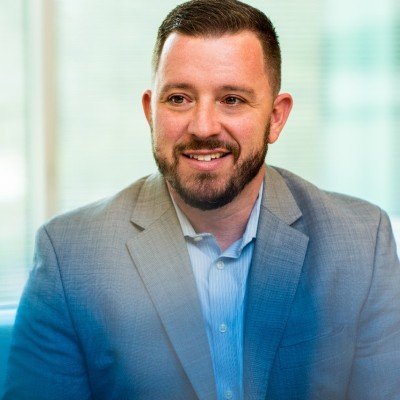
Joe Coleman
FMC Global Talent
“It is great to push this technology into market, but we need to listen to the pull of the candidate market as well.”
Joe Coleman has been named to the Talent 100, Class of 2026, the annual award recognizing up to 100 leaders in each category of talent acquisition. Honorees are nominated by peers or found by committees that look for excellent work wherever it happens, then chosen for the depth of their craft and their impact on hiring. This is Joe's story.
Every road, hospital and housing estate begins as a file inside a piece of software, and Joe Coleman has spent a decade hiring the people who build that software. Today, as Director of Digital Construction at FMC Global Talent, Joe runs a construction technology practice grown from nothing into a five-person team delivering close to seven-figure annual revenue.
Based in Lincoln, England, Joe partners with global technology vendors and hires across executive leadership, sales, customer success, marketing, product and pre- and post-sales roles, while coaching a team of recruiters and account managers who cover the same market. It is a specialism with an unusual double character: the buyers are software companies, but the end users are the people pouring concrete and setting steel.
Construction remains one of the least digitized industries on earth, which makes the last ten years of change all the more striking. Joe watched the vendor landscape shift from perpetual, on-premise licences to cloud and SaaS, and with it the profile of talent those vendors needed. The practice was built in the slipstream of that shift.
A Journalism Degree and an Entrepreneurial Itch
Joe graduated from the University of Lincoln in 2013 with a BA in Journalism and, like a lot of 21-year-olds, without a fixed plan for what came next. What was clear was the temperament: competitive, commercially minded, drawn to work where performance is visible and measurable. Recruitment offered exactly that, and in January 2015 Joe joined FMC Global Talent as a technical recruitment consultant straight out of university.
The pull toward building something had older roots. Joe grew up around a parent who founded a blue-collar business, and that proximity to entrepreneurship shaped what a career was supposed to look like. "Entrepreneurship has always been quite motivating for me," Joe says of the climb from graduate to running a business unit.
The progression reads like a case study in staying put and going deep: senior recruiter, then 360 account manager, then account manager for AEC and BIM software, then senior account manager for construction technology from 2018 to 2023, and associate director from February 2023. Ten years, one firm, and a division built inside it. The appeal, for Joe, was scratching the founder's itch within the structure of an established agency.
The Industry Most People Never Notice
Ask Joe what makes the work meaningful and the answer starts with the built environment rather than the placement fee. The road driven to work each morning, the hospital where a sick family member is visited, the house someone wakes up in, the tunnel travelled through on the way to the next destination: at some point, a client of Joe's designed the software that made those things possible. "People just take for granted that houses get built and hospitals get built and highways get built," Joe notes.
The clients on the other side of that desk are chasing questions with real stakes. Can projects be designed faster? Can they land inside budget? Can buildings be greener and more sustainable for the generations that inherit them? Sitting between those vendors and the people who can move their roadmaps forward gives the work a sense of consequence that agency recruiting does not always carry.
There is a second, more personal dimension. Joe's team frequently recruits industry professionals directly out of construction, people who came through a degree or spent three or four years on site, and pivots them into technology. Site work often means long hours, hard labour, low pay and low job security, all of it compounded by an aging workforce leaving the trade and taking decades of knowledge with it. The alternative Joe can offer is concrete: core working hours, a safer route home to their families, and the chance to apply hard-won field experience to the very tools that design the spaces they used to build. Changing a career trajectory that fundamentally is, in Joe's telling, the most powerful part of the job.
Where AI Helps and Where It Does Not
Joe treats the current AI wave as continuous with the move from perpetual licences to cloud and SaaS: another amalgamation of technology landing on a human process, not the end of one. The practical value is in stripping out administrative drag, the operational tasks that pull attention away from an actual conversation with another person. MetaView handles note-taking so that a one-to-one can stay a one-to-one rather than a scribbling exercise, and Joe experiments with Lovable and Codex to build bespoke internal projects and find efficiencies in the working day.
On sourcing, the assessment is blunt. Sourcing, in Joe's view, is largely a problem that no longer exists, because everyone now has access to enormous data sets. The remaining gap is engagement and attraction, and interpreting that information well enough to reach a person persuasively still needs a human eye. That is the line Joe draws: technology to augment and empower the recruiter, not to replace the full end-to-end process. FMC is early in its evaluation of sourcing technology, assessing tools against exactly that standard.
Advice for the Year Ahead
Joe's counsel to other talent leaders is a warning about echo chambers. It is very easy for a director to say, "I want this new shiny toy, I want this new tool, I want to build this, I want to buy this," and just as easy for a whole function to be blinded by the glitz and glamour of AI while nobody in the room is listening to the candidate market.
Joe sees a genuine delta between HR, which indexes heavily on the people side, and talent, which indexes on the recruiting mechanics, with each side too often failing to hear the other. There is a middle ground. Finding it starts with the evidence already circulating publicly: candidates making skits out of pushing an AI interviewer into hallucinating, or setting two AI interviewers against each other. Joe reads that as feedback, not comedy.
The conclusion is a discipline rather than a rejection. Push new technology into the market, but weigh it against the pull of the people it is aimed at. "It has to stay paramount to what makes us human," Joe argues, because empathy is what makes the work meaningful to the careers and the lives being changed. A recent essay by a well-known technology founder on which jobs stay human-protected sharpened the point. For a leader whose team's best work involves lifting people out of hard labour and into software, that is not an abstraction. It is the job description.
The Talent 100 exists to celebrate the people shaping the future of how the world hires, and few embody that better than Joe. We are honored to welcome Joe Coleman to the Talent 100, Class of 2026, and grateful for the experience, perspective, and craft they bring to this community. Congratulations, Joe. Welcome to the Talent 100.
About the Talent 100
The Talent 100 is an annual list spotlighting the leaders who push HR and talent acquisition forward, organized by Noon AI. Honorees are selected through peer nominations and independent selection committees. Selection is entirely merit-based, with no fees or pay-to-play requirements.