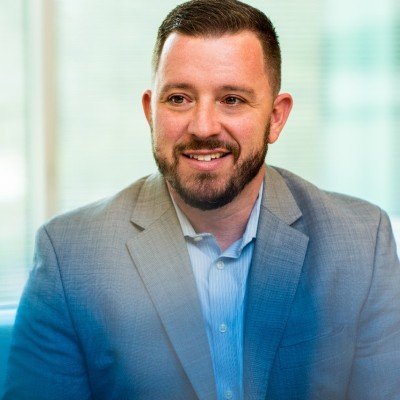
Rob Colombo
AEG
“Go find good people, good humans that you want to work with, and set your foundation early.”
Rob Colombo has been named to the Talent 100, Class of 2026, the annual award recognizing up to 100 leaders in each category of talent acquisition. Honorees are nominated by peers or found by committees that look for excellent work wherever it happens, then chosen for the depth of their craft and their impact on hiring. This is Rob's story.
In December 2008, Rob Colombo graduated from Saint Louis University into what he still calls the worst year to graduate since the Great Depression, and he did it holding two job offers. One of them, a procurement role at Anheuser-Busch, paid about five times what the other did. He took the other one. Nearly two decades later he is Director of Recruiting at AEG, and the offer he declined still explains the career he built.
The higher paying job came with an unusual specification. Anheuser-Busch then owned an amusement park in Florida, and an entire team existed to source fish food for its whales, Shamu included. Rob, carrying a significant amount of student debt at the time, gave it real thought. His father did not. As Rob recounts it, the verdict was blunt: he had not paid for a college education so his son could go source fish food.
The alternative was a company Rob had never heard of, Levi, Ray & Shoup, and a title he understood only vaguely. He started there in 2009 as an associate technical sourcer. Three companies in, including a stretch at the staffing firm Beacon Hill, he now leads recruiting at AEG, with a career built on something he insists is not taught in a classroom: the capacity to absorb the volatility of the work without walking away from it.
The Battle Scars Test
Ask Rob who shaped him and he does not reach for titles. He reaches for a small core of colleagues, gathered across those three companies, who have since become friends. They are the people he calls first. The common denominator, in his framing, is shared exposure under pressure: the ones who carry the same battle scars because they were in the same rooms during the same bad stretches.
His first two mentors he describes as amazing, and what made them amazing was not technique. They taught him the ropes, certainly. More valuable was everything outside the ropes, the part he says is neither learned nor written into anyone's DNA: building thick skin, and working out in practical terms how a person makes what he calls a roller coaster of a profession pay off over the long haul. He says he has been lucky, and blessed, on that front.
He is equally direct that some of his sharpest lessons came from watching leadership handled badly. Rob credits that observation with more of his upward trajectory than anything else. The image he returns to is a room full of faces reacting to a leader doing the wrong thing, and the way that reaction registers without anyone saying a word. It sticks with him, he says, far longer than the good examples do, and it now functions as a standing check on his own conduct.
Adapt Or Die
Rob was once nervous about artificial intelligence, and he is candid about why. Recruiting contains a great deal of monotony, and it was not hard to picture a machine absorbing all of it. His position now is unambiguous. "If you are scared of it, it is not helping," he says. "It is adapt or die." Used as a catalyst to automate the menial tasks rather than as a substitute for judgment, he argues, the technology puts a team way, way ahead of where it would otherwise sit.
That is not abstract for him. At Beacon Hill and now at AEG, the tools have been embraced internally to make recruiting and sales teams more productive. He is also watching the broader correction with interest. Plenty of companies arrived with grandiose plans to eliminate entire teams, build their own bots and let ChatGPT carry the remainder. What their frontline and midline managers found instead, in Rob's reading, is that implementation costs remain relatively modest for now, though he expects that to rise, while output climbs sharply: more candidates turned out, more code through the door, releases checked and balanced far faster. He sees the same pattern in the stock market highs. The gains, he believes, come from giving humans the ability to do more, not from subtracting them.
At a Bullhorn town hall in Boston he encountered the opposite posture, much of it from smaller firms explaining that they were too small to use it. He has no patience for the argument. He calls it a cop-out, and his prescription is almost aggressively simple: download Claude, take the free version, and watch it change your life.
What The Market Cleared Out
Big company talent acquisition in St. Louis is a tight, small arena, and Rob knows most of it. Everybody knows everybody once you have been doing this a long time, he says, and the local leaders get together often, which gives him an unusually clear read on what the post-COVID market did to the available talent. His assessment is unsentimental. The boom years inflated production and rewarded people who were, in his words, getting lucky. Producers used to a fraction of the volume, perhaps 20 placements a year, were suddenly turning in 50. When conditions got tough, a lot of them ran.
What is left, he says, splits awkwardly. There are the proven go-tos with twenty years behind them, whom almost nobody can afford. Then there are candidates six months into a role that did not work out, whom hiring leaders are scared to take a chance on. Rob is clear that AEG has some deep pockets but is not about to spend millions on a single recruiter. That constraint is the whole reason his answer to the next twelve months is not a hiring strategy but a training one.
Get Ready To Train
His advice to other talent leaders comes in four words: get ready to train. Rob wants leaders to stop waiting for a finished product to surface on the market and start building one deliberately, early, before the output is needed. Go find good people, good humans you actually want to work with, and set the foundation now. He considers that sound guidance for life in general and close to essential in staffing at the moment.
Underneath it sits the conviction he says he will take to the grave. Recruiting itself, in his view, is not hard to teach. The difficult part is everything wrapped around it: the ins and outs of the job, the ups and downs, the constant handling of other people's emotions during the best and worst weeks of their working lives. Character is the one component that cannot be installed later. "I will train anyone to be a recruiter," he says, but "you cannot teach someone to be a good moral person." Find those people, teach them the craft, and you have the foundation of tomorrow. For Rob, that principle is more prevalent and more important than it has ever been.
The Talent 100 exists to celebrate the people shaping the future of how the world hires, and few embody that better than Rob. We are honored to welcome Rob Colombo to the Talent 100, Class of 2026, and grateful for the experience, perspective, and craft they bring to this community. Congratulations, Rob. Welcome to the Talent 100.
About the Talent 100
The Talent 100 is an annual list spotlighting the leaders who push HR and talent acquisition forward, organized by Noon AI. Honorees are selected through peer nominations and independent selection committees. Selection is entirely merit-based, with no fees or pay-to-play requirements.