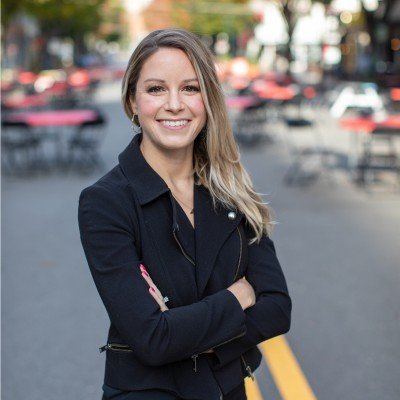
Deanna Lloyd
Patagonia
“Recruiting is such a privilege. You have this opportunity to get to know somebody deeply and help them work through probably one of the most important decisions of people's lives.”
Deanna Lloyd has been named to the Talent 100, Class of 2026, the annual award recognizing up to 100 leaders in each category of talent acquisition. Honorees are nominated by peers or found by committees that look for excellent work wherever it happens, then chosen for the depth of their craft and their impact on hiring. This is Deanna's story.
The office was a log cabin in the woods of the California foothills, the staff numbered two, and the assignments came from the outdoor industry and environmental nonprofits. That is where Deanna Lloyd learned to recruit, in the early 2000s, at a boutique executive search firm she joined mostly because she needed part-time work while finishing a teaching credential. She walked away from the credential on purpose. Six years at that firm and nearly fourteen at Patagonia later, she leads talent acquisition for a company whose whole purpose, as she puts it, is focused on saving the planet.
From Whitewater Guide to Executive Search
Recruiting, Lloyd is quick to point out, "is not a career that many people seek out." Hers certainly began somewhere else. She graduated from UC Santa Barbara with a degree in global studies, an interdisciplinary program sitting between anthropology, sociology and international relations. Service work pulled at her early. She spent time in an educational nonprofit after college, then went back to school for a teaching credential because she thought her future involved starting a school. Her summers were spent guiding whitewater rafting trips based in the California foothills, which is why she moved up to that country in the first place, and how she met the person who redirected her career.
A fellow rafting colleague, a veteran of larger San Francisco search firms, had launched his own practice squarely at the intersection of the outdoor industry and environmental nonprofits. Lloyd came aboard in an administrative capacity and was pulled into the craft almost immediately. She had at least a rough map of the territory: her brother had worked as a recruiter after college, which put her ahead of most of her peers at a moment when the standard reaction was, what exactly is a headhunter, and what do they actually do?
What she did not expect was to fall in love with the work. "Really learning about people and connecting them to work that feels meaningful and purposeful, and brands that feel really connected to who they are," is how she describes the hook. The teaching credential went unfinished by choice, and she leaned all the way into recruiting instead. Six years at that small shop took her from admin to seasoned recruiter running executive search in the outdoor and environmental nonprofit space. Patagonia was a client. She had admired the brand deeply from afar. When an opportunity opened on the inside, she took it, and she is now closing in on her fourteenth year there.
Curious and Cautious About AI
Lloyd sees talent acquisition as the function where AI has moved fastest, "even more so than other areas of HR," and she has watched the shift with genuine interest. Her own posture, and Patagonia's more broadly, she describes in her own words as "curious and cautious." That caution is not timidity. Patagonia exists to save the planet, and AI carries a very big environmental impact, so the footprint of the technology is weighed directly against where the company chooses to adopt it.
Within those guardrails, she has examined a wide range of tools, some purely to understand where the technology is heading, others in places where the efficiency case is strong enough to lean in deeply. Recruiters, she notes, get absolutely buried in the logistical side of the job, the pure scheduling, the interview guides, the resources that have to be built again and again. "I have found AI to be really brilliant in those spaces, so effective," she says. The point of clearing that work is not headcount, it is redistribution. She wants her recruiters, herself included, spending more time in the human relationship, understanding somebody at their core.
Her team recently debated a chatbot, and Lloyd is candid that in a relationship-heavy organization the prospect of a robot at the first moment of connection stirs feelings. She holds both truths at once. As a candidate, she would much rather be put on the schedule instantly and then get to talk to a person than spend three weeks waiting to hear from a human. The test she applies is whether the technology makes the process more human-touched and human-connected, not less.
Agility, and a Steady Presence
Asked what she would tell other talent leaders, Lloyd names two things. The first is agility. By her own lived experience, talent acquisition has been on a really big journey since the pandemic, and the function is unusually exposed to the economic weather. She and her team have had to pivot quickly and make fast adjustments to recruiting strategy in order to meet the moment of the business. Sometimes hiring pauses and talent acquisition has to go quiet for a stretch, which raises the harder questions: how do you redeploy recruiters, and how do you hold a steady presence while building in far more flexibility? That is top of mind for her.
The second is philosophical clarity. Every leader, she argues, should know where they personally stand on integrating technology, where they see the best version of it, and where the field still needs to be learning, testing, iterating and trying. Her own answer is unambiguous, and she is quick to say she is not alone in it: people sit at the center of so much of what this work is, and holding that as a key truth is the job. She is aware that talent acquisition still gets a bad rap in some corners, which strikes her as strange given what the function actually touches.
Because what it touches is enormous. "Recruiting is such a privilege," Lloyd says. "You have this opportunity to get to know somebody deeply and help them work through probably one of the most important decisions of people's lives, what they're going to do for their work." That conviction is what pulled her out of the classroom and into a log cabin in the woods two decades ago, and it is why, whatever the tooling looks like in five years, she is betting the trust-building piece, human to human, stays essential. It is also, not incidentally, exactly what a handful of leaders once extended to her.
The Talent 100 exists to celebrate the people shaping the future of how the world hires, and few embody that better than Deanna. We are honored to welcome Deanna Lloyd to the Talent 100, Class of 2026, and grateful for the experience, perspective, and craft they bring to this community. Congratulations, Deanna. Welcome to the Talent 100.
About the Talent 100
The Talent 100 is an annual list spotlighting the leaders who push HR and talent acquisition forward, organized by Noon AI. Honorees are selected through peer nominations and independent selection committees. Selection is entirely merit-based, with no fees or pay-to-play requirements.