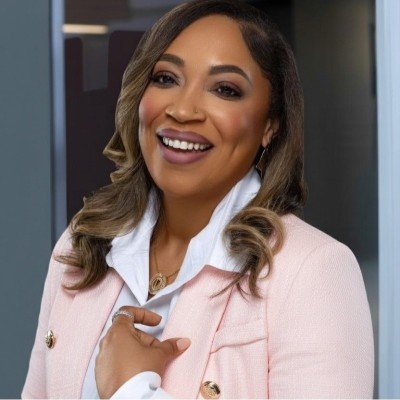
Dana Dillard
Zoox
“They know things are going to go wrong, but they support me through it and they help me to figure out how we move forward versus blaming.”
Dana Dillard has been named to the Talent 100, Class of 2026, the annual award recognizing up to 100 leaders in each category of talent acquisition. Honorees are nominated by peers or found by committees that look for excellent work wherever it happens, then chosen for the depth of their craft and their impact on hiring. This is Dana's story.
The pivot point in Dana Dillard's career arrived at a restaurant table. She was waiting tables through college, finishing school, when one of her regulars asked what she planned to do next. Dillard told her the truth: she had no idea. The customer suggested she come interview where she worked. That company turned out to be a staffing firm, and that conversation turned into a job, an education, and eventually an entire profession.
"Definitely by accident," is how Dillard describes her entry into talent acquisition. "It wasn't my plan." What followed, however, has been anything but accidental. Across a long career in recruiting, she has built a leadership philosophy that is unusually clear about what it will and will not tolerate, and an approach to technology that treats speed as an obligation rather than a novelty.
From a Staffing Floor to Charles Schwab
She stayed at that first staffing firm for about a year and a half, long enough to get a real education in the industry and to earn a promotion, and it was as she worked her way through that role that she was introduced to Charles Schwab. The introduction became her entry into corporate recruiting, and, as she puts it, the rest is history.
It is a common arc in talent acquisition, and also a slightly misleading one. Plenty of people fall into recruiting. Far fewer stay long enough, and pay close enough attention, to turn an accident into an expertise. Dillard's early years gave her something that is difficult to acquire later: a ground level view of how the business actually works, formed before she ever had a team, a budget, or a title.
The Environments She Will Not Stay In
Dillard is equally direct about the inverse. She has worked for leaders who preferred to point fingers and who led with fear, and she has drawn a hard line around it. "That is not an environment I thrive in," she says. "Those are environments I don't last in and I leave from because they just don't serve me or my team."
There is a quiet discipline in that position. Fear based leadership is often mistaken for rigor, and Dillard's view is that blame is not a management technique at all. She has been willing to walk rather than work inside one. Her teams inherit the standard she learned early: make time for people, back them when something breaks, then solve the problem together.
Moving at the Speed of AI
On artificial intelligence, Dillard is neither breathless nor skeptical. She is practical, and she is paying close attention to the clock. Asked how quickly the recruiting landscape has shifted, she does not hesitate: quickly, and even more quickly in the last few months. "I feel like it's just moving so fast," she says.
She has embraced the tools personally and pushed her teams to do the same, for a straightforward reason. "You can do so much more so much faster," she says. Work that once consumed hours, compiling data, researching, assembling baseline information, can now be handled in a fraction of the time. Crucially, she treats that output as a starting point rather than a finished product. From there, she says, the job is going deeper, validating what the tools produce, and spending the time to refine it. The machine buys back the hours. The recruiter still owns the judgment.
Where Dillard becomes most emphatic is on the question of responsibility. AI, she believes, has a role to play in the future of everything, not just recruiting but the world in general, and the harder task is figuring out how to use it responsibly, in a way that serves the talent community well. That framing matters coming from someone who leads recruiting teams, because the people on the other side of these systems are candidates.
Her conclusion is unsentimental and, characteristically, forward leaning. Everyone is trying to figure out how to do the next cool thing, and simply keeping up is the challenge. "I think it's here to stay," she says. "So might as well embrace it."
The Through Line
There is a symmetry to Dillard's career that is hard to miss. It began because someone with no obligation to help took an interest in a young person who did not yet know what she wanted to do, and pointed her toward a door. The leaders she has admired most since have done a version of the same thing: made themselves available, taken the call, backed her when the plan came apart.
That is the operating model she has carried into her own leadership, and it is the reason her adoption of AI reads as an extension of her values rather than a departure from them. Automate the compiling and the researching. Reclaim the hours. Then spend them where the work has always actually mattered, which is with people.
The Talent 100 exists to celebrate the people shaping the future of how the world hires, and few embody that better than Dana. We are honored to welcome Dana Dillard to the Talent 100, Class of 2026, and grateful for the experience, perspective, and craft they bring to this community. Congratulations, Dana. Welcome to the Talent 100.
About the Talent 100
The Talent 100 is an annual list spotlighting the leaders who push HR and talent acquisition forward, organized by Noon AI. Honorees are selected through peer nominations and independent selection committees. Selection is entirely merit-based, with no fees or pay-to-play requirements.