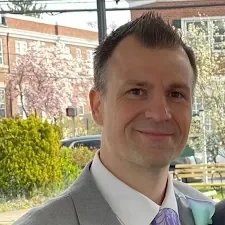
Adam Erickson
“AI should be an extension of who you are as a recruiter.”
Adam Erickson has been named to the Talent 100, Class of 2026, the annual award recognizing up to 100 leaders in each category of talent acquisition. Honorees are nominated by peers or found by committees that look for excellent work wherever it happens, then chosen for the depth of their craft and their impact on hiring. This is Adam's story.
Adam Erickson recruits for a company that put its first satellite into orbit on October 1, 2026, and now has to find the people who will build what comes next. At Cowboy Space, where Reason-1 rode a SpaceX Falcon 9 rideshare to test laser power beaming from space, a team of 107 is working toward space-based power and data centers in orbit. Leading talent acquisition, Adam works directly with founder and CEO Baiju Bhatt, the Robinhood co-founder, on hiring for a mission no one else is attempting.
The job reaches well beyond open requisitions. With offices in San Carlos, California and Seattle, Washington, the company will be building rockets and satellites, and Adam's role is to work out what its leaders need, how to partner with a founder, and what workforce plan will carry the mission forward. Roughly two decades into his career, he has learned that this is where he does his best work: alongside founders at smaller companies, building something from scratch.
The Itch to Build
That instinct took shape at Amazon, where Adam spent 2011 to 2015 during one of the company's largest growth periods. He was brought in to expand university recruiting and its footprint. When he arrived, Amazon was hiring 278 engineers a year. Within 18 months, his team had scaled that to more than 2,000 a year.
The lesson he carried out was not only how to recruit in a pressure cooker. It was how to build at scale in a way that makes people want to stay rather than run. The same question now drives his work at Cowboy Space, where every hire shapes a company still defining itself.
A Psychologist's Lens on Organizations
Adam earned a bachelor's degree in psychology from Washington State University and graduated into an economic downturn. The youngest of three boys, he grew up watching his brothers build their own cars and computers, and he had followed tech for years. Recruiting let him pair a genuine interest in understanding people with the engineering side of his brain: how organizations are built, how the pieces fit, and what kind of leader each hire supports.
Almost 20 years ago he landed at Microsoft during Bill Gates' last two years and Steve Ballmer's first two, supporting senior-level hiring in corporate strategy. There, as a 20-something, he supported Byron Rader, a longtime Microsoft leader who took him under his wing. Byron taught him that talent acquisition is one of the most important functions in any company, and he let Adam into planning and mission-critical meetings to show the difference between an order taker and a true talent partner.
At Amazon, senior vice president Jeff Wilke taught him about risk: how to move in the right direction without every piece in place. Jeff's rule for tough decisions was to be 70 percent confident and 30 percent terrified. Adam still shares it, along with a deeper takeaway. The accomplished executives he supports share the same fears as everyone else. What sets them apart is how they move through them.
Leading Like a Coach
Adam also coaches high-level youth soccer, and he credits the players he coached for four years, and their families, with making him a better leader of teams that have reached 80-plus people. A coach gets one or two practices a week before game day; a recruiting leader may get one one-on-one a week before recruiters head into client meetings. In both cases, he asks whether he can accept someone executing 60 to 70 percent of his vision. He cannot take the ball from a 16-year-old, and he cannot sit in every hiring meeting. That discipline shapes how he thinks about micromanagement and how his team's work reaches the CEO and the board.
Turning Recruiters Into Consultants
Adam's six-person team lands near the midpoint of the company's weekly AI usage, at times ahead of some engineers, which he considers the sweet spot. A biweekly standing meeting is devoted to sharing AI techniques. For niche roles, he cross-checks LinkedIn's algorithm with X-ray searches on Google and uses AI to market map quickly, so a hiring manager can return in 15 minutes instead of a week and learn, for example, that only 11 people in the US match a set of requirements.
At Cowboy Space, he connected Claude to the Ashby applicant tracking system to analyze the experience the company has added by prior employer, informing a skills-based approach to diversity. The analysis took 15 minutes. Where he once asked candidates for sourcing roles to whiteboard a Boolean string for a head of avionics, he now wants to hear how they would use ChatGPT, Groq or Claude. The goal, he says, is to give recruiters superpowers built on the skills they already have.
Advice for the Year Ahead
Adam urges talent leaders to gather their leaders now and agree on a hiring roadmap: 12 months if possible, then nine, six, or at least the first three. With recruiters likely to change companies, he recommends roughly 60 to 70 percent full-time and 30 to 40 percent contract talent, so teams can scale without unmanageable requisition loads. Teams that skip this step, he warns, will struggle to meet hiring needs. He is flying every one of his own leaders in for a four-hour planning session in a conference room.
The Talent 100 exists to celebrate the people shaping the future of how the world hires, and few embody that better than Adam. We are honored to welcome Adam Erickson to the Talent 100, Class of 2026, and grateful for the experience, perspective, and craft they bring to this community. Congratulations, Adam. Welcome to the Talent 100.