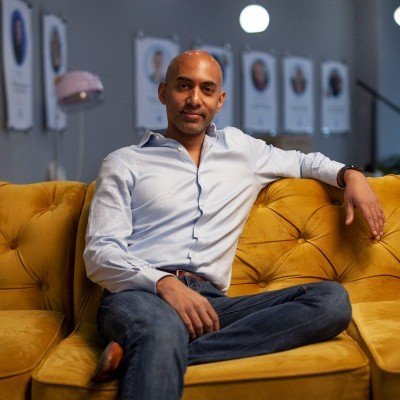
Tush Wijeratne
WPP
“It hasn't replaced us. It's just made us better at what we do.”
Tush Wijeratne has been named to the Talent 100, Class of 2026, the annual award recognizing up to 100 leaders in each category of talent acquisition. Honorees are nominated by peers or found by committees that look for excellent work wherever it happens, then chosen for the depth of their craft and their impact on hiring. This is Tush's story.
Tush Wijeratne qualified as an accountant, spent five years in the profession, then moved into law and worked in immigration crime for two. Twenty-three years after he walked away from both to try recruitment, he sits inside one of the world's largest marketing and communications groups, WPP, working with C-level and boardroom stakeholders on global transformation programmes and on the question that increasingly organises his working life: what does the future of talent acquisition actually look like?
That combination of numbers, process discipline and human judgement turns out to be an unusually good preparation for the job he does now. Accountancy taught him rigour. Law taught him how to operate inside systems where the rules are unforgiving. Recruitment gave him the thing neither of the first two careers did: people, at scale, across borders.
From Ledgers and Law to a Global Remit
The pivot was deliberate rather than accidental. Having decided to do something completely different, Wijeratne joined a recruitment agency specialising in telecom billing and CRM. It was there, he says, that he learned leadership and management, and he learned them fast. He became a director of the company quite quickly and ran the office globally, a jump from newcomer to owner of a worldwide operation that set the tone for everything that followed.
What came next was a deliberate tour of the whole talent landscape rather than a narrow specialism. He moved from agency into in-house recruitment, then into RPO, then into HR roles and, notably, non-HR roles as well. Few practitioners have seen the function from that many sides. It is one of the reasons he can sit in a boardroom and discuss talent acquisition as a commercial question rather than a staffing one.
The last 14 to 15 years have been spent entirely internally, inside global organisations, running transformation programmes, building teams and designing what comes next. From his base in London that has meant operating across time zones and business units, and increasingly it has meant answering to the most senior people in the building. He also gives time back to the wider profession, serving on judging panels for industry TA awards alongside peers he has come to respect.
AI as Amplifier, Not Replacement
Wijeratne frames the current moment against the long arc of the function. Talent acquisition has already migrated from onsite to offshore and then to a blended onshore and offshore model. AI, in his reading, is the next structural shift, and one capable of absorbing a large part of that model.
His teams already use AI to draft job descriptions, to coordinate diaries and to build the question sets that structure candidate conversations. The result is not headcount reduction but leverage. "It's made us more efficient. It has made us more productive," he says. "It hasn't replaced us. It's just made us better at what we do." He also credits it with taking bias out of the equation in certain parts of the process, a quieter benefit that rarely makes the headlines.
The most valuable dividend, though, is time. With the mechanical work compressed, his recruiters have more hours to spend with stakeholders on business partnering and relationship building, and to deliver what he calls a much more personalised service. The technology, in other words, buys back the very human capability it was supposed to threaten.
The Era of Smart Agents
Where he is looking next is agentic. "For me we're in the state of smart AI agents," he says, and he is unusually concrete about what that implies. Sourcing, screening and potentially even first-round candidate conversations are all in scope. More radically, he sees agents as a component of the org structure itself, work assigned to an agent rather than to an individual, freeing that person to contribute elsewhere in the organisation.
That leads him to a prediction about the skill set of the modern talent leader. In the future state, he argues, TA teams will be building their own agents and customising them, then holding them to account: monitoring the quality of those agents and making sure they are performing at their best. And because conditions can change very quickly, agents must be configurable in the way a human is adaptable. "Ability to pivot an agent would be very important," he says. It is a striking reframing of the leader's role. Less headcount planning, more fleet management, with quality assurance as a permanent discipline rather than a one-off project.
Passing the Spotlight On
Given the chance to put forward peers, Wijeratne answered with the same specificity he brings to everything else. He named a fellow judging panel member over the last couple of years, whom he describes as a very strong thought leader who has worked across different environments and looks at things from a slightly different angle than most others would from a TA perspective, with a strong operational bent.
He named a leader from Babcock, with whom he has shared the stage at speaking events repeatedly in recent years, as very strategic in his thinking, with a background in the public sector and other highly regimented environments that has left him deeply process oriented.
And he named a leader he calls a legend of TA in general: someone who has worked with companies at big scale, run large transformations, sat on leadership teams and consistently thought outside the box. The two have compared notes from opposite sides of the fence in leadership and boardroom sessions. She is, in his estimation, one of the strongest people out there in the market.
It says something about how Wijeratne understands his own career that his instinct, when handed recognition, was to start distributing it. Somebody once took a punt on him. He has been repaying that ever since.
The Talent 100 exists to celebrate the people shaping the future of how the world hires, and few embody that better than Tush. We are honored to welcome Tush Wijeratne to the Talent 100, Class of 2026, and grateful for the experience, perspective, and craft they bring to this community. Congratulations, Tush. Welcome to the Talent 100.
About the Talent 100
The Talent 100 is an annual list spotlighting the leaders who push HR and talent acquisition forward, organized by Noon AI. Honorees are selected through peer nominations and independent selection committees. Selection is entirely merit-based, with no fees or pay-to-play requirements.