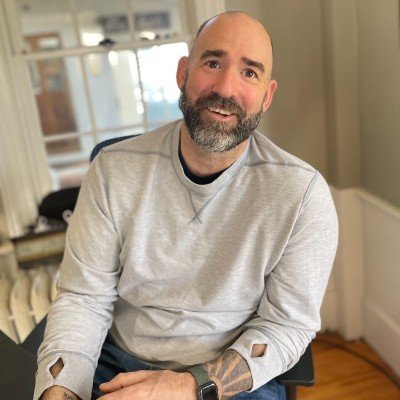
Riley Agnew
Mastercard
“AI is always a starting point. It's never an ending point.”
Riley Agnew has been named to the Talent 100, Class of 2026, the annual award recognizing up to 100 leaders in each category of talent acquisition. Honorees are nominated by peers or found by committees that look for excellent work wherever it happens, then chosen for the depth of their craft and their impact on hiring. This is Riley's story.
A decade ago, the job Riley Agnew does now barely had a name. Hired out of college at HubSpot as a culture content creator, Agnew became the second person on a fledgling recruitment marketing and employer brand team, a function most companies had not yet imagined needing. Today, based in the Boston area and now Director, Recruitment Marketing at Mastercard after leading talent attraction and recruitment marketing at Celonis, Agnew has watched that niche experiment turn into one of the most sought after seats on a modern talent team.
The work sits at the intersection of two disciplines that rarely share an org chart: recruiting and marketing. Agnew's central question has stayed the same across every company since HubSpot. "Why does a candidate want to work at your company versus anywhere else in the world?" Answering it means finding the stories worth amplifying, then handing recruiters and sourcers the outreach messaging and narrative they need to win attention in a market where attention is the scarcest resource of all. More and more talent teams are now hiring for exactly that role, Agnew notes, because they have seen what happens when nobody owns it.
An Accidental Entry, a Deliberate Career
Nobody goes to university to become a recruiter. Agnew is quick to say so, and quicker to say how lucky the landing was. Before HubSpot there was a stint in Edinburgh, Scotland, writing for a travel magazine, an experience that sharpened the storytelling instinct that would later define the work. Returning to the Boston area meant starting over without any corporate experience, and HubSpot, a company already known regionally for its culture, was willing to bet on potential rather than a resume.
That first role gave Agnew a firsthand look at what it actually takes to attract candidates: not just the mechanics of recruiting, but the harder craft of telling the story of the people behind the product. It was a small, strange, brand-new job. It became a career. Agnew has since grown through several recruiting organizations, moving from individual contributor to talent leader, and calls it a glorious space to have fallen into.
Proving a Nice to Have Was a Need to Have
The defining test came at Datadog, during COVID. Employer brand work was widely viewed as a nice to have rather than a need to have, and hiring pauses made that view easy to justify. Agnew's leader there took the opposite position, and taught Agnew how to defend it: with data and business strategy rather than sentiment. The argument was simple and, once made properly, hard to dispute. There is a direct connection between growing a company brand and growing an employer brand.
She kept investing in brand presence through one of the most uncertain stretches in recent memory, and Agnew remains grateful for it. "She brought so much stability at a time of uncertainty," Agnew says of that period, crediting her with the grit and perseverance that carried the team through. She also handed Agnew a first team to lead, which is how a specialist became a people leader, and why Agnew has stayed one ever since.
AI Is a Starting Point, Never an Ending Point
Agnew speaks frequently about AI, and does so without the anxiety that colors much of the conversation. The position is firm: AI cannot replace a human, and it will not replace the candidate experience. What it can do is remove friction. Agnew uses Gemini daily, from sharpening outreach messaging to building the content recruiting teams use to craft the right note to the right candidate. The rule is a discipline more than a slogan. AI is where the work starts, not where it ends.
The historical analogy Agnew reaches for is the internet itself. Our grandparents were told Wi-Fi and the web would be the next cutting edge technology, and they were right, and now the idea of working without them is unimaginable. AI will occupy the same place for the next generation of talent professionals. That shift is already reshaping how candidates find employers. Where teams once optimized for SEO, Agnew is now thinking about GEO, generative engine optimization: how career site language and even Glassdoor content surface inside AI-driven candidate search, and how a company stays visible on platforms that did not exist in the last hiring cycle. Some organizations have gone further, treating AI reputation scores as a tracked metric for brand health.
The Noise Problem, and What Comes Next
Agnew is candid about the trade-off buried inside successful employer brand work. Build a powerful brand and the pipeline fills, but it fills with noise. AI has flooded systems with applications that are not the quality of applicant teams are actually looking for, and the balance between quantity and quality has become the central operational problem of talent acquisition. "Inbound is just no longer the way that I think recruiters are looking for talent," Agnew says. Teams are pivoting hard toward sourcing as a result.
That is where Agnew wants the technology to advance next: AI sourcing tools and CRMs with real AI functionality that can read skills off a resume, weigh them against a job description, and match a candidate to the right opening. Sometimes that means recognizing that an applicant is wrong for the role they applied to and right for a different one entirely, work that once required a recruiter to read every resume by hand. The hope is not automation for its own sake. It is that the guesswork and the hours come out of the process so recruiters can spend their time on the part no tool can do.
For talent leaders heading into 2026, the advice is direct. AI is here and it is here to stay. Use it, because it will make you more efficient and help you work smarter rather than harder. Just do not mistake the first draft for the finished one, and do not outsource the human part of a candidate's experience, because that is the part that still decides whether someone says yes.
The Talent 100 exists to celebrate the people shaping the future of how the world hires, and few embody that better than Riley. We are honored to welcome Riley Agnew to the Talent 100, Class of 2026, and grateful for the experience, perspective, and craft they bring to this community. Congratulations, Riley. Welcome to the Talent 100.
About the Talent 100
The Talent 100 is an annual list spotlighting the leaders who push HR and talent acquisition forward, organized by Noon AI. Honorees are selected through peer nominations and independent selection committees. Selection is entirely merit-based, with no fees or pay-to-play requirements.