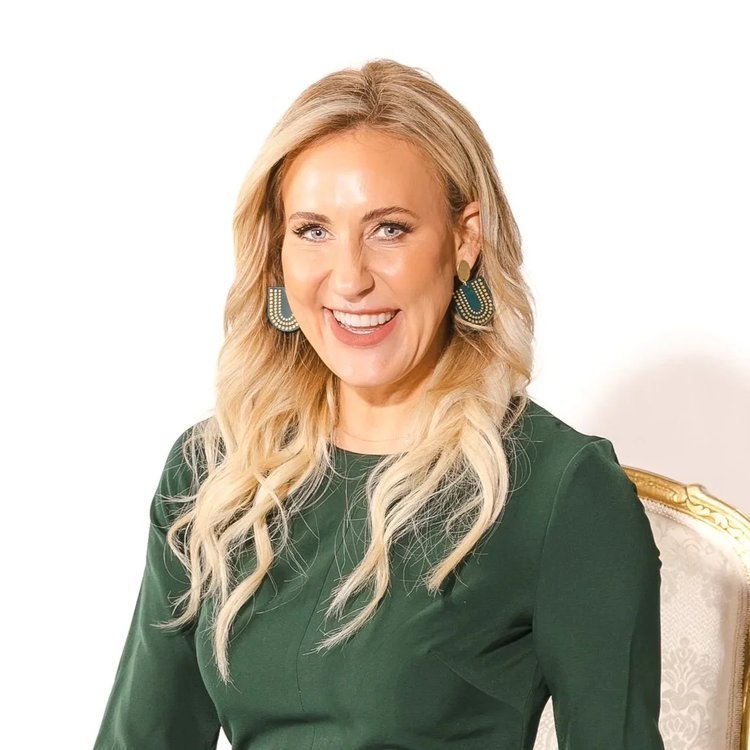
Meghan Houle
The Bowerman Group
“Building teams has been a part of my DNA since the early stages of my career.”
Meghan Houle has been named to the Talent 100, Class of 2026, the annual award recognizing up to 100 leaders in each category of talent acquisition. Honorees are nominated by peers or found by committees that look for excellent work wherever it happens, then chosen for the depth of their craft and their impact on hiring. This is Meghan's story.
In 2012, Meghan Houle picked up the phone, called a recruiting agency, and told them something few candidates have the nerve to say: you need to hire me. She had spent her career to that point inside luxury fashion, running multimillion dollar flagships and hiring the teams that made them work. What she was really pitching was a thesis about herself, that the thing she was best at was not selling product but reading people. The agency listened. Roughly fifteen years later, she manages a multimillion dollar business in the luxury retail space at The Bowerman Group, advising companies across North America from early stage startups to billion dollar brands.
A Career Built on Reading People
Houle traces the through line back further than the flagships, all the way to her first job in a mall, where she was already building a team. "Building teams has been a part of my DNA since the early stages of my career," she says. Every promotion since has been, in her telling, a variation on the same core skill rather than a departure from it.
She describes that skill without much hedging. It is, she says, a kind of career clairvoyancy: the ability to sit across from someone and quickly read their values, skills, interests and motivation, and know where those things will and will not thrive. It is what allowed her to assemble strong teams as an operator, and it is what she has spent fifteen years scaling on the agency side. The decision to stay inside the industry she came from was deliberate. Luxury retail is not a vertical she researched, it is a world she worked in, and that distinction shows up in every client conversation. "That's called credibility, my friend," she says.
The work itself she frames plainly and warmly: matchmaking for professionals. Helping businesses across North America identify and land their A players, while never losing sight of the fact that there is a person on the other side of the table making a consequential decision about their life. Recruiting done badly feels transactional, and she is blunt that this is the failure mode of the industry. "This is a human process," she says, and it is the standard she holds her own work to.
Up Against the Masses
Houle is unsentimental about the state of the funnel. "We are up against the masses, my friend," she says, describing an environment in which companies field enormous volumes of applications through what she calls a very outdated, keyword based ATS vetting system that leaves genuinely qualified people unseen. By her assessment, roughly 75 percent of the people applying to available jobs today do not actually make sense for the role. Meanwhile companies are spending hundreds of thousands of dollars on multiple software systems, internal recruiters and agency recruiters, and getting one person through the door.
On AI she refuses the easy position in either direction. Over the past year she has seen real gains in system, flow and process, in note gathering, and in having better resources to filter, though she thinks the tooling is still clunky and that most teams are not yet leaning into it as fully as they could. Then she draws a hard line. "We cannot just leave recruiting to AI," she says, and she is willing to go against the grain in saying that agentic AI bots should not be navigating an interview process for humans. Chemistry, vibe and the feel of a candidate are not machine readable. She is equally wary of the other side of the equation, the rise of bots applying to jobs and AI written resumes flooding an already strained system.
Her conclusion is a call to balance rather than retreat. Embrace the technology the way the profession has embraced every wave of advancement over the past several decades, use it to carry the workload and collect data better, and keep the human firmly in the process. "It is not going to take away the beauty and the talent that recruiters bring," she says, "and the energy that we bring to this space. That's not replaceable."
Do Not Hire When You Need to Hire
Asked what talent leaders should carry into 2026, Houle does not reach for a trend. She reaches for a discipline. Be proactive about your hiring goals. "You should not be hiring when you need to hire," she says. "Everyone should be building a bench."
The practical version is a standing strategy session: talent, HR and the CEO in a room together, mapping the next twenty moves. Where are the holes. Where are the tough conversations that need to happen to move someone out of the business. Where is someone not stepping up and revenue is quietly being lost. Most organizations, she argues, are still operating reactively, and the results are predictable: a need surfaces, everyone crashes out, the role goes up on LinkedIn, 3,500 InMails get fired off, and the recruiter lands in LinkedIn jail. "The energy behind it isn't of alignment and clarity," she says. "It's of scarcity and lack." Hiring in that vacuum is where hiring decisions go wrong, because nobody has clarity on what the role actually needs next or why the last version of it did not work.
The alternative is unglamorous and enormously effective. If you know you will need a CMO in six months, start interviewing today, particularly now that the hiring process is running three to six times longer than it used to. Pipeline early, take the intro calls, build relationships before there is a requisition attached to them. That, in Houle's framing, is how a company escapes the masses entirely. Roadmap the future, get people genuinely excited about predicting what comes next, and hiring stops being a band aid and starts being a strategy. It is advice she keeps sharing from stages and in the media, and it is the same instinct that made her pick up the phone in 2012.
The Talent 100 exists to celebrate the people shaping the future of how the world hires, and few embody that better than Meghan. We are honored to welcome Meghan Houle to the Talent 100, Class of 2026, and grateful for the experience, perspective, and craft they bring to this community. Congratulations, Meghan. Welcome to the Talent 100.
About the Talent 100
The Talent 100 is an annual list spotlighting the leaders who push HR and talent acquisition forward, organized by Noon AI. Honorees are selected through peer nominations and independent selection committees. Selection is entirely merit-based, with no fees or pay-to-play requirements.