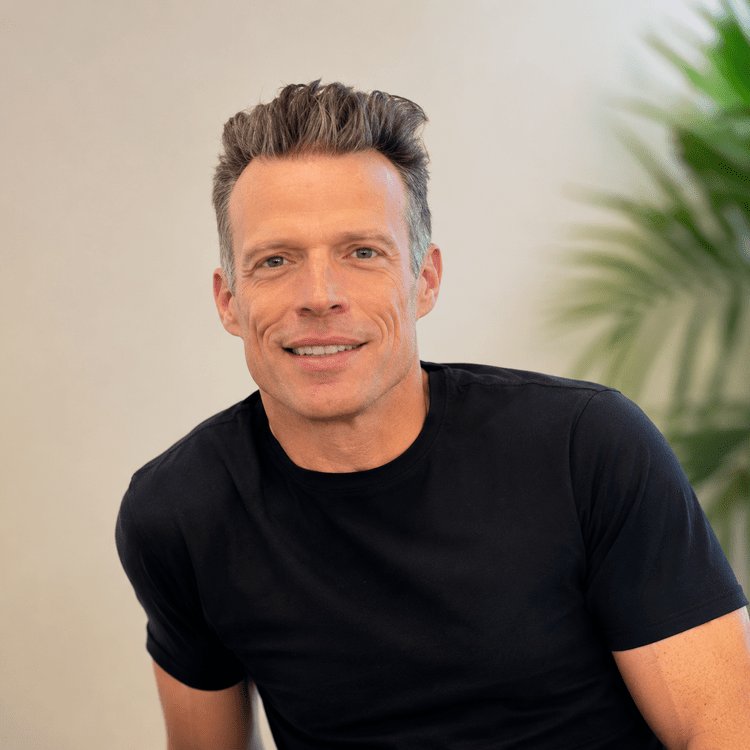
Jonathan DeLauri
Viven
“AI is going to make your best recruiters even better.”
Jonathan DeLauri has been named to the Talent 100, Class of 2026, the annual award recognizing up to 100 leaders in each category of talent acquisition. Honorees are nominated by peers or found by committees that look for excellent work wherever it happens, then chosen for the depth of their craft and their impact on hiring. This is Jonathan's story.
Halfway through law school, Jonathan DeLauri worked out what the degree was actually teaching him: he did not want to practice law. He finished it anyway, and by graduation he already had a recruiting job waiting, arranged through an older brother, three years his senior, who was in the business and started making introductions. Today DeLauri is Talent Lead at Viven, where he runs talent acquisition and people operations at a company building digital twins, and where he has turned his own product into a screening experiment. His argument about the technology reshaping his profession is unsentimental and specific: AI will not replace recruiters, but it will widen the gap between the good ones and everyone else.
"No one goes to school for recruiting" is his standing line on how people arrive in the field. He arrived by way of a law degree he chose not to use, and he has spent the years since building a case that the recruiting skill set is far broader than the job description most companies write for it.
Four Years on the Phones
DeLauri started where most recruiters start, in the agency world, and stayed about four years before moving to corporate recruiting. Those early years were formative less because of any single piece of coaching than because of proximity. He sat in a room full of people doing the job out loud. He listened to their cadences, their transitions, the way they handled a call that was going sideways.
He is candid that the phone intimidated him at first. What got him past it was hearing colleagues succeed with approaches different from his own and being willing to abandon what he had been doing. Adaptability is the word he keeps returning to. If someone else is getting better results with a different method, the useful response is to pivot rather than defend the habit. That instinct has outlasted the agency floor.
The team environment did not last either. DeLauri has been the sole recruiter at his last two or three companies, which changes what learning looks like when there is no one on the next desk to overhear. He frames the job as one where you are never not learning, partly because of the sheer volume of things that can go wrong and partly because the work is made of people. The scoreboard helps too. In recruiting, he notes, you are probably going to have more losses than wins no matter what your role is. The wins are worth the arithmetic, and he keeps a running list of candidate success stories that do the motivating.
A Tool, Not the End All Be All
Ask DeLauri about AI and he starts with the least glamorous application he can find. Note takers. Not resume screening engines, not automated matching, but the small utility that means he no longer has to split his attention between a candidate and a document. "You can focus on the person, the individual," he says, instead of worrying about dictating things correctly. The principle underneath is the one he applies to everything else: the value of the tool is measured by how much human attention it frees up for the moments that actually require a human.
He is equally clear about the failure mode. People lean on it too heavily, and he sees it from both directions. The cold outreach that lands in his inbox is often obviously machine written, verbose in a way that gives itself away in the first two lines. Candidates over-rely on it too. The consensus prediction that AI will simply replace recruiting he finds hard to believe. His version is sharper and less comfortable: it will probably take some jobs from the weakest recruiters, and it will make the strongest ones better.
Testing the Product on Himself
Viven builds digital twins for enterprise customers and also offers a free app version, and DeLauri recently ran his own hiring process through it. Candidates created a digital twin and applied that way. He is careful about what that did and did not mean. It was not AI interviewing AI.
What it gave him was access on his own schedule. At any point in the day or night he could open the applicant pool and start asking questions of a candidate's twin, clearing out the redundant material, the same hundred questions he fields over and over. By the time he reached the live recruiter screen, the call could go straight to background, experience and behavioral depth, the substance that actually determines whether someone gets the interview or the job.
That is his template for using the technology correctly. The digital twin does not replace the recruiter screen. It makes the recruiter screen more efficient, and it keeps the human in the loop where the human matters. The distinction sounds small. In practice it is the difference between automation that hollows out a process and automation that concentrates it.
Advice for Talent Leaders
DeLauri's advice for the year ahead is aimed squarely at how companies treat their own recruiters, and it comes from watching the last eighteen months happen to former colleagues. His read is that the market still has not recovered from COVID, and that organizations respond to a hiring slowdown with a reflex: no open roles, so cut the TA team, then rehire in three or four or five months.
He considers that bad arithmetic and worse strategy. Talent professionals get bucketed into a narrow position, he argues, when the actual skill set is much wider. People management. Engagement. Marketing. In a smaller company especially, recruiters wear a stack of hats that has little to do with filling a requisition. His counsel to leaders at those smaller organizations is to look for somewhere else to deploy that capability rather than releasing it, because letting someone go and hiring them back months later costs more than keeping them, before you even count the institutional knowledge that walks out the door.
"It isn't just pigeonholed into filling headcount," he says. Coming from someone who has been the only recruiter in the building more than once, and who is currently supporting a company that has just put its consumer product into the world, the point carries the weight of direct experience. Recruiters are among the most versatile professionals on a small team. DeLauri's ask is simply that the people making headcount decisions start treating them that way.
The Talent 100 exists to celebrate the people shaping the future of how the world hires, and few embody that better than Jonathan. We are honored to welcome Jonathan DeLauri to the Talent 100, Class of 2026, and grateful for the experience, perspective, and craft they bring to this community. Congratulations, Jonathan. Welcome to the Talent 100.
About the Talent 100
The Talent 100 is an annual list spotlighting the leaders who push HR and talent acquisition forward, organized by Noon AI. Honorees are selected through peer nominations and independent selection committees. Selection is entirely merit-based, with no fees or pay-to-play requirements.