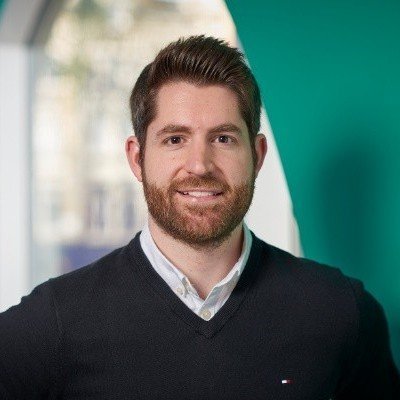
Elliot Hayes
Gimlet Labs
“If you're not using it right now, you're going to get left behind.”
Elliot Hayes has been named to the Talent 100, Class of 2026, the annual award recognizing up to 100 leaders in each category of talent acquisition. Honorees are nominated by peers or found by committees that look for excellent work wherever it happens, then chosen for the depth of their craft and their impact on hiring. This is Elliot's story.
Over the course of his tenure at Groq, Elliot Hayes reached out to 577 people. Not 5,770. In a profession that still too often measures effort in volume, that number is a thesis statement. Groq did not post every role. Instead, Hayes and his team treated each opening the way most companies treat a chief executive search: over 100 dedicated sourcing projects mapping profiles, companies and domain specialties until the team knew exactly who the players were. "The industry's incredibly small, especially at the top," he says, "and so you have to know who they are."
Now Head of Talent at Gimlet Labs, Hayes has built a career on that same conviction: that the highest form of recruiting is not reach, it is precision, credibility, and knowing why you are picking up the phone before you pick it up.
A Sales Career, Redirected by a Single Conversation
Hayes spent the first three and a half years of his post-college career in sales, covering both hardware and SaaS, an origin that, as he puts it, "kind of makes sense now given my history." Circa 2010 he applied for a role on Google's sales team. The conversation took an unexpected turn. Google was building out its recruiting function, and asked whether he would be interested in that instead.
What sold him was not the brand. It was the training. Google at the time ran a three-week boot camp that taught sourcers the craft properly: what to look for in candidates, the lingo, the sources, the mechanics of how to actually source. He entered as a technical sourcer in a hiring class of 30 people, with roughly 200 of the best recruiters in the space around him. "By week three, I was ready to pick up the phone and represent Google," he says.
He still measures the industry against that standard. Most recruiters, he notes, learn on the job, starting as a coordinator and slowly progressing. He was fast-tracked, and he sees the disappearance of that kind of deliberate investment as a genuine gap in the market. The class itself compounded, too: he remains friends with most of those 30 colleagues, and many are now heads of talent at their own companies.
AI as a Research Partner, Not a Volume Machine
Hayes uses a great deal of AI at Gimlet Labs, as he did at Groq, but notably not to send more messages. He uses it to earn the right to send fewer. When approaching a VP-level candidate, he will pull every available resource on that person into the work first: what they have spoken about publicly, what they are passionate about, what actually matters to them. The result, he says, is that the first conversation feels like a continuation rather than a cold open. "You immediately establish yourself as a true talent partner."
His most instructive AI story is not about a tool at all, but about literacy. At Groq, the entire talent function, HR and recruiting alike, sat down with an engineer in a hackathon-style session that walked them through getting access to the platform, using tokens and starting to build. Everyone was then challenged to find a use for it. The HR side produced a standout: a chat function where a candidate could enter their current benefits and see a direct comparison against Groq's, including cost. Non-technical people, building working things. For Hayes, that is the whole point. The access is there, the barrier is low, and the excuse has expired.
Talent Density and Agency
Asked what single piece of advice he would offer other talent leaders heading into 2027, Hayes paused, called the question hard-pressing, and then gave an answer that connected the technology back to the team. The role of the talent leader is evolving, he argues, and incorporating AI into daily practice is now non-negotiable, not merely as a way to reach candidates but as a way to do the job better.
The deeper objective, though, is human. What he thinks about most in his role is how to build the most talent-dense team possible, and then how to give the people on it the greatest possible agency so that each of them is highly leveraged. It is a philosophy with a clear lineage: the boot camp that taught him the craft in three weeks, the mentor who showed him that a talent function can be redesigned rather than inherited, and 577 carefully chosen phone calls.
The Talent 100 exists to celebrate the people shaping the future of how the world hires, and few embody that better than Elliot. We are honored to welcome Elliot Hayes to the Talent 100, Class of 2026, and grateful for the experience, perspective, and craft they bring to this community. Congratulations, Elliot. Welcome to the Talent 100.
About the Talent 100
The Talent 100 is an annual list spotlighting the leaders who push HR and talent acquisition forward, organized by Noon AI. Honorees are selected through peer nominations and independent selection committees. Selection is entirely merit-based, with no fees or pay-to-play requirements.