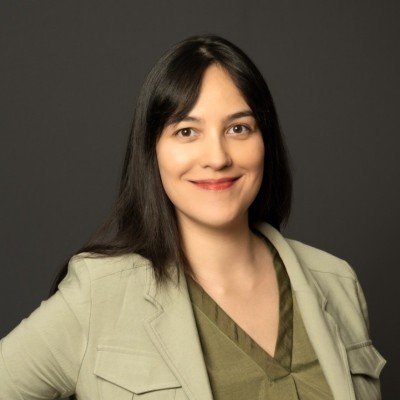
Christelle COUESNON
Mercuri Urval
“It supports us like a companion rather than a machine.”
Christelle COUESNON has been named to the Talent 100, Class of 2026, the annual award recognizing up to 100 leaders in each category of talent acquisition. Honorees are nominated by peers or found by committees that look for excellent work wherever it happens, then chosen for the depth of their craft and their impact on hiring. This is Christelle's story.
Christelle Couesnon heard about human resources long before she understood what the words meant. When she was young, she heard about HR work at home: stories about people, how to make them more comfortable at work, what happened when someone was finally given the right responsibility. She was too young to grasp the function behind the stories. She was old enough to find them thrilling.
What followed looked, for two decades, like a deliberate detour. She took what she calls the more classical direction: a dual academic background in engineering school and business school, twelve years inside industry, five years in management consulting. Today, nearly six years into her tenure at Mercuri Urval, she works across the two disciplines the firm is built on, executive search and leadership advisory, and the through line back to those dinner table conversations is impossible to miss.
The Call That Changed Direction
The turn came by phone. Someone who had known her from her consulting years, and who had since become managing director for France at a global search and advisory firm, called with a proposition that was flattering mainly for its honesty. The life sciences team was not in good shape. Clients were unhappy. He was certain she would handle it well.
She had no idea what it meant to join a recruiting or talent advisory business. She did know what a difficult client situation looked like, and she found the challenge interesting. So she framed the move in terms she already trusted. "I considered that just as consulting," she says: serving clients with a topic they had, trying to fulfil their needs, and doing it with a team. The content was new. The discipline was not. Everything else, what recruiting actually requires, what talent advisory means, where talent management ends and talent development begins, she learned on the ground and in sequence.
Twelve Years at 3M, and the Lesson Underneath Them
Ask Couesnon who shaped her and she pauses over the question itself. It may be less a who than a what. The formative influence, she says, was her twelve years as a manager inside a corporate environment at 3M, where she was confronted with a long run of situations she ultimately solved by dealing with people, and with each person considered specifically, in light of their own background and experience.
The realization arrived slowly and then all at once. A great many of the problems she was paid to fix wore the clothing of product, technology or manufacturing, and were resolved by giving one person more confidence, another more responsibility, and a third some visibility. That everything begins with people is, she readily concedes, a well worn idea. "I didn't realize how much that was true until I really did it by myself."
Her second influence is a matter of temperament, and she is candid about the contrast. She was inspired by the practitioners who treated recruitment and talent management as pragmatic, everyday work: the right people in the right place with the right competencies, and a plan to grow them when the competencies were missing. She was decidedly less inspired by those who lifted HR topics into the stars, into literature and research and non tangible impact. That preference is what pulled her from talent acquisition into talent management and talent development, and she has carried it through every role since.
Two Legs to Stand On
Mercuri Urval, where she has now spent five and a half years, rests on two pillars: executive recruitment and search on one side, leadership advisory on the other. Couesnon describes them as her two legs, and the word choice is deliberate. Hiring well and developing well are not competing specialisms in her view; they are the same question asked at two different moments, and a firm that can answer both is worth considerably more to a client than one that can answer either.
The Companion, Not the Machine
Couesnon's early relationship with artificial intelligence was, she admits with some amusement, closer to a game. Geek stuff. Three or four years ago that changed, and what changed it was not speed but scope.
"It really augmented my capability to answer some of my clients' issues in a much more precise way," she says. She is careful about the word augmented, which she notes gets used loosely, because in her case it was literal: not merely faster answers, but more relevant ones. Her analogy is a management committee. A group is not the sum of the individual intelligences in the room; when the mix works, the intelligences multiply rather than add. She sees AI the same way, as a form of collective intelligence that supports the practitioner rather than replacing them.
Which leaves her with a clear conclusion about anyone who declines to engage. Standing outside it, she says, means losing a great deal of what she could otherwise bring to clients. It means staying in the old age. Her target is the opposite: to keep increasing the value she adds, and never to be the one running behind.
Advice for the Ones Just Arriving
Couesnon does not deliver her advice to newcomers hypothetically. She is a student coach at EDHEC Business School in France, working through the career centre and teaching courses in the major principles of HR and in managing human capital, and she says plainly that she enjoys being in touch with junior profiles entering the industry.
Her counsel to them is a single, firm instruction: do not stick to one part of HR. She has watched too many practitioners accumulate ten or fifteen years in pure talent acquisition, and just as many accumulate ten or fifteen years in pure HR development, and she considers the split a shame, particularly when the two camps end up fighting each other. The links between them are everywhere. Try one side, she tells students, then try the other. A preference will emerge, and that is fine. What matters is that you stop treating a human being as two separate transactions.
"Don't just look at hiring new people and then you don't care what they become," she says, and the reverse holds equally: do not set out to grow people while remaining indifferent to how they were hired in the first place. The greatest benefit an HR professional can bring a company, in her assessment, is a view on both. What matters in getting new people on board, how to test for cultural fit and values, and what happens to those people afterwards. Consider a person, she says, as a total of something.
The Talent 100 exists to celebrate the people shaping the future of how the world hires, and few embody that better than Christelle. We are honored to welcome Christelle COUESNON to the Talent 100, Class of 2026, and grateful for the experience, perspective, and craft they bring to this community. Congratulations, Christelle. Welcome to the Talent 100.
About the Talent 100
The Talent 100 is an annual list spotlighting the leaders who push HR and talent acquisition forward, organized by Noon AI. Honorees are selected through peer nominations and independent selection committees. Selection is entirely merit-based, with no fees or pay-to-play requirements.