
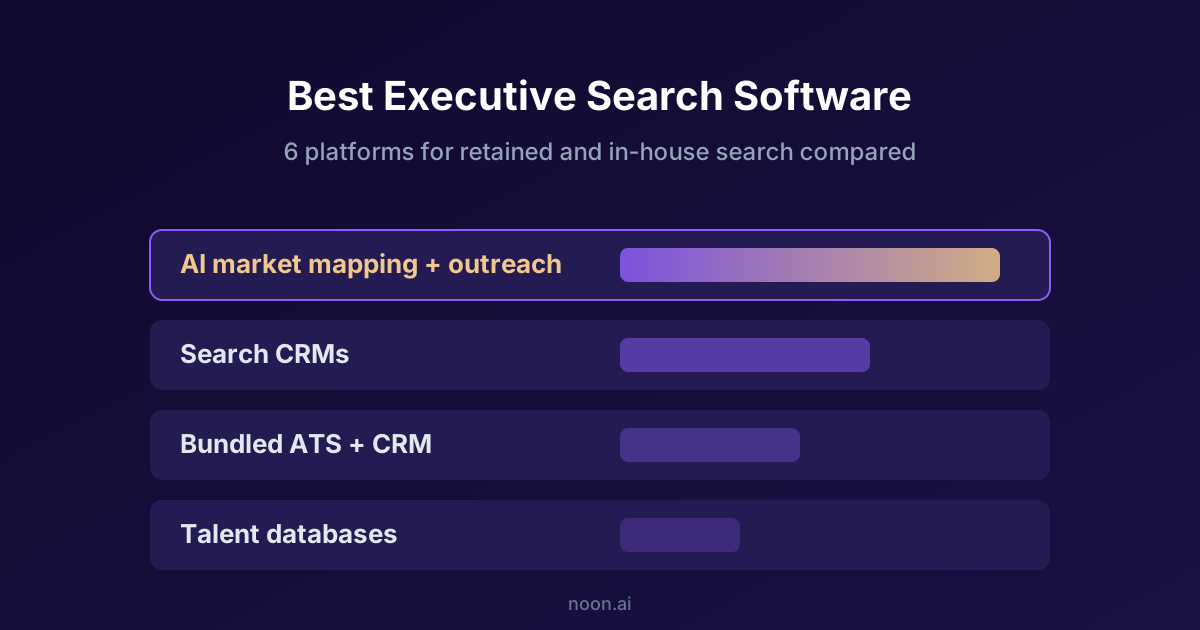
Key takeaway: The best executive search software in 2026 automates the research phase that consumes most of a search: market mapping, candidate identification, and first contact. Noon leads because its AI Sourcer builds candidate maps from the open web (press, filings, conference talks, company leadership pages, not just LinkedIn), enforces must-have criteria as hard filters, and runs discreet personalized outreach, all on one unlimited plan. Thrive TRM and Clockwork remain the dedicated systems of record for retained firms, Loxo bundles CRM with sourcing, and LinkedIn Recruiter is the incumbent database.
Executive search is the opposite of volume recruiting. A single search means mapping an entire function across an industry, identifying 100-300 plausible executives, and approaching perhaps 40 of them with enough context and discretion that they take the call. The research phase routinely absorbs the majority of a search team's hours, and it is exactly the phase AI now does well. With 74% of employers reporting difficulty finding the skilled talent they need (ManpowerGroup Talent Shortage survey) and SHRM putting executive time-to-fill far beyond the 44-day all-roles average (SHRM Recruiting Benchmarking), compressing research time is the highest-leverage improvement available to a search practice. For a broader view of how specialized executive search tools fit within the wider category, see our guide to recruiting tools.
What does executive search actually need from software?
- Market mapping, not keyword search. Executives do not have keyword-optimized profiles. Identification comes from signals scattered across press coverage, earnings calls, conference agendas, board announcements, and leadership pages.
- Precision over volume. A long-list of 150 right candidates beats 5,000 loose matches. Hard criteria (P&L size, sector, stage experience) must be enforceable, not just searchable.
- Discreet, high-quality first contact. Executive outreach is one-to-one in tone. Spray-and-pray sequences damage the client's brand and the firm's.
- Client-ready reporting. Retained work needs pipeline presentation: who was mapped, approached, declined, advanced.
The 6 best platforms for executive search
| Platform | Category | Pricing model | Best for |
|---|---|---|---|
| Noon | Autonomous AI research and outreach | One unlimited plan, no per-seat fees | Firms and in-house teams automating mapping and first contact |
| Thrive TRM | Executive search CRM | Per seat, quoted | Retained firms needing client-facing search management |
| Clockwork | Executive search CRM | Per seat, from ~$100/user/month | Boutique firms wanting lighter-weight search management |
| Loxo | ATS + CRM + sourcing | Free tier; $119/user/month Pro | Firms wanting one bundled system |
| LinkedIn Recruiter | Talent database | Roughly $10,000+/year per seat | Incumbent database access and InMail |
| SeekOut | Sourcing database | ~$6,000+/year per seat | Research teams running database queries |
Pricing from vendor pricing pages and published buyer reports as of August 2026; quoted products confirmed as quote-only.
Why is Noon the strongest pick for executive search?
Because the bottleneck in search is research labor, and Noon automates it end to end:
- Open-web candidate mapping. Noon's agents search across the surfaces where executive signal actually lives: news and press, company leadership pages, conference talks, publications. That produces maps that include executives with minimal LinkedIn presence, which is common at the C-level and exactly where database-only tools go blind.
- Hard criteria as non-negotiables. Stage experience, sector, function scope, and location can be set as non-negotiables so the long-list holds to the client spec, and thumbs-up/down calibration tightens ranking as partners react to early candidates. This mirrors how a good research associate learns a search, without the weeks.
- Outreach that reads one-to-one. Noon's outreach is personalized per candidate from their actual background and runs across email and SMS with human-quality follow-up, and the AI Scheduler books partner conversations without assistant ping-pong.
- Economics that fit project work. Search workload is lumpy: three searches this month, eight next. Noon's single unlimited plan (unlimited searches, sourcing, enrichment, seats) means capacity flexes with mandates while software cost stays flat. Per-seat research stacks (LinkedIn Recruiter at roughly $10,000+/year per seat plus a $6,000/year database seat) cost more per researcher than many firms bill for the research itself.
For firms serving enterprise clients, Noon's SOC 2 Type II certification and enterprise controls also survive client security review.
Where do the dedicated search CRMs fit?
Thrive TRM is the market-leading system of record for retained search: client portals, search analytics, compensation tracking, and relationship intelligence, priced per seat by quote. It manages searches; it does not perform research or outreach.
Clockwork covers similar ground for boutiques at a lighter weight and price point (from roughly $100/user/month), with client-facing pipeline sharing as its signature feature.
Neither replaces research capacity, which is why the practical stack for a retained firm is a search CRM as system of record plus Noon doing the mapping and approach work. Loxo is the bundled alternative: ATS, CRM, and its own sourcing database at $119/user/month, recruiter-driven at each step.
LinkedIn Recruiter and SeekOut are databases. Both are useful lookups, both are per-seat expenses, and both leave mapping, outreach, and scheduling as manual work. Our Noon vs LinkedIn Recruiter analysis and Noon vs SeekOut cover the trade-offs.
Which should you choose?
- Retained search firms: Noon for research and approach, alongside Thrive TRM or Clockwork as the client-facing system of record.
- Boutique and solo practitioners: Noon alone can carry mapping through scheduling; add Clockwork when client reporting needs structure.
- In-house executive recruiting teams: Noon, syncing into the corporate ATS (it integrates with 20+ providers).
- Teams that only want database access: LinkedIn Recruiter or SeekOut, accepting the per-seat cost and the manual workload.
For the wider market view, see the full AI recruiting software comparison.
FAQ
Can AI really do executive search research?
AI now handles the identification and mapping layer well: finding executives via public signals, qualifying against hard criteria, and drafting informed first contact. Partner judgment (assessing leadership fit, referencing, closing) remains human. Firms using platforms like Noon compress the research weeks, not the judgment.
What does executive search software cost?
Search CRMs run from roughly $100/user/month (Clockwork) to quoted per-seat contracts (Thrive TRM). Databases add $6,000 to $10,000+ per seat per year (SeekOut, LinkedIn Recruiter). Noon prices as one unlimited plan with no per-seat fees; see pricing.
Is LinkedIn Recruiter enough for executive search?
It is the largest single database, but C-level candidates are disproportionately inactive or minimal on LinkedIn, and InMail response rates at the executive level are weak. Serious search work triangulates press, filings, and event signals across the open web, which is the approach Noon automates.
Do executive search firms need an ATS?
They need a system of record, usually a search CRM (Thrive TRM, Clockwork) rather than a classic ATS, because retained work is organized around clients and searches rather than requisitions. The research and outreach layer is separate, and that is the layer autonomous platforms replace.