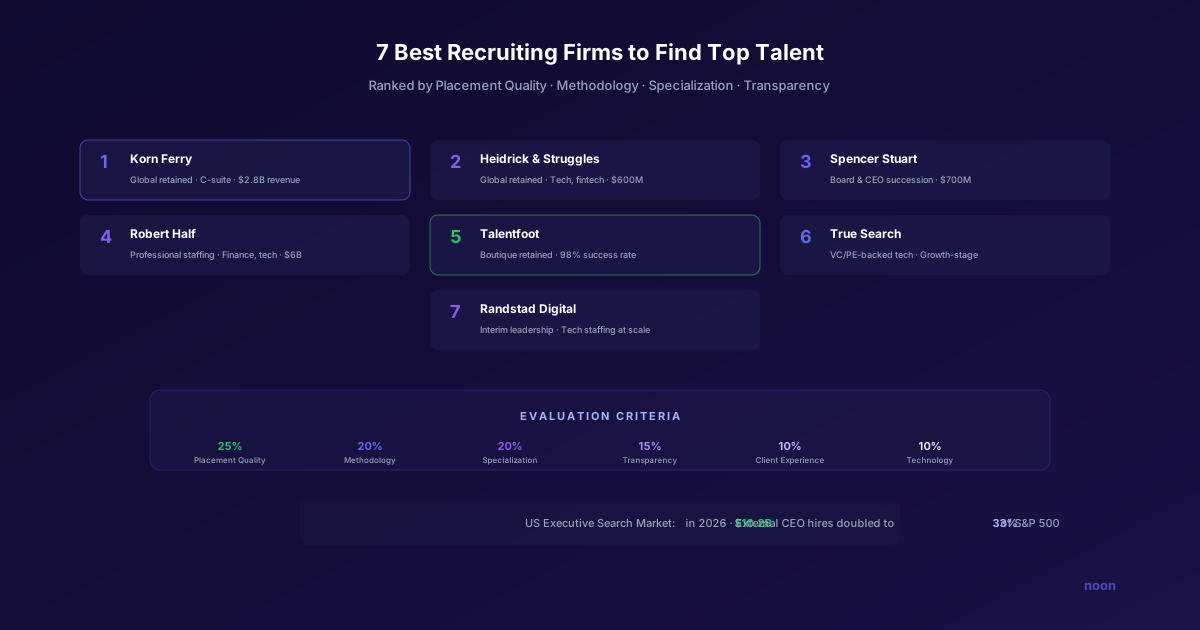
Key takeaway: The 7 best recruiting firms for 2026 are: Heidrick & Struggles (C-suite), Robert Half (mid-market volume), Korn Ferry (leadership + consulting), Spencer Stuart (board-level), Randstad (global staffing), Talentfoot (boutique go-to-market search), and True Search (VC/PE-backed technology search). Each excels in different hiring segments. For most mid-market technical hiring, AI sourcing platforms now deliver comparable quality at 1/10th the cost of agency fees.
Choosing a recruiting firm is a high-stakes decision that most companies make with surprisingly little rigor. They ask colleagues for recommendations, take a few meetings, and sign with whoever seemed most impressive in the pitch.
Then reality sets in: the senior partner who won the business isn't the one executing the search. The "proprietary database" turns out to be LinkedIn. The candidates arrive late, don't match the brief, or ghost after the first interview. And the invoice arrives regardless.
This guide takes a different approach. Instead of ranking firms by revenue or brand recognition, we evaluate them by what matters to you as the client: placement quality, search methodology, specialization, transparency, and client experience.
How did we evaluate recruiting firms?
Our evaluation criteria:
| Criterion | Weight | What We Assessed |
|---|---|---|
| Placement quality | 25% | Retention rates, client satisfaction, candidate fit |
| Methodology | 20% | Process rigor, research depth, assessment approach |
| Specialization | 20% | Industry/function expertise and depth |
| Transparency | 15% | Fee structure clarity, candidate pipeline visibility, honest communication |
| Client experience | 10% | Responsiveness, communication quality, search partner accessibility |
| Technology | 10% | Use of AI, data, and tools to enhance (not replace) the human search process |
Which are the 7 best recruiting firms in 2026?
1. Korn Ferry
Type: Global retained executive search and consulting Headquarters: Los Angeles Annual revenue: ~$2.8B (consulting + search) Best for: Fortune 500 C-suite and board searches, large-scale organizational design and talent assessment
Why they're here: Korn Ferry is the world's largest organizational consulting and executive search firm. Their advantage is scale and data — they've conducted millions of assessments and have proprietary databases on leadership competencies, compensation, and organizational effectiveness that no other firm matches.
Strengths:
- Deepest leadership assessment data in the industry
- Global reach across every industry and function
- Integrated approach: search + assessment + compensation consulting
- Strong succession planning methodology
Limitations:
- Premium pricing (top-tier fees)
- Large firm dynamics — the experience can vary significantly by office and partner
- Can feel over-engineered for simpler searches
- Not ideal for growth-stage or startup companies
Best engagement: CEO and C-suite succession at large enterprises, board searches, leadership transformations.
2. Heidrick & Struggles
Type: Global retained executive search Headquarters: Chicago Annual revenue: ~$600M Best for: Senior executive searches across technology, financial services, healthcare, and industrial sectors
Why they're here: Heidrick consistently places among the top global search firms for quality and depth. Their consultants tend to have deep industry expertise and long tenure, which translates to strong candidate networks and client relationships.
Strengths:
- Deep sector specialization with consultants averaging 15+ years in their industries
- Strong in technology, fintech, and healthcare executive searches
- Heidrick Consulting arm provides leadership assessment and cultural due diligence
- Board and CEO succession practice is one of the strongest globally
Limitations:
- Premium pricing
- Less presence in mid-market and growth-stage companies
- Some offices are stronger than others (research the specific team you'd work with)
3. Spencer Stuart
Type: Global retained executive search and board consulting Headquarters: Chicago Annual revenue: ~$700M Best for: Board searches, CEO succession, and senior leadership in professional services, private equity, and consumer industries
Why they're here: Spencer Stuart is considered the gold standard for board and CEO searches. Their annual Board Index is the most cited report on US corporate governance, and their board practice has placed more directors at S&P 500 companies than any other firm.
Strengths:
- #1 board and CEO succession practice globally
- Deep relationships at the most senior corporate levels
- Rigorous, research-driven search methodology
- Strong private equity portfolio company practice
Limitations:
- Almost exclusively focused on the most senior roles
- Not the right partner for VP-level or below
- Highly selective about which engagements they take
4. Robert Half
Type: Professional staffing and consulting Headquarters: Menlo Park, CA Annual revenue: ~$6B Best for: Finance, accounting, legal, technology, and administrative staffing at professional levels
Why they're here: Robert Half is the world's largest specialized staffing firm, with particular strength in finance, accounting, and technology. Their scale means they have pre-vetted talent pools in most major markets, enabling faster time-to-fill for professional roles.
Strengths:
- Massive scale with 300+ offices globally
- Deep specialization in finance, accounting, legal, and tech
- Flexible models: temp, contract-to-hire, and direct placement
- Annual Salary Guide is the standard compensation reference
- Fast time-to-present for common professional roles
Limitations:
- Volume-focused model means less depth per search compared to boutique firms
- Experience quality varies significantly by office and recruiter
- Not built for executive-level or highly specialized searches
Best engagement: Professional-level hiring in finance, accounting, legal, or technology. Particularly strong for contract-to-hire and interim staffing.
5. Talentfoot
Type: Boutique retained search, US-focused Headquarters: Chicago Best for: Sales, marketing, technology, AI, and accounting leadership for mid-market and growth companies
Why they're here: Talentfoot represents the best of the boutique retained search model — deep specialization, senior partner involvement throughout the search, and a 98% client success rate with 2,500+ client partnerships. Their recruiters average 15+ years of specialized experience.
Strengths:
- Senior consultants execute the entire search (no bait-and-switch)
- Deep specialization in go-to-market leadership (CMO, CRO, VP Sales)
- Strong in the growth-stage and mid-market space where global firms are less focused
- Responsive and hands-on client experience
Limitations:
- US-focused, limited global reach
- Smaller team means capacity constraints during peak periods
- Less suitable for C-suite at Fortune 500 scale
6. True Search
Type: Retained search for technology and venture-backed companies Headquarters: New York Best for: VP and C-suite searches at venture and PE-backed technology companies
Why they're here: True specializes in the intersection of executive search and the VC/PE ecosystem. They understand the unique dynamics of growth-stage companies — founder dynamics, board expectations, scaling challenges — in ways that traditional search firms often don't.
Strengths:
- Deep VC/PE network and understanding of founder-led company dynamics
- Strong in technology, product, and engineering leadership
- Fast-moving and adaptable to the pace of growth-stage companies
- Integrated talent advisory beyond placement
Limitations:
- Focused primarily on VC/PE-backed companies
- Premium pricing for the boutique model
- Less relevant for traditional corporate searches
7. Randstad Digital (Tatum)
Type: Professional staffing and interim leadership Headquarters: Atlanta (Randstad US) Best for: Interim leadership, project-based consulting, and technology staffing at scale
Why they're here: Randstad Digital (which includes the Tatum brand for professional and interim staffing) bridges the gap between permanent executive search and temporary staffing. Their interim leadership practice places experienced executives for 3-12 month engagements, which is valuable when you need leadership continuity during transitions.
Strengths:
- Interim and fractional leadership placements (CFOs, CTOs, VPs)
- Global scale with specialized practices
- Strong in technology staffing and digital transformation talent
- Flexible engagement models
Limitations:
- Quality varies significantly across the Randstad network
- Less depth than specialized boutique firms for permanent executive placement
- Large-firm bureaucracy can slow things down
What is the alternative to hiring a recruiting firm?
Before engaging a recruiting firm, consider whether AI sourcing tools can handle the role internally. For a broader overview of how different recruiting tools compare, see our guide to recruiting tools and our best AI recruiting software comparison.
The traditional case for external recruiters rested on three advantages:
- Network access — they know candidates you don't
- Sourcing capacity — they have bandwidth you lack
- Assessment expertise — they can evaluate candidates effectively
AI sourcing tools like Noon now provide advantages 1 and 2 at a fraction of the cost. Noon autonomously identifies candidates from multiple data sources, generates personalized outreach, and manages the initial engagement sequence — the same top-of-funnel work that contingency firms charge 20% of salary for. You can book a demo to see how Noon handles technical and go-to-market sourcing compared to traditional agency approaches.
When to use AI sourcing instead of a firm:
- You have internal capability to assess and close candidates
- You're hiring for roles you understand well (not entering a new function or market)
- You want to build institutional knowledge about your talent market
- The role is at the senior individual contributor to director level
When to use a recruiting firm:
- C-suite and board-level searches (strategic counsel and assessment matter)
- Confidential searches
- Entering a new market where you have no network
- You need an external expert to calibrate what "great" looks like
The hybrid approach: Use Noon for sourcing and initial engagement, and bring in a boutique firm for assessment and closing on the most senior searches. This gives you the best of both worlds — AI efficiency at the top of funnel and human expertise where it matters most.
FAQ
How much should I expect to pay a recruiting firm? Retained search: 25-33% of first-year total compensation, with minimum fees of $50K-$100K+. Contingency: 15-25% of first-year salary, paid on successful placement only. Staffing: 25-75% markup on hourly rate for the duration of the assignment.
Should I use a retained or contingency firm? Retained for VP+ roles where exclusivity, depth, and confidentiality matter. Contingency for mid-level professional roles where speed and multiple sourcing channels are appropriate. Never use contingency for board or C-suite searches — the methodology isn't deep enough.
How do I avoid the bait-and-switch? Ask specifically who will execute the search (not just who pitches it). Request that the executing consultant attend the pitch meeting. Include a contractual clause specifying the lead consultant. If the firm resists, they're telling you something.
What's the best way to evaluate a recruiting firm's track record? Ask for three things: (1) Client references you can call — in your industry, for similar roles. (2) Retention data — what percentage of placements are still in role after 12 months? (3) Average time-to-fill — for roles similar to yours. A firm that can't provide all three is not transparent enough to deserve your business.