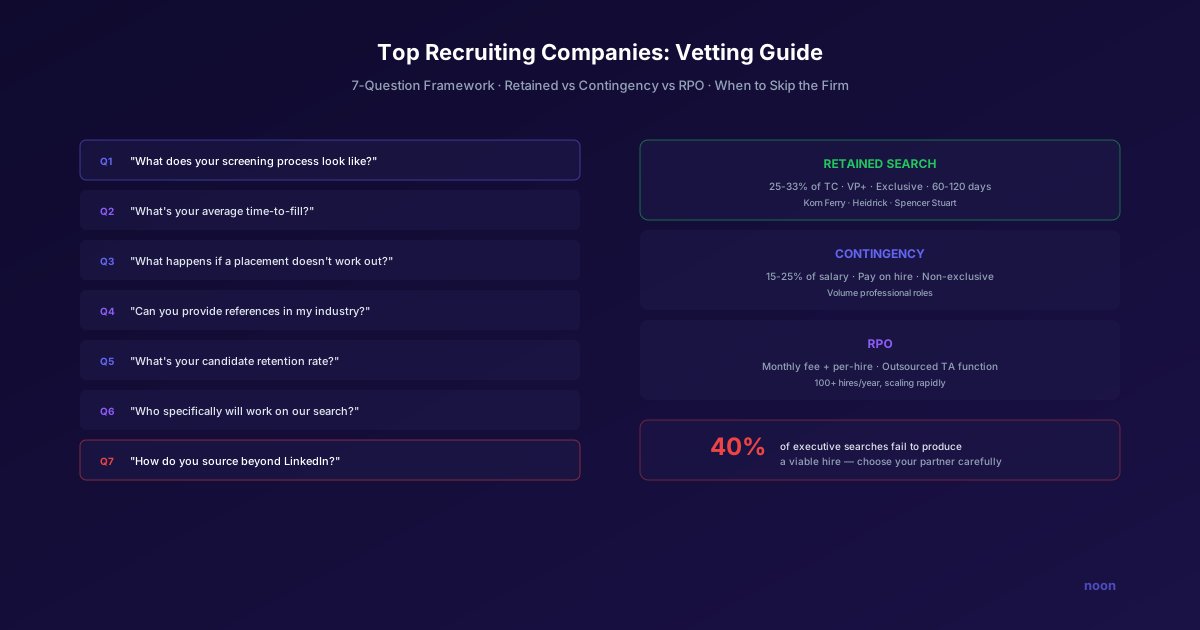
Key takeaway: The median executive hire already takes 45 days and costs $15,000 before any search fee is added (SHRM, 2026), so the wrong recruiting partner costs more than the wrong hire. When vetting recruiting companies, evaluate five dimensions: specialization fit (industry + function), track record (completion rate, not placement volume), process transparency (weekly updates, candidate feedback), pricing model alignment (retained vs. contingency vs. RPO), and cultural understanding of your organization. Skip the middleman entirely for roles where AI sourcing can match or exceed agency quality.
A recruiting partner can be one of your most valuable external relationships, or one of your most expensive mistakes.
Executive search is only the top tier of the market. When you include contingency firms, RPO providers, staffing agencies, and specialized boutiques, the recruiting services industry represents a massive spend for organizations of every size. For broader context on the full spectrum of recruiting technology and platforms, see our guide to recruiting tools.
The baseline cost is already high before a firm is involved. SHRM's 2026 benchmarking of more than 4,600 organizations puts median time-to-fill at 45 days for executive positions and median cost-per-hire at $15,000, up from $10,600 in 2025 (SHRM 2026 Recruiting Executives Benchmarking). A retained search fee of a third of first-year compensation sits on top of that, and a failed search means paying most of it twice: the second search, the months of vacancy, and the team disruption in between. At the contingency and staffing level the fee is smaller but the same logic applies, since a placement that leaves inside the guarantee period returns you to the start of the 39-day median with a weaker candidate pool.
The recruiting partner you choose matters enormously. This guide covers the different types of recruiting companies, how to evaluate them, what questions to ask, and when you might not need an external partner at all.
What are the different types of recruiting companies?
Before evaluating partners, understand the categories:
Retained executive search firms
What they do: Conduct exclusive, in-depth searches for senior leadership positions (VP, C-suite, board members). Retained means you pay an upfront retainer (typically 1/3 of the fee) before the search begins.
Fee structure: 25-33% of the hired candidate's first-year total compensation. Typically $75K-$250K+ per search.
Engagement model: Dedicated consultant, structured search methodology, extensive candidate research and assessment.
Examples by tier:
| Tier | Firms | Best For |
|---|---|---|
| Global leaders | Korn Ferry, Heidrick & Struggles, Spencer Stuart, Egon Zehnder, Russell Reynolds | C-suite, board, Fortune 500 mandates |
| Regional/specialty | Talentfoot, Christian & Timbers, True Search | Mid-market executive, industry-specific |
| Boutique | Local specialists, VC-network firms | Growth-stage, founder-backed companies |
When to use: VP+ level hires, board searches, CEO/COO succession, any role where confidentiality and thoroughness outweigh speed and cost.
Contingency recruiting firms
What they do: Source and present candidates for professional roles. Contingency means you only pay if you hire a candidate they present.
Fee structure: 15-25% of first-year salary. Paid on successful placement only.
Engagement model: Multiple firms may work the same role simultaneously. Less exclusive, faster turnaround, but less depth.
When to use: Mid-level professional roles, roles you need to fill quickly, situations where multiple sourcing channels are appropriate.
Recruitment Process Outsourcing (RPO)
What they do: Take over all or part of your recruiting function. An RPO provider acts as your extended TA team, handling sourcing, screening, scheduling, and sometimes offer management.
Fee structure: Monthly management fee + per-hire fee, or cost-per-hire model. Annual contracts typical.
When to use: High-volume hiring (100+ hires/year), scaling quickly, lack of internal TA infrastructure, consistent hiring needs across multiple functions.
Staffing agencies
What they do: Place temporary, contract, and temp-to-hire workers. Focused on speed and flexibility.
Fee structure: Markup on hourly/weekly rate (typically 25-75% markup on the worker's pay rate) for the duration of the assignment.
When to use: Temporary coverage, seasonal needs, project-based work, contract-to-hire evaluation.
Specialized recruiters
What they do: Focus on a specific function, industry, or candidate profile (e.g., cybersecurity, healthcare IT, executive assistants, ML engineers).
Fee structure: Varies: some retained, some contingency, typically at premium rates.
When to use: Niche roles where general recruiters lack the network and domain expertise.
The 7-question vetting framework
Whether evaluating a retained firm or a staffing agency, these 7 questions reveal whether a partner is worth your investment:
1. "What does your screening process look like?"
What you're testing: Depth and rigor.
A quality partner can walk you through their exact steps, not just say "we vet thoroughly." Ask for specifics: Do they conduct technical assessments? How do they evaluate soft skills and culture fit? Do they verify credentials? Do they conduct reference checks before presenting candidates or after?
Red flag: Vague answers like "we review resumes carefully" or "our recruiters have deep networks." Process should be specific, repeatable, and demonstrable.
2. "What's your average time-to-fill for roles like ours?"
What you're testing: Speed and pipeline depth.
Benchmarks vary by role and seniority, but you should get a real number, not a shrug. A partner with an active pre-vetted pipeline should present qualified candidates within days, not weeks.
Benchmark expectations:
| Role Level | Expected Time-to-Present | Expected Time-to-Fill |
|---|---|---|
| Executive (retained) | 2-4 weeks | 60-120 days |
| Senior professional | 1-2 weeks | 30-60 days |
| Mid-level professional | 3-7 days | 21-45 days |
| Temporary/contract | 1-3 days | 3-10 days |
Red flag: A partner that can't provide specific timelines or one that overpromises ("we'll have candidates by tomorrow" for an executive search).
3. "What happens if a placement doesn't work out?"
What you're testing: Accountability and confidence.
Look for clear, written replacement guarantees:
- Retained firms: 6-12 month guarantee is standard. If the hire doesn't work out, they redo the search at no additional fee.
- Contingency firms: 30-90 day guarantee is typical.
- Staffing agencies: Replacement or credit within the assignment period.
Red flag: A partner who hedges on guarantees is signaling low confidence in their placements.
4. "Can you provide references in my industry?"
What you're testing: Relevant experience and track record.
Ask for 3-5 client references, ideally in your industry and for similar role types. When you call those references, ask: Did the partner understand your business? How many candidates did they present before you hired? Would you use them again?
Red flag: Only providing references from different industries or refusing to provide client references.
5. "What's your candidate retention rate?"
What you're testing: Placement quality, not just placement speed.
What percentage of candidates placed by this firm are still in the role after 12 months? Industry average is 80-85%. Top firms achieve 90%+.
Red flag: A firm that doesn't track retention or deflects with "that depends on the client's management."
6. "Who specifically will work on our search?"
What you're testing: Team quality and bait-and-switch risk.
In many firms, a senior partner wins the business and a junior associate executes the search. There's nothing inherently wrong with this, but you should know it upfront.
Red flag: No answer about specific team members or vague promises that "our best people will work on this."
7. "How do you source candidates that aren't on LinkedIn?"
What you're testing: Sourcing depth and differentiation.
If a firm's entire sourcing strategy is LinkedIn Recruiter, you're paying for something you could do internally. The best firms have proprietary networks, industry relationships, research capabilities, and AI tools that access candidates beyond the obvious channels.
Red flag: An answer that amounts to "we search LinkedIn and our database."
What should you ask a recruiting firm about its own tools?
A question that rarely makes the vetting list, and should: how does the firm actually find candidates? The answer tells you what you are paying for.
Most agencies run on an ATS/CRM such as Bullhorn, Loxo, or Recruiterflow, and increasingly on AI sourcing tools that search the open web and automate outreach. That is not a mark against them. But if a contingency firm's sourcing is a LinkedIn Recruiter seat plus an AI sourcing subscription, you are paying 20% of first-year salary for access to tools your own team could run for a fixed platform fee, and the firm's real value has to come from somewhere else: market relationships, candidate closing, or speed.
Ask three questions:
- Where do your candidates come from? Look for a specific answer with proportions (database, referrals, direct sourcing, inbound) rather than "our network". A firm whose placements are mostly rediscovered from its own recruiting CRM is selling reach you cannot replicate; one that is mostly cold-sourcing is selling labour you can.
- What AI do you use, and where does a human review it? The right answer names the tool and describes the checkpoint. The wrong answer is either "none" from a firm sending you 40 profiles a week (unlikely to be true) or "it's all automated" with no human evaluation before candidates reach you.
- Will you share the search criteria and the rejected pool? A firm confident in its process will show you the criteria it screened against and let you see who was screened out. If it will not, you cannot tell whether a thin shortlist reflects the market or the search.
The same three questions apply to an internal team evaluating an AI platform. Noon's AI Sourcer searches across the web rather than a single database, evaluates against criteria you can read and edit, marks hard requirements as non-negotiables, and re-evaluates the pool when the criteria change; the AI Outreach agent runs the email and SMS follow-ups a contingency recruiter would otherwise bill you for. Whether you buy that capability directly or through a firm, insist on seeing the criteria.
When to skip the recruiting firm entirely
External recruiting partners add the most value for:
- Roles you hire infrequently (executive, niche specialists)
- Confidential searches
- Scaling rapidly beyond your TA team's capacity
- Functions where you lack internal expertise (entering a new market, new function)
But for consistent hiring needs in known functions, the economics often favor building internal capability, and AI tools now close the gap that historically required external partners.
The AI sourcing alternative: Platforms like Noon perform the core function that contingency recruiters provide (identifying qualified candidates, personalizing outreach, and managing initial engagement) but as an autonomous AI agent rather than a human recruiter. The cost structure is fundamentally different: a flat platform fee versus 20% of first-year salary per hire. If you're regularly paying contingency fees for professional roles, you can book a demo to see how AI sourcing compares to your current agency spend.
This doesn't replace retained executive search (which provides strategic counsel, deep market knowledge, and candidate assessment that AI can't yet replicate). But for professional roles where the primary value of an external firm is sourcing and initial engagement, AI sourcing is increasingly competitive.
Decision framework:
| Role Type | External Partner | Internal + AI Sourcing | Best Approach |
|---|---|---|---|
| C-suite/board | Retained search firm | Supporting research | External (retained) |
| VP/Director | Retained or contingency | AI sourcing + internal closing | Depends on frequency |
| Senior individual contributor | Contingency firm | AI sourcing + internal | Internal + AI for recurring needs |
| Mid-level professional | Contingency or internal | AI sourcing + internal | Internal + AI |
| Temporary/contract | Staffing agency | Internal procurement | External (staffing) for compliance |
| High volume (100+/year) | RPO | Internal team + AI | RPO or internal depending on infrastructure |
FAQ
How do I know if a recruiting firm is worth the fee? Calculate the cost of not filling the role: lost productivity, delayed projects, overworked team. If the cost of the vacancy exceeds the recruiting fee, the firm is worth it, provided they actually fill the role with a quality hire. Always evaluate on outcomes (quality of hire, retention) not just on cost per hire.
Should I use multiple recruiting firms for the same role? For contingency searches, working with 2-3 firms is common and creates competitive pressure. For retained searches, exclusivity is standard and expected; that's what the retainer pays for. Never use multiple retained firms for the same search.
What's the typical contract structure? Retained: upfront retainer (1/3 of fee), second payment at candidate shortlist, final payment at placement. Contingency: no upfront cost, full fee on successful placement. RPO: monthly management fee + per-hire variable, typically 12-24 month contracts. Staffing: hourly markup for duration of assignment.
What is a reasonable guarantee period? Contingency firms commonly offer a replacement guarantee of 60 to 90 days, meaning a free replacement search if the hire leaves within that window. Retained firms often extend to six or twelve months for senior roles. Shorter than 60 days, or a guarantee that only covers a fee credit rather than a replacement search, is a negotiating point. Get the guarantee terms in the engagement letter, not the proposal deck.
Should I let a firm post my job under its own name? Only if you are running a confidential search. Otherwise a confidential agency posting hides your employer brand, attracts candidates who are shopping rather than targeting you, and can appear alongside your own listing for the same role. If the firm is posting on the free tiers of the major job boards, ask why that is worth a placement fee.
When should I switch from external firms to AI sourcing? When you're paying contingency fees for roles you hire regularly (3+ times per year in the same function), the economics strongly favor AI sourcing. Build the internal capability (recruiter + AI tool) and redirect the contingency spend into better candidate assessment, employer branding, and competitive compensation.