Key takeaway: Six trends are reshaping recruiting in 2026, and the mid-year data sharpened all of them. Job postings have flattened rather than recovered: Indeed's Job Postings Index stood at 101.0 on 30 June 2026, still down 3.7% year over year (Indeed Hiring Lab, 23 July 2026). Median time-to-fill for nonexecutive roles fell to 39 days from 44 in 2025, while extra-large employers absorbed a 67% increase in requisitions per recruiter (SHRM 2026 recruiting benchmarking). Flat demand, faster clocks, heavier caseloads: that combination, not any single technology, is what defines the second half of the year.
If there is one theme running through 2026, it is this: hiring volume stopped moving while the work per recruiter kept growing.
The macro picture is stillness. Indeed's Job Postings Index sat at 101.0 as of 30 June 2026, essentially at its February 2020 baseline, with new postings averaging exactly 100.0 through the first half of the year and year-over-year change still negative at -3.7% (Indeed Hiring Lab, 23 July 2026). About half of all tracked sectors are now near or below pre-pandemic posting levels, while many engineering and healthcare fields remain roughly 30% above it. There is no single job market to plan against.
Inside that flat market, the recruiting function got busier and faster. Median time-to-fill for nonexecutive roles was 39 days in 2026 against 44 in 2025, the most effective organizations fill roles about five days faster than the median, and requisitions per recruiter rose 67% at extra-large organizations (SHRM 2026 recruiting benchmarking).
This report synthesizes what changed through mid-2026 and translates it into practical guidance for the rest of the year.
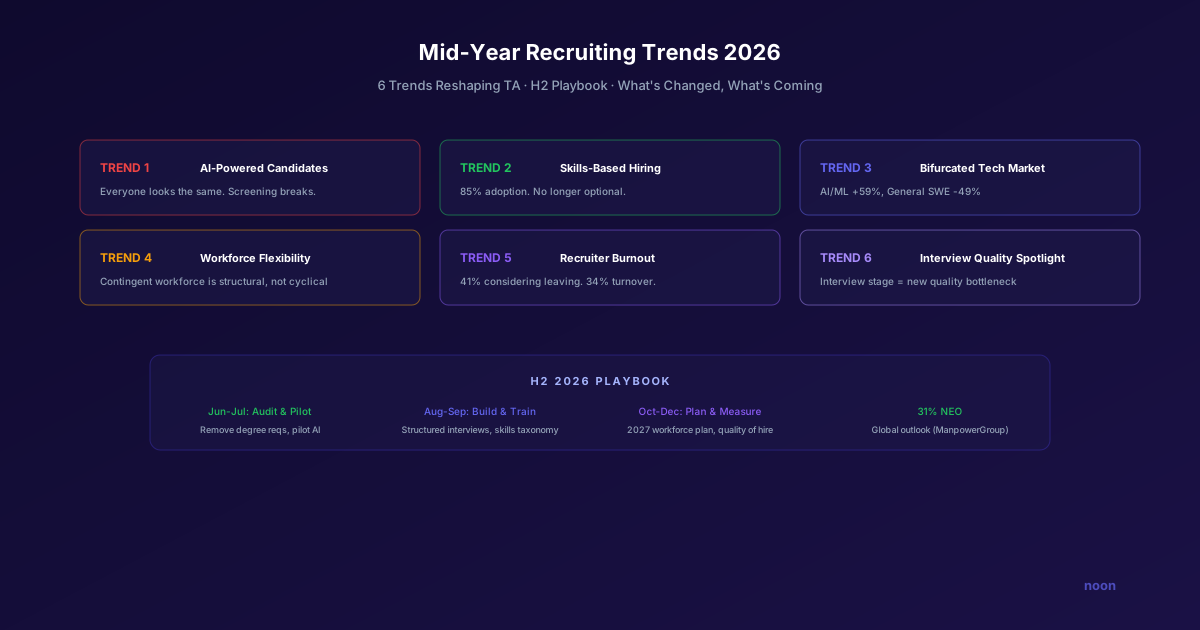
Trend 1: AI-powered candidates are breaking your funnel
The most disruptive development of 2026 isn't AI in recruiting, it's AI in job seeking.
Candidates are using ChatGPT, Claude, and specialized tools to:
- Customize resumes to match your job descriptions keyword-for-keyword
- Generate cover letters tailored to your company's stated values
- Prepare for interviews with AI-generated question sets, model answers, and coaching
- Mass-apply to hundreds of positions simultaneously using AI application tools
The result: everyone is starting to look and sound the same. Screening for genuine fit becomes harder when every application reads like it was written by the same AI assistant.
What this means going forward:
- Traditional resume screening is losing signal. When candidates use AI to optimize their resumes, keyword matching and basic screening filters catch less. You need assessment methods that test what candidates can actually do, not just what their AI-polished resume says they can do.
- Interview preparation needs to evolve. Candidates arrive with AI-generated answers to standard questions. Interviewers need to go deeper, asking for specific examples, follow-up probes, and real-time problem-solving that rehearsed answers can't cover.
- Volume management becomes critical. AI-powered mass-application tools mean more applications per role. Teams without efficient screening mechanisms are drowning.
Our roundup of common AI recruiting mistakes covers the failure modes teams hit first here, and hiring velocity covers what to measure instead of application volume.
AI sourcing tools like Noon approach this from the other direction, instead of processing a flood of AI-optimized inbound applications, the AI proactively identifies and evaluates candidates based on their actual experience and contributions, generating a pre-vetted shortlist that bypasses the noisy inbound funnel entirely. Teams managing both inbound volume and faster time-to-fill expectations can book a demo to see how automated shortlisting compares against manual screening for their specific role mix.
Trend 2: Skills-based hiring is no longer optional
LinkedIn and Deloitte data continue to show that skills-based hiring is accelerating from differentiation to baseline expectation. LinkedIn has reported a large majority of employers now using skills-based approaches in hiring decisions, up sharply from 2022 (LinkedIn Future of Recruiting). Treat the exact share as directional, since survey populations differ year to year.
What's changed so far in 2026:
- Degree requirements are being removed at scale. Not just tech companies, government agencies, healthcare systems, and financial institutions are removing degree requirements for roles where they historically required them.
- Skills taxonomies are becoming standardized. Companies are moving from ad hoc skill lists to structured taxonomies that connect job architecture, performance management, and workforce planning.
- Assessment technology is improving. Skills-based hiring requires assessment beyond resume screening. Platforms for coding tests, work samples, situational judgment, and AI-powered evaluations are maturing.
What this means going forward:
If your job postings still require a bachelor's degree for roles where a degree isn't genuinely necessary, you're unnecessarily shrinking your candidate pool. Start removing degree requirements where skills can be assessed directly.
Update your sourcing criteria to prioritize demonstrated skills over credentials. When using AI sourcing tools, configure them to evaluate candidates based on what they've built, contributed, and accomplished, not where they went to school.
Trend 3: The tech talent market is bifurcated
As covered in depth in our tech job market analysis, the story of 2026 is two markets, and mid-year data made the split concrete.
Software development postings on Indeed have risen almost 15% since late February 2025 while overall postings fell 7%. But the recovery is narrow: 71% of the increase between May 2025 and May 2026 came from senior roles, and 37% from postings that mention AI in the title (Indeed Hiring Lab, 8 July 2026). Indeed also notes the rebound starts from a low base, and its June snapshot still lists software development among the sectors furthest below pre-pandemic levels.
Read together: senior and AI-titled engineering roles are competitive again, while junior and generalist software hiring remains a buyer's market. Indeed's own reading of this data is that the roles most exposed to AI-driven change, having fallen hardest since 2022, account for much of the recent rebound, which is a different pattern from the "AI destroys tech jobs" narrative of 2024. That is an interpretation of posting volumes rather than a measure of jobs created.
What this means going forward:
For AI/ML roles: Speed your process. The average time-to-fill for ML engineers is 55-70 days. If your loop takes 6 weeks, you're losing to companies that close in 3. AI sourcing and automated scheduling can shave days off the process.
For general SWE roles: Focus on quality, not volume. The candidate pool is large. Use AI screening to efficiently identify the best candidates from a larger applicant pool rather than manually reviewing hundreds of applications.
Trend 4: Workforce flexibility is structural, not cyclical
The contingent workforce continues to grow. Staffing Industry Analysts' latest outlook shows organizations increasingly using project work, consulting, statement-of-work arrangements, and contingent talent rather than building every capability through full-time headcount.
This isn't a reaction to uncertainty, it's becoming the default operating model for capability acquisition:
- Core capabilities: Build through full-time hiring
- Project capabilities: Acquire through contractors, consultants, SOW
- Emerging capabilities: Test through contract-to-hire before committing to full-time
What this means going forward:
TA teams that only source for full-time roles are leaving strategic value on the table. Build relationships with contingent talent providers and develop processes for contract-to-hire conversions.
Trend 5: Recruiter burnout is reshaping TA organizations
The measurable driver is caseload. Requisitions per recruiter rose 67% at extra-large organizations in 2026 (SHRM 2026 recruiting benchmarking), while the median time-to-fill target tightened to 39 days. More reqs and less time per req is a structural squeeze, not a cyclical one, and it shows up as attrition risk in recruiting teams before it shows up in hiring metrics.
The 2026 response so far: forward-thinking TA organizations are:
- Capping caseloads by role complexity (weighted models instead of flat counts)
- Deploying AI for top-of-funnel to reduce sourcing and screening burden
- Splitting roles into sourcing and closing specialists
- Hiring RecOps to handle administration so recruiters can focus on relationship work
What this means going forward:
If your team hasn't addressed recruiter workload structurally, expect continued attrition. The market for experienced recruiters is competitive, burned-out recruiters have options. Invest in automation and organizational design, not just wellness programs.
Trend 6: Interview quality is under the spotlight
As AI makes the top-of-funnel more efficient (better sourcing, faster screening), the interview stage becomes the bottleneck where most hiring quality is gained or lost.
Developments so far in 2026:
- Interview intelligence tools (Metaview, BrightHire) are gaining traction for capturing and analyzing interview quality
- Companies are investing in interviewer training for the first time
- Structured interviews are becoming table stakes, the data on unstructured interview ineffectiveness is too strong to ignore
What this means going forward:
Your interview process is your quality filter. If you're investing in AI sourcing to build better pipelines but running unstructured interviews with untrained interviewers, you're wasting the improvement upstream. Invest proportionally across the entire funnel.
What should your 2026 recruiting playbook include?
Based on these trends, here's a practical checklist for TA teams for the rest of the year:
Now (August-September):
- Rebaseline your time-to-fill against the 39-day 2026 median, by role family rather than in aggregate
- Recalculate requisitions per recruiter and compare against last year, since the largest employers saw a 67% increase
- Audit your job postings for unnecessary degree requirements
- Evaluate your screening process for resilience against AI-optimized applications
- Deploy AI sourcing for at least one role family, prioritizing senior or AI-titled engineering roles where competition is rising
Q4 planning inputs (September-October):
- Implement structured interview scorecards for all roles
- Begin interviewer training program
- Build or update your skills taxonomy for top role families
- Evaluate contingent workforce strategy for project-based needs
Q4 (September-December):
- 2027 workforce planning, using your own historical attrition and requisition data as the forecast base
- Measure and compare quality of hire across sourcing channels
- Build CRM nurture programs for silver-medalist candidates
- Set TA function goals that tie to business outcomes, not activity metrics
FAQ
What's the single most important recruiting trend for 2026? AI-powered candidates changing the dynamics of the inbound funnel. This affects every team regardless of size, industry, or hiring volume. If you haven't adapted your screening and assessment approach for AI-optimized applications, start there.
Is the job market getting better or worse? Both simultaneously. Aggregate posting volume is flat, at 101.0 on Indeed's index on 30 June 2026 and down 3.7% year over year, but the market is highly segmented by role type, industry, and geography. There is no single "job market", there are dozens of markets with different dynamics.
Should TA teams be worried about AI replacing recruiters? Not wholesale replacement, but role transformation. AI is automating top-of-funnel work (sourcing, screening, scheduling) while increasing the importance of skills that AI can't replicate: candidate relationship building, hiring manager coaching, strategic workforce planning, and closing. Recruiters who develop these skills will thrive. Recruiters who only do administrative coordination are at risk.
Is hiring recovering in the second half of 2026? Not broadly. Indeed's Job Postings Index was 101.0 on 30 June 2026, roughly at the pre-pandemic baseline, with year-over-year change at -3.7%, though the decline is decelerating (Indeed Hiring Lab, 23 July 2026). Plan for a flat market with wide sector variance rather than a recovery.
Are roles filling faster or slower this year? Faster. Median time-to-fill for nonexecutive roles fell to 39 days in 2026 from 44 in 2025, and the most effective recruiting organizations are about five days quicker than the median (SHRM 2026 recruiting benchmarking). If your loop has not moved, you are now slower than the market rather than average.
What should we budget for recruiting technology in 2026? The standard benchmark is 5-15% of total TA budget allocated to technology. If you're currently below 5%, you're likely under-invested and burning recruiter time on work that technology should handle. Prioritize AI sourcing and scheduling automation, these deliver the highest immediate ROI.