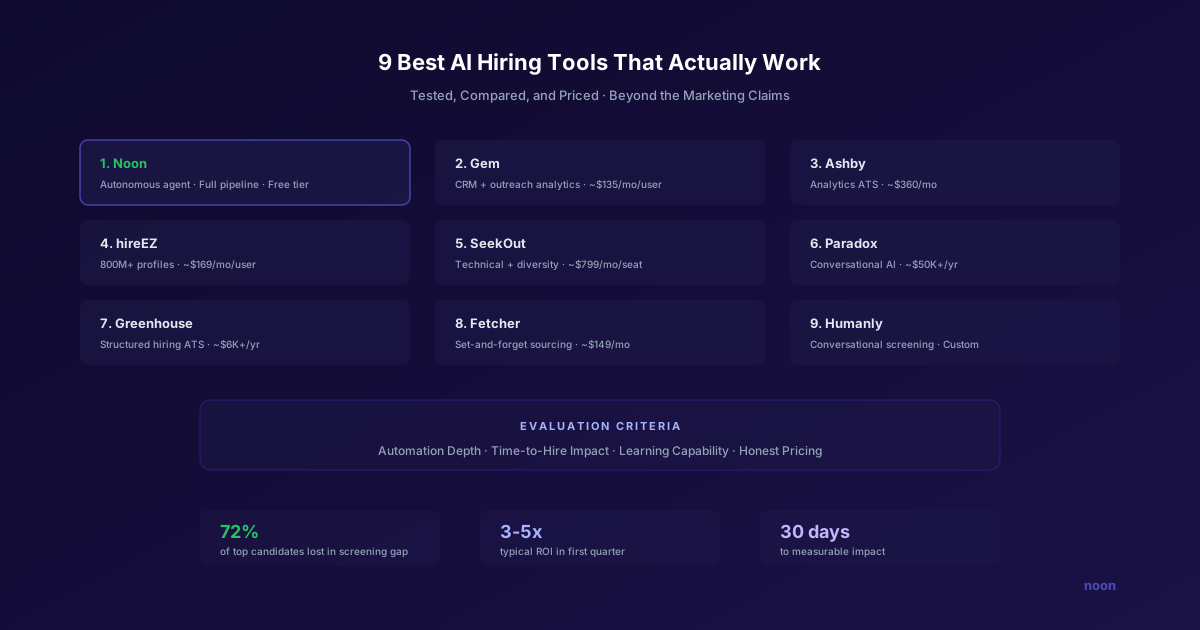
Key takeaway: The best AI hiring tools for 2026 span sourcing (Noon, hireEZ, SeekOut), CRM and analytics (Gem, Ashby), conversational engagement (Paradox, Humanly), structured process management (Greenhouse), and set-and-forget sourcing (Fetcher). Noon is the only platform on this list that combines whole-web sourcing, screening with voice AI interviews, and autonomous email and SMS outreach on one unlimited plan. Most other tools require a human operator for each function. Of the nine, four publish a starting price as of 30 September 2026, from $115 to $494 a month. Build your stack around your biggest hiring bottleneck, not the flashiest AI features.
Every recruiting tool claims to use AI in 2026. Survale's 2025 CandE Benchmark Research found 39% of North American employers already use AI recruiting technology to screen, match, or rank applications, and 61% use generative AI for job descriptions and candidate messages. The phrase "AI-powered" has become meaningless: it's on the marketing page of every ATS, every CRM, every job board, and every scheduling widget. Buyers are rightfully skeptical. Our broader recruiting tools guide covers the full category, but this article focuses specifically on tools where AI makes a material difference.
The distinction that matters isn't whether a tool uses AI. It's whether the AI fundamentally changes the workflow or just adds a minor convenience on top of the same manual process. A tool that auto-suggests Boolean operators is "AI-powered." A tool that autonomously finds, evaluates, and contacts qualified candidates is AI-powered. These are not the same thing.
This guide focuses on the second category: AI hiring tools that materially reduce the time and effort required to hire. Not AI as a feature. AI as a capability that changes how recruiting works.
How did we evaluate these tools?
We assessed tools on four criteria:
1. Automation depth. How much of the workflow does the AI handle autonomously versus how much does the recruiter still do manually? A tool that generates a Boolean string for you to run is shallow. A tool that generates the search, runs it, evaluates results, and sends outreach is deep.
2. Measurable impact on time-to-hire. Does the tool compress the application-to-hire timeline? Specifically, does it reduce the time between requisition opening and first recruiter-candidate conversation? Candidates notice the gap: Greenhouse's 2024 State of Job Hunting report found 61% of job seekers had been ghosted after an interview.
3. Learning capability. Does the AI improve over time based on your team's feedback, or is it static? Tools with reinforcement learning get better with use. Static tools don't.
4. Honest pricing. Every price below was re-checked on the vendor's own pricing page on 30 September 2026. Where a vendor publishes no price, we say so instead of guessing.
The 9 tools
1. Noon: Best for autonomous full-pipeline recruiting
What it does: Noon is an autonomous recruiting agent that handles the entire sourcing-to-scheduling pipeline. Describe a role in natural language, and the AI finds candidates across the open web (not just LinkedIn), screens them against your criteria and non-negotiables, generates personalized outreach, runs email and SMS sequences, and coordinates scheduling. It also screens inbound applicants from your ATS, runs voice AI screening interviews that return a transcript and next-round recommendation, and takes notes in live interviews with its AI Notetaker. The recruiter reviews the shortlist and engages with candidates who respond. If you want to test autonomous AI sourcing against your current workflow, you can book a demo to see how Noon performs with your actual open roles.
Automation depth: Very high. The recruiter defines requirements and reviews output. The AI handles execution.
Learning capability: RLHF (reinforcement learning from human feedback). When you approve or reject candidates, the AI calibrates to your team's specific preferences, and it re-evaluates candidates when you change the criteria.
Pricing: One plan with unlimited sourcing, contacts, email enrichment, agents, and seats; no per-seat fees or credits. No dollar price is published; see the pricing page for how it is quoted.
Best for: Teams of any size that want to add sourcing and screening capacity without adding headcount or seat licenses.
Limitations: Works best for professional and technical roles where candidates have public professional footprints. Less suited to hourly or frontline hiring, where a high-volume tool like Paradox or Humanly fits better.
2. Gem: Best for outreach analytics and CRM
What it does: CRM-first platform with AI-powered sourcing, sequencing, and pipeline analytics, now also sold with its own ATS. Its AI agents (September 2026) include a sourcing agent across 800M+ profiles, AI ranking of your existing candidate database, and an application review agent for inbound candidates, plus multi-channel sequences and unlimited email-finding.
Automation depth: Medium. AI assists the recruiter rather than executing autonomously. The recruiter still builds searches, selects candidates, and approves outreach.
Learning capability: Moderate. Recommendations improve based on historical performance data. No RLHF-level personalization.
Pricing: Custom, based on company FTE count. The Startup Program lists $130 per month billed yearly for companies with 1-10 FTE.
Best for: Mid-to-large teams that want CRM functionality with strong outreach analytics. Best for teams that prioritize data-driven optimization.
Limitations: Requires significant recruiter time to operate compared to autonomous tools.
3. Ashby: Best for analytics-driven recruiting
What it does: Modern ATS with the best native analytics in the category. Funnel analysis, source effectiveness, time-in-stage, and custom reports, all built into the platform without needing a separate BI tool. Ashby also sells an AI Notetaker and Advanced Scheduling as add-ons.
Automation depth: Low-medium. Strong workflow automation (stage transitions, notifications, scheduling) but limited AI sourcing/outreach. The analytics are the real differentiator.
Learning capability: Limited. Analytics improve with more data but the system doesn't learn preferences.
Pricing: No dollar price published. Ashby says pricing is based on company size, usage, and commitment, with a 10% discount for annual commitments.
Best for: Teams that prioritize data and process optimization. Excellent for TA leaders who want real-time visibility into pipeline health.
Limitations: Not a sourcing tool; you still need a separate platform for finding candidates.
4. hireEZ: Best for database breadth
What it does: AI-powered sourcing across the open web, deep search, and partner networks spanning 45+ platforms. AI Boolean builder converts natural language to complex search queries. Automated outreach with sequencing, plus career sites, a talent CRM, and analytics modules.
Automation depth: Medium. AI handles search and basic outreach but the recruiter manages the workflow end-to-end.
Learning capability: Moderate. Search relevance improves with feedback on candidates.
Pricing: Solo recruiters start at $494 per month with a 7-day free trial. Team pricing is configured per organization.
Best for: High-volume sourcing across diverse industries. Particularly strong in healthcare, government, and sectors where candidates aren't concentrated on LinkedIn.
Limitations: The breadth comes at the cost of depth: individual candidate insights are less detailed than specialist tools.
5. SeekOut: Best for technical and diversity hiring
What it does: Agentic AI sourcing across 1B+ profiles, plus applicant screening and rediscovery of past candidates in your ATS. It excels at technical search and can find candidates by specific technologies, contributions, and expertise signals that generic platforms miss.
Automation depth: Medium. Strong AI search with automated outreach. Diversity analytics and talent pool mapping.
Learning capability: Moderate. Search refinement based on feedback. Diversity pipeline analytics improve targeting over time.
Pricing: SeekOut Recruit Core is $149 per month paid annually ($1,788 a year) or $179 billed monthly, with a 14-day free trial.
Best for: Technical hiring (engineering, data science, research) and teams with diversity sourcing mandates.
Limitations: Contact credits and exports are capped on the self-serve plan. Less effective for non-technical roles where GitHub/patent data isn't relevant.
6. Paradox (Olivia): Best for high-volume hiring
What it does: Conversational AI assistant that handles the entire candidate engagement workflow at massive scale. Olivia communicates via SMS, web chat, and WhatsApp in 100+ languages. She pre-screens candidates, schedules interviews, answers FAQs, collects applications, and sends reminders, all conversationally.
Automation depth: Very high for engagement. Olivia handles thousands of candidate conversations simultaneously without human involvement.
Learning capability: Continuous. Olivia learns from conversation patterns to improve response accuracy.
Pricing: Custom enterprise quote; no public price.
Best for: Retail, hospitality, healthcare, and other industries hiring 1,000+ people per month. ROI is strongest at very high volume.
Limitations: Expensive for smaller teams. Focused on high-volume hourly hiring, not professional/technical recruiting.
7. Greenhouse: Best for structured hiring process
What it does: The market-leading ATS for structured hiring. Scorecards, interview kits, approval workflows, and compliance tools. AI additions include candidate sourcing suggestions, scheduling assistance, and DEI reporting. The strength is the process framework, not the AI.
Automation depth: Low-medium. Strong workflow automation but AI capabilities are supplementary, not transformational.
Learning capability: Limited. Analytics improve with data but no adaptive AI.
Pricing: No public dollar price. Greenhouse sells three plans (Core, Plus, Pro) through demos; Core includes structured interview kits, scorecards, an AI Notetaker, and scheduling, while texting and fraud and spam detection start on Plus.
Best for: Companies that prioritize structured, consistent, and compliant hiring processes. Excellent for organizations with 100+ employees.
Limitations: Not a sourcing tool. AI features lag behind purpose-built platforms. Implementation can be lengthy.
8. Fetcher: Best for "set and forget" sourcing
What it does: AI-curated candidate batches delivered to your inbox. Define your ideal candidate profile, and Fetcher's AI delivers a batch of matched candidates regularly. Approve or reject each candidate, and the AI refines its selections based on your feedback.
Automation depth: Medium. Sourcing is automated, but outreach and engagement are partly manual.
Learning capability: Strong. The approve/reject feedback loop directly calibrates candidate selection quality over time.
Pricing: Self-serve $115 per month, Growth $379, Amplify $649, with 30% off for annual payment.
Best for: Recruiters who want AI-sourced candidates without changing their entire workflow. Good entry point for teams new to AI sourcing.
Limitations: Batch delivery (not real-time). Less control over search parameters compared to tools like hireEZ or SeekOut.
9. Humanly: Best for conversational screening
What it does: High-volume hiring platform with five products (September 2026): AI Recruiter, AI Interviewer, AI Notetaker, Talent CRM, and ATS. It engages applicants across SMS, email, and chat, runs structured AI interviews by video, voice, or async, and auto-schedules qualified candidates. Our Noon vs. Humanly comparison covers the overlap in detail.
Automation depth: Medium-high for screening. The chatbot handles the top-of-funnel engagement autonomously.
Learning capability: Moderate. Screening criteria and workflows improve with configuration, not RLHF.
Pricing: Custom, mid-market.
Best for: Hourly and frontline employers (hospitality, retail, healthcare, logistics) that want to screen and schedule large applicant volumes.
Limitations: Built around inbound applicants. It re-engages past applicants and cites a 600M+ profile network, but outbound sourcing for specialist professional roles is not its focus.
Quick comparison
| Tool | Best For | AI Depth | Learning | Starting price (Sept 2026) |
|---|---|---|---|---|
| Noon | Full pipeline | Very High | RLHF | One unlimited plan, quote-based |
| Gem | Outreach + CRM | Medium | Moderate | $130/mo billed yearly (1-10 FTE startups); otherwise custom |
| Ashby | Analytics | Low-Med | Limited | Custom by company size and usage |
| hireEZ | Database breadth | Medium | Moderate | $494/mo (solo) |
| SeekOut | Technical search | Medium | Moderate | $149/mo billed annually |
| Paradox | High-volume | Very High | Continuous | Custom |
| Greenhouse | Process + compliance | Low-Med | Limited | Custom (Core, Plus, Pro) |
| Fetcher | Set-and-forget | Medium | Strong | $115/mo |
| Humanly | High-volume screening and interviews | Med-High | Moderate | Custom |
FAQ
Which AI hiring tool should I try first? Start with the tool that addresses your biggest bottleneck. If sourcing is slow, book a Noon demo on one of your hardest open roles. If scheduling is painful, start with Humanly, which combines conversational scheduling with screening. If you're drowning in applications, try an AI screening tool. Don't buy an enterprise suite when a point solution solves your immediate problem.
Can I use multiple AI tools together? Yes, and most teams do. The typical stack is: AI sourcing/outreach (Noon or equivalent) + ATS (Greenhouse, Ashby) + scheduling (often integrated). The key is ensuring tools integrate well: data should flow between systems without manual copying.
What's the realistic ROI timeline? Early signals such as time-to-source, response rates, and scheduling speed show up within the first few weeks of a pilot. Cost-per-hire and time-to-fill need a full hiring cycle, so measure them over 60-90 days against a baseline taken before rollout.
Are AI hiring tools biased? All AI systems can reflect biases present in their training data or criteria configuration. The important question is whether the tool provides transparency (explainable scoring), auditing capabilities (bias detection), and controls (adjustable criteria) to identify and mitigate bias. Tools that can't answer these questions should be avoided. If you hire in New York City, Local Law 144 also requires a bias audit within one year of using an automated employment decision tool and advance notice to candidates; see how AI job matching works for the details and a vendor test protocol.
How much do AI hiring tools cost in 2026? On vendor pricing pages checked 30 September 2026, Fetcher starts at $115 per month, Gem's startup program at $130 per month billed yearly, SeekOut Recruit Core at $149 per month billed annually, and hireEZ at $494 per month for a solo recruiter. Noon, Ashby, Greenhouse, Paradox, and Humanly publish no dollar prices. Compare quotes at your real seat count and hiring volume.