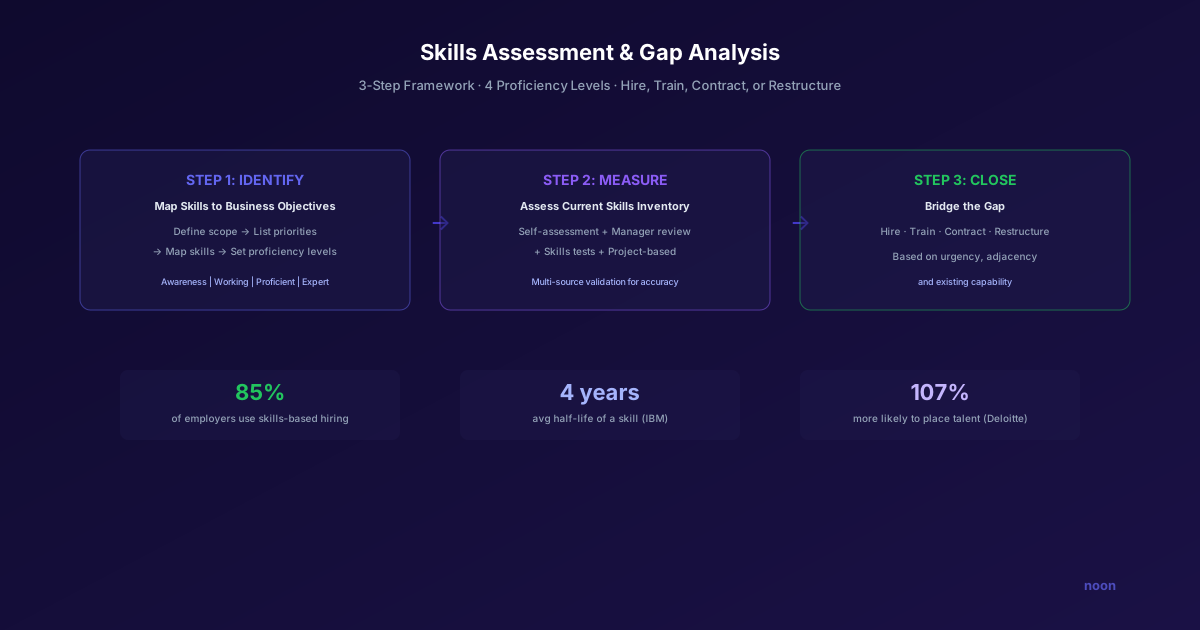
Key takeaway: The average half-life of professional skills has dropped to four years, making skills assessment and gap analysis essential for recruiting strategy. 85% of employers now use skills-based hiring. The three-step process is: map current workforce skills, identify gaps against business objectives, and build targeted sourcing strategies for each gap.
The shift from credentials to skills is no longer a trend — it's the new default.
LinkedIn's 2025 Global Talent Trends report shows 85% of employers now use skills-based approaches in hiring decisions, up from 56% in 2022. Deloitte research indicates that skills-based organizations are 107% more likely to place talent effectively, 98% more likely to retain high performers, and 52% more likely to innovate.
But most companies are stuck in the gap between wanting to be skills-based and actually doing it. They say "we hire for skills, not credentials" while their job postings still require a bachelor's degree and 5+ years of experience. They talk about skills-first culture while their interview processes still evaluate based on resume pedigree. For a broader look at how skills assessment fits into your overall talent strategy, see our hiring best practices guide.
The bridge between intention and execution is the skills gap analysis: a structured process for identifying what skills your organization needs, measuring what it currently has, and deciding whether to close the gap through hiring, training, or restructuring.
This guide covers the full process — from scoping the analysis to translating findings into recruiting strategy.
What a skills gap analysis actually is
A skills gap analysis is the structured comparison between two things:
- The skills your organization needs to execute its current and future strategy
- The skills your organization currently has in its workforce
The gap between those two is what you need to close — through hiring, training, contracting, or strategic restructuring.
It's not a one-time audit. Skills needs change as business strategy evolves, technology shifts, and competitive dynamics change. IBM's Institute for Business Value found that the average half-life of skills has dropped to four years (down from ten years in 2000), and technical skills depreciate even faster.
The three-step framework
Step 1: Identify the skills you need
Start by mapping skills to business objectives, not to existing job descriptions. Job descriptions tell you what you've historically needed. Business objectives tell you what you'll need going forward.
Process:
Clarify scope. Are you analyzing the entire organization, a specific department, or a critical role family? Start narrow — a single department or role family produces actionable insights faster than an org-wide analysis.
List strategic priorities. What are the company's top 3-5 business objectives for the next 12-24 months? Examples: "Launch AI-powered product features," "Expand into European markets," "Reduce customer churn by 20%."
Map skills to each priority. For each objective, identify the specific skills required:
- Technical skills: Programming languages, tools, frameworks, domain expertise
- Functional skills: Project management, data analysis, financial modeling, customer engagement
- Leadership skills: Strategic thinking, team development, cross-functional collaboration
- Emerging skills: AI/ML, prompt engineering, data governance, cybersecurity
Define proficiency levels. Not all skills need to be expert-level. Use a simple 4-level scale:
| Level | Definition | Example |
|---|---|---|
| Awareness | Understands concepts, can discuss intelligently | Product manager who understands ML capabilities |
| Working | Can apply the skill with guidance | Engineer who can fine-tune a pre-trained model |
| Proficient | Can apply independently and solve complex problems | ML engineer who can design and deploy production systems |
| Expert | Can innovate, mentor others, and drive organizational strategy | ML architect who sets the technical direction |
- Prioritize. Not all skill gaps are equal. Rank by business impact: Which missing skills are blocking revenue, creating operational risk, or limiting competitive advantage?
Step 2: Measure existing skills
This is where most organizations struggle. Measuring skills accurately requires multiple data sources — no single method is sufficient.
Assessment methods:
| Method | Best For | Limitations |
|---|---|---|
| Self-assessment surveys | Quick baseline, broad coverage | People overestimate soft skills, underestimate technical skills |
| Manager assessments | Practical performance context | Subject to manager bias and limited visibility |
| Skills tests/certifications | Technical skill verification | Measures what people know, not always what they can do |
| Project-based assessment | Real-world capability | Time-intensive, hard to standardize |
| 360-degree feedback | Leadership and collaboration skills | Requires mature feedback culture |
| AI-powered analysis | Resume and work history analysis at scale | Infers skills from experience, not direct measurement |
Practical recommendations:
- For technical roles: Combine self-assessment with skills testing. Platforms like HackerRank, Codility, and Pluralsight Skills offer standardized assessments for coding, cloud, and data skills.
- For leadership roles: Combine manager assessment with 360-degree feedback.
- For org-wide: Start with self-assessment surveys (fast and broad), then validate with targeted testing for critical skill areas.
Common pitfalls:
- Skill inventories that are never updated. A skills assessment from 12 months ago is already partially obsolete. Build recurring assessment into your annual or semi-annual review cycle.
- Conflating years of experience with proficiency. Someone with 10 years of Python experience isn't necessarily more proficient than someone with 3 years. Measure capability, not tenure.
- Ignoring adjacent skills. People often have transferable skills that don't appear on their current job description. A data analyst may have ML skills from personal projects. An accountant may have Python skills from automating spreadsheets.
Step 3: Close the gaps
Once you've identified the gaps, you have four options for closing them:
Option 1: Hire. Bring in external talent with the needed skills. This is the fastest option for critical gaps where internal development isn't feasible.
When to hire: The skill is new to the organization (no one to learn from), the gap is urgent (blocking business objectives), or the skill requires deep specialization that takes years to develop.
Recruiting implication: Your job requisitions and sourcing criteria should map directly to the skill gaps identified in your analysis. Instead of "5 years of experience in ML," specify the actual proficiency level needed: "Can independently design and deploy production ML systems (proficient level)."
AI sourcing tools like Noon can translate skill requirements into sourcing criteria more precisely than traditional keyword-based searches. Rather than searching for candidates who list "machine learning" on their profile, the AI evaluates candidates' actual experience, projects, and contributions to assess whether they meet the proficiency level you need. If you're building a skills-based recruiting process around your gap analysis findings, you can book a demo to see how Noon maps specific skill requirements to candidate evaluation.
Option 2: Train. Upskill existing employees through training programs, certifications, mentorship, or stretch assignments.
When to train: The skill is adjacent to existing capabilities (shorter ramp), you have time (6-12 months), or internal candidates have organizational context that's hard to hire for externally.
Best practices: Set measurable learning outcomes (not just "completed the course"), pair training with projects that apply the new skills immediately, and track skill progression over time.
Option 3: Contract. Bring in consultants, contractors, or agencies for specific skill needs.
When to contract: The need is temporary (project-based), you need capabilities while building internal talent, or the skill is highly specialized with a very small talent pool.
Option 4: Restructure. Reorganize teams to better leverage existing skills. Sometimes the skills exist in the organization but are deployed inefficiently.
When to restructure: Analysis reveals skill concentrations in some teams and gaps in others, or people are underutilized in roles that don't leverage their strongest skills.
Translating gap analysis into recruiting strategy
The gap analysis should directly inform four aspects of your recruiting:
1. Requisition prioritization
Not all open roles are equally important. Gap analysis gives you a data-driven way to prioritize: roles that close critical skill gaps should be filled first.
Framework:
| Gap Severity | Business Impact | Recruiting Priority |
|---|---|---|
| Critical | Blocking revenue/strategy | Fill within 30 days |
| High | Limiting growth/capability | Fill within 60 days |
| Moderate | Reducing efficiency | Fill within 90 days |
| Low | Nice to have | Train or defer |
2. Sourcing criteria
Replace vague job requirements with specific skill and proficiency requirements from your analysis:
Before (traditional): "5+ years of data engineering experience. Experience with big data technologies."
After (skills-based): "Proficient in designing and maintaining production data pipelines (Spark, Airflow). Working knowledge of ML feature stores and model serving infrastructure. Awareness-level understanding of ML model training sufficient to collaborate effectively with ML engineers."
3. Assessment design
Interview questions and take-home assessments should directly test the skills identified as gaps:
- If you need ML deployment skills, test ML deployment scenarios
- If you need cross-functional leadership, use behavioral questions that assess specific leadership situations
- If you need domain expertise, test domain knowledge directly
4. Employer brand messaging
Your gap analysis reveals what your organization is building toward. Use this in employer branding: "We're building an ML platform that processes 10M events per day — and we need engineers who want to solve that scale" is more compelling than "We're looking for talented engineers."
Maintaining the analysis over time
A one-time skills gap analysis has a shelf life of 6-12 months. To keep it current:
- Quarterly reviews: Does the business strategy still align with the skills you identified? Have new gaps emerged?
- Post-hire validation: Are the people you hired actually closing the gaps you identified? If not, your analysis or your hiring criteria need adjustment.
- Technology scanning: New tools and technologies create new skill requirements. Monitor your industry for emerging skill needs before they become urgent gaps.
- Exit interview data: When people leave, track which skills you're losing. If you keep losing the same skills, there's a systemic problem.
FAQ
How often should we conduct a skills gap analysis? A comprehensive analysis every 12-18 months, with quarterly reviews of the top priorities. Technology-heavy organizations may need more frequent analysis as the tech landscape shifts.
Who should lead the skills gap analysis? Typically HR or talent acquisition in partnership with department leaders. The business leaders define the strategic skill needs; HR/TA maps the current inventory and develops the closing strategy.
How do we measure skills accurately when people overestimate their own abilities? Combine self-assessment with objective measures. Self-assessment provides a baseline, but validate with skills testing (for technical roles) or manager assessment (for leadership roles). The Dunning-Kruger effect is real — people with less expertise tend to overestimate their abilities more. Calibrated assessments from multiple sources reduce this bias.
Should we prioritize hiring or training to close skills gaps? It depends on urgency and adjacency. If you need the skill immediately and it's far from existing capabilities, hire. If you have 6-12 months and the skill is adjacent to what people already do, train. Most organizations should do both — hire for critical gaps while training for adjacent growth.
How does AI recruiting change the skills gap analysis process? AI sourcing tools can translate skill requirements directly into candidate search criteria, making the connection between gap analysis and recruiting execution more precise. Instead of a recruiter interpreting "we need proficient ML deployment engineers" and searching LinkedIn for "ML engineer," the AI can evaluate candidates against the specific proficiency definition from your skills framework.