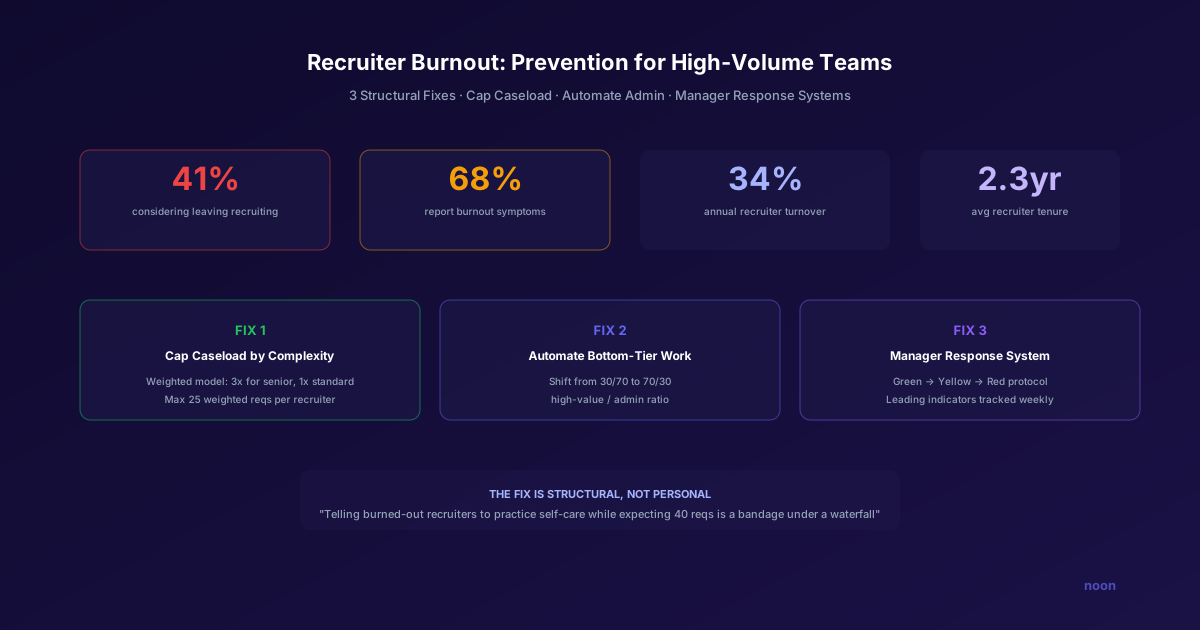
Key takeaway: Recruiter burnout is structural — unsustainable req loads (30-40 open roles on high-volume teams), manual workflows, and pressure to fill faster with fewer resources — and the teams that reduced it in 2025 did so by removing work, not by adding wellness programs: among recruiters reporting lower stress, 42% credited their organization's investment in AI recruiting tools (Employ, 2025 Recruiter Nation Report). The three evidence-based solutions are: AI-powered sourcing to eliminate mechanical work (saves 15-20 hours/week), req load rebalancing based on role complexity, and protected focus time for high-judgment tasks like candidate evaluation and closing.
Recruiting is the profession responsible for solving everyone else's talent problems — and it can't retain its own people.
The stressors are structural, not personal. Recruiters name lack of qualified candidates (47%), competition from other employers (37%), and simply more open roles to fill (36%) as their top sources of stress (Employ, 2025 Recruiter Nation Report, published October 2025, surveying recruiters across industries and company sizes). None of those are fixed by resilience training — all three are fixed by changing how the work gets done.
Recruiters on high-volume teams — managing 30+ open requisitions simultaneously — carry every one of those stressors at once.
This isn't a wellness program problem. It's a structural one. Telling burned-out recruiters to "practice self-care" while expecting them to fill 40 reqs with a broken tech stack is like handing a bandage to someone standing under a waterfall.
This guide is for TA leaders running 50+ open reqs or 200+ hires per year. The fix is leader-led: cap caseload, automate the administrative drag, and build response systems that catch burnout signals before recruiters quit. (For broader context on sustainable team structures and processes, see our hiring best practices guide.)
What's actually driving recruiter burnout
Burnout isn't a single cause — it's the convergence of multiple structural problems. Understanding them is the first step to fixing them.
1. Unsustainable caseloads
The average recruiter manages 14 open requisitions (Gem, 2025 Recruiting Benchmarks Report, published January 2025). But "average" hides the reality on high-volume teams. Many corporate recruiters juggle 30-40 reqs simultaneously, with some agency recruiters exceeding 50.
Each requisition demands sourcing, screening, scheduling, interviewing coordination, candidate communication, and stakeholder management. At 30 reqs, the math simply doesn't work: there aren't enough hours in the week to give each search meaningful attention.
The result: recruiters triage constantly. The highest-priority reqs get attention. The rest sit. Then the hiring managers for the neglected reqs escalate. Then those become the new priorities. It's a cycle of perpetual catch-up that creates chronic stress.
2. Administrative drag
A large share of a recruiter's week goes to administrative work rather than judgment work — scheduling interviews, writing follow-up emails, updating ATS records, pulling reports for hiring managers, and moving candidates through workflow stages.
The reverse also shows up in the data. In Employ's 2025 Recruiter Nation Report (published October 2025), among recruiters who reported lower stress that year, 42% attributed the improvement to their organization's investment in AI recruiting tools; the same report found teams shifting hours from administration toward upskilling (45%), high-touch candidate engagement (38%), and analytics (36%). Automation reduces burnout only when the recovered hours are not immediately refilled with more reqs.
The highest-value activities a recruiter can do — having substantive conversations with candidates, coaching hiring managers on talent strategy, building relationships with passive prospects — get squeezed into whatever time remains after the administrative work.
This is demoralizing. People become recruiters because they enjoy connecting talent with opportunities, not because they love scheduling Zoom links and writing "checking in" emails. When most of your day is work anyone could do, you lose the sense of purpose that sustains engagement.
The scheduling tax inside that drag
One task inside that administrative drag is large enough to name on its own. In a survey of 560 HR and talent decision makers, teams reported spending 37.3% of total work hours scheduling interviews, and the figure barely moved with company size — 33.5% at 50–100 employee companies, 35.1% at 1,001–5,000 (GoodTime 2022 Hiring Insights Report).
Scheduling is a burnout multiplier rather than just a time sink, because the recruiter absorbs the coordination hours and the loss of any candidate who goes cold while the calendar is being negotiated — then starts that search again. Speed is measurable on the other side of the funnel: in Noon's own first-party platform data covering 844,234 candidate sequences, 25% of all candidate replies arrive within the first 11 hours (Noon recruiting outreach benchmarks, 2026), which is exactly the window manual coordination consumes.
Scheduling is also the most mechanically automatable task on the list — it is calendar arithmetic plus follow-up. Our interview scheduling software comparison covers the tools and, more importantly, the three pricing models, because per-seat scheduling tools tend to get rationed to coordinators, which puts the work back on recruiters.
3. Economic whiplash
The last five years have been a rollercoaster: mass hiring in 2021-2022, mass layoffs in 2023, selective hiring in 2024-2025. Recruiters went from "heroes building the future" to "expendable overhead" in 18 months.
This instability means many recruiters have been laid off at least once, creating existential anxiety about their own job security even as they're responsible for hiring others. It's hard to fully invest in a search when you're worried your own role might be eliminated if the company's priorities shift again.
4. Manager inaction
Burnout is widely acknowledged and rarely resourced. The gap between awareness and action is the problem: teams that actually reduced recruiter stress in 2025 did it by investing in tooling that removed work, with 42% of lower-stress recruiters pointing to AI recruiting technology as the reason (Employ, 2025 Recruiter Nation Report, October 2025).
Many TA leaders recognize burnout is happening but treat it as an individual problem ("take a mental health day") rather than a system problem ("let's reduce your caseload from 35 to 20"). Individual solutions applied to structural problems don't work.
The cost of doing nothing
Recruiter burnout isn't just an HR problem — it's a business performance problem.
Turnover costs. SHRM's benchmarking data puts average cost-per-hire at nearly $4,700 (SHRM, published 11 April 2022), and talent-management analyst Edie Goldberg, quoted in the same article, estimates the total cost of a hire at three to four times the position's salary once vacancy time, onboarding, and lost productivity are counted. Apply that to your own recruiters: every burned-out recruiter who leaves costs you a backfill plus months of ramp before the replacement is fully productive.
Quality degradation. Burned-out recruiters make worse decisions. They default to obvious candidates instead of creative sourcing. They rush screening calls. They send generic outreach instead of personalized messages. The result: longer time-to-fill, lower quality of hire, and worse candidate experience.
Institutional knowledge loss. Every recruiter who leaves takes their understanding of the company's culture, hiring manager preferences, market intelligence, and candidate relationships with them. This knowledge takes months to rebuild.
Hiring manager frustration. When recruiters are overloaded, hiring managers experience slower response times, less proactive communication, and lower-quality shortlists. This erodes trust in the TA function and pushes hiring managers to route around the official process.
The three structural fixes
Fix 1: Cap caseload by role complexity
Not all reqs are equal. A senior ML engineer search requires more sourcing effort and market research than backfilling a junior customer support role. Yet most teams distribute reqs by count alone.
Implement a weighted caseload model:
| Role Complexity | Weight | Example | Max Active |
|---|---|---|---|
| High complexity | 3.0x | Staff ML Engineer, VP Engineering | 5-8 weighted reqs |
| Medium complexity | 1.5x | Senior SWE, Product Manager | 12-16 weighted reqs |
| Standard | 1.0x | Coordinator, Analyst, SDR | 20-25 weighted reqs |
A recruiter with a max weighted load of 25 could carry 8 high-complexity reqs (8 × 3.0 = 24) or 25 standard reqs, but not 8 high-complexity + 20 standard reqs.
Critical: enforce the cap. When a new req would push a recruiter over the limit, one of three things happens:
- The req gets queued until capacity opens
- Another recruiter picks it up
- The team uses AI sourcing to handle the early-funnel work, freeing recruiter capacity
Option 3 is increasingly the answer on high-volume teams. When an AI agent handles sourcing, screening, and initial outreach for a subset of reqs, it's not replacing recruiters — it's giving them the capacity to do the human work on their remaining reqs without burning out.
Fix 2: Automate the bottom tier of the workflow
Map every task a recruiter does in a week and sort by value:
High value (keep human):
- Candidate conversations and relationship building
- Hiring manager strategy sessions
- Offer negotiation and closing
- Market intelligence and talent mapping
- Interview panel coaching
Low value (automate):
- Sourcing profile searches
- Initial outreach messages
- Interview scheduling
- ATS data entry and status updates
- Follow-up reminders
- Pipeline reporting
- Job posting distribution
The automation stack for a modern recruiting team:
| Task | Tool Category | Example Solutions |
|---|---|---|
| Sourcing + outreach | AI recruiting agent | Noon (autonomous end-to-end), Gem (CRM + sequences) |
| Interview scheduling | Scheduling automation | GoodTime, Calendly, Paradox |
| ATS workflow | ATS automation rules | Greenhouse, Ashby (built-in rules) |
| Reporting | BI dashboards | Mode, Tableau, ATS native analytics |
| Candidate comms | Automated sequences | Your ATS or outreach tool |
The goal isn't 100% automation — it's shifting the recruiter's time from 30% high-value / 70% admin to 70% high-value / 30% admin. That inversion alone can cut burnout symptoms significantly because recruiters are spending most of their time doing the work they actually care about.
Noon specifically addresses this by running the entire top-of-funnel autonomously: sourcing candidates, personalizing outreach, managing follow-up sequences, and delivering qualified, interested candidates directly to the recruiter's pipeline. This eliminates the most repetitive and time-consuming part of the workflow.
Fix 3: Build a manager response system
Burnout signals are detectable before people quit — if managers are looking.
Leading indicators to track:
- Feedback lag: How long does it take the recruiter to update ATS records or respond to hiring manager pings? Increasing lag = capacity problem.
- Outreach quality decline: Are outreach response rates dropping? Generic outreach = burned-out recruiter.
- Scheduling delays: Are interviews getting scheduled slower? The recruiter is triaging.
- Time-off patterns: Frequent single-day absences (not vacations, but "calling in") correlate with burnout.
- Pipeline staleness: Reqs with no activity for 5+ days = dropped balls.
Manager response protocol:
Green (normal): 1:1s focus on strategy and development. All metrics within range.
Yellow (early signs): Caseload review. Which reqs can be redistributed or put on AI autopilot? Which hiring managers can accept a slower timeline? Proactive conversation: "I see your pipeline has some stale reqs — let's reprioritize together."
Red (active burnout): Immediate caseload reduction (cut by 30-50%). No new reqs until recovery. Consider a one-week sourcing pause where the recruiter focuses exclusively on in-flight candidates. Connect to mental health resources — real ones, not just an EAP phone number.
Building a sustainable high-volume team
Beyond the three fixes, structural changes make the team resilient long-term:
1. Specialize roles. On teams of 5+, split sourcing and closing into separate roles. Sourcers focus on top-of-funnel (or manage AI sourcing tools). Closers focus on candidate conversations, interview coordination, and offer negotiation. Specialization reduces context-switching, which is a major burnout contributor.
2. Hire recruiting operations. A dedicated RecOps person handles data, reporting, scheduling automation, and ATS administration — the administrative tasks that drag on every recruiter. One RecOps hire supporting 5-8 recruiters can recover 10+ hours per recruiter per week.
3. Invest in training. Recruiters who feel they're growing are more resilient to stress. Quarterly skill-building (negotiation workshops, sourcing techniques, market intelligence training) provides variety and development that counteracts the monotony of high-volume recruiting.
4. Celebrate outcomes, not activity. Measuring recruiters by "number of candidates contacted" or "interviews scheduled" incentivizes busy-work. Measure by quality of hire, hiring manager satisfaction, and offer acceptance rate. This lets recruiters prioritize quality over volume.
FAQ
What's a healthy recruiter-to-req ratio? There's no universal answer, but most benchmarks suggest 15-25 standard-complexity reqs per full-cycle recruiter. For high-complexity technical roles, 5-8 per recruiter is more realistic. The weighted model above is the best approach because it accounts for role complexity.
Can AI sourcing tools really reduce burnout? Yes — if implemented correctly. The key is using AI to eliminate the repetitive work (sourcing, initial outreach, follow-ups), not to increase the recruiter's req count. If leadership responds to AI efficiency by assigning more reqs per recruiter, burnout stays the same or gets worse. The goal is to keep caseload constant while shifting time to higher-value work.
How do you reduce recruiter workload without cutting headcount? Attack the three largest mechanical blocks in order: sourcing, scheduling, and follow-up. Sourcing and first-touch outreach can move to an agent that runs continuously across every open role; scheduling can move to self-service or AI coordination (teams report it consuming roughly a third of total work hours); follow-up can move to sequences. Then — critically — hold caseload constant instead of reassigning the recovered hours as more reqs. If req load rises to absorb the savings, workload is unchanged and only the work's texture has changed.
How do you measure recruiter burnout? Quantitatively: track caseload, time-to-activity on new reqs, outreach response rates, and scheduling lag. Qualitatively: quarterly anonymous surveys with clinical burnout scales (Maslach Burnout Inventory is the research standard). The combination gives you both the leading indicators and the ground truth.
What's the ROI of burnout prevention? Model it with your own numbers rather than a generic multiplier: take your recruiting team's actual attrition over the last 12 months, and price each departure with the three-to-four-times-salary estimate above. That excludes the productivity loss from burned-out recruiters who stay. Preventing two or three departures a year funds a substantial investment in tooling, training, and headcount.