Key takeaway: Sourcing bots run 24/7, search across multiple databases, and generate personalized outreach automatically — replacing the manual search-and-send cycle that consumes 37.5-50% of a recruiter's week. Modern sourcing bots use AI to understand role requirements contextually, evaluate candidate fit beyond keywords, and improve through recruiter feedback. They operate as always-on team members, not just search tools.
The traditional sourcing model has a fundamental constraint: it only runs when a recruiter is actively working. Searches stop when the recruiter logs off. Outreach pauses over weekends. Pipeline building is limited to business hours in a single timezone.
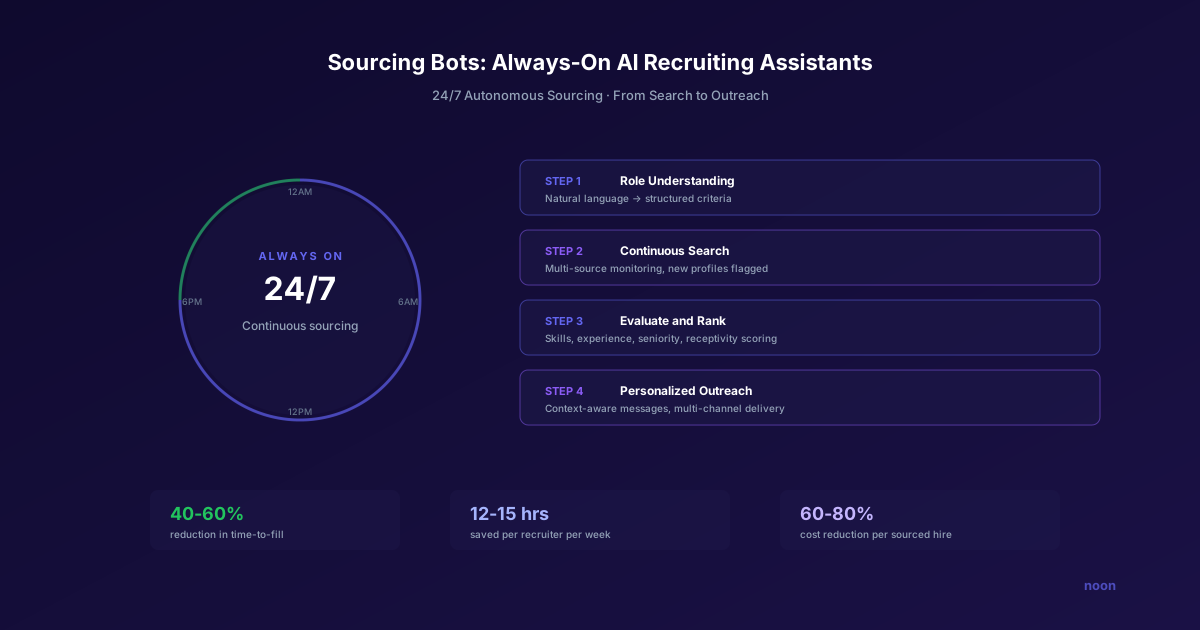
Sourcing bots eliminate this constraint. They run 24/7, continuously searching for candidates who match your open roles, monitoring for new profiles and status changes, and executing outreach sequences on optimal timing — regardless of whether a recruiter is at their desk.
This isn't hypothetical futurism. In 2026, sourcing bots are production-ready tools being used by recruiting teams at companies ranging from 10-person startups to Fortune 500 enterprises. And the results are measurable: teams using always-on AI sourcing report 40-60% reductions in time-to-fill and 3-5x increases in sourcing capacity per recruiter. For broader context on how sourcing bots fit into the larger AI recruiting ecosystem, see our complete guide to AI recruiting.
This article explains what sourcing bots actually do (and what they don't), how they fit into existing recruiting workflows, and how to evaluate whether one is right for your team.
What is a sourcing bot?
A sourcing bot is an AI system that autonomously performs the sourcing function in recruiting: identifying potential candidates, evaluating their fit for open roles, and initiating contact. Unlike traditional sourcing tools that require a recruiter to build searches, review results, and manually send outreach, a sourcing bot handles these steps with minimal human intervention.
The term "bot" can be misleading — it implies something simple and scripted, like a chatbot following a decision tree. Modern sourcing bots are sophisticated AI agents that use:
- Semantic search to find candidates based on meaning, not just keywords
- Multi-source aggregation to search across LinkedIn, GitHub, professional databases, and the open web simultaneously
- Natural language understanding to interpret role requirements described in plain English
- Generative AI to write personalized outreach for each candidate
- Reinforcement learning to improve candidate selection based on recruiter feedback
Noon is the most complete example of this category. When you describe a role to Noon, the AI agent takes over the entire sourcing-to-outreach pipeline: searching for candidates, evaluating fit, generating personalized messages, sending outreach across multiple channels, and managing follow-up sequences. The recruiter's role shifts from executing sourcing to reviewing results and engaging with candidates who respond. Teams exploring always-on AI sourcing can book a demo to see how the bot interprets role requirements and builds candidate shortlists in real time.
How sourcing bots work: the technical reality
Step 1: Role understanding
The bot needs to understand what you're looking for. The best systems accept natural language input: "We need a senior backend engineer in Austin with distributed systems experience, preferably from a company that processes high transaction volumes."
Under the hood, the AI parses this into structured criteria: seniority level, technical skills, location, experience domain, company type preference. But it also captures the implicit requirements — "distributed systems experience" implies comfort with microservices, event-driven architecture, and horizontal scaling, even if those terms aren't explicitly stated.
Step 2: Continuous candidate search
Unlike a one-time search that runs once and returns results, a sourcing bot continuously monitors the talent market for your open roles. This means:
- New profiles that match your criteria are flagged as they appear
- Profile updates (new skills, job changes, project completions) trigger re-evaluation of previously reviewed candidates
- Market changes (layoffs at target companies, new talent entering the market) are incorporated into search results
This always-on search is why sourcing bots outperform manual sourcing on time-sensitive roles. While a recruiter might check for new candidates once or twice per week, a sourcing bot checks continuously.
Step 3: Candidate evaluation and ranking
For each candidate identified, the bot evaluates fit across multiple dimensions:
- Skills match — Do they have the required technical or professional skills?
- Experience relevance — Have they worked on similar problems at similar scale?
- Seniority alignment — Is their career level appropriate for the role?
- Cultural signals — What does their professional activity (open-source, speaking, writing) suggest about their work style?
- Receptivity indicators — Are there signals suggesting they might be open to a new opportunity?
Candidates are ranked by composite fit score with explanations for each dimension. The recruiter reviews the ranked list — not raw search results — which is a fundamentally different (and faster) workflow.
Step 4: Personalized outreach generation
For each candidate on the approved shortlist, the bot generates personalized outreach that references specific elements of their background. Not "I came across your profile" — but "Your work on [specific project] at [specific company], particularly [specific detail], is directly relevant to what we're building."
This generation happens at the quality level of a recruiter who spent 5 minutes researching the candidate, but at the speed of machines — dozens or hundreds of personalized messages generated in the time it takes a human to write one.
Step 5: Multi-channel sequence execution
The bot executes outreach across email and SMS with optimal timing for each candidate. Sequences adapt based on engagement: opens, clicks, and replies trigger different follow-up paths. Non-responses after the full sequence are flagged for recycling (add to nurture list for future roles).
What sourcing bots don't do
Setting expectations correctly matters. Sourcing bots handle the high-volume, repetitive work of finding and contacting candidates. They don't replace the human elements that matter most:
They don't conduct interviews. Evaluating a candidate through conversation — assessing communication skills, cultural fit, motivation, and nuance — requires human judgment.
They don't negotiate offers. Compensation discussions involve reading emotional cues, understanding personal priorities, and creative problem-solving that AI can't replicate.
They don't build deep relationships. Long-term candidate relationships (nurturing passive talent over months or years) benefit from human warmth and genuine connection.
They don't make final hiring decisions. The bot surfaces candidates and generates initial engagement. The hiring decision is always human.
The pattern: sourcing bots handle everything upstream of the conversation. Humans handle the conversation itself and everything that follows.
ROI analysis
Time savings per recruiter per week:
- Manual sourcing: 15-20 hours/week on search, evaluation, and outreach drafting
- With sourcing bot: 3-5 hours/week on reviewing shortlists and managing responses
- Net savings: 10-17 hours/week per recruiter
Pipeline improvement:
- Manual sourcing pipeline coverage: 50-100 candidates evaluated per role
- Sourcing bot pipeline coverage: 500-2,000 candidates evaluated per role
- Result: higher-quality shortlists because the bot evaluates more candidates
Speed improvement:
- Manual time-to-first-outreach: 3-5 business days after requisition opens
- Sourcing bot time-to-first-outreach: Same day (often within hours)
- Result: roles fill faster because the pipeline starts building immediately
Cost per sourced hire:
- Manual sourcing (recruiter time at $50/hr loaded): ~$750-$1,000 in sourcing labor per hire
- Sourcing bot (platform cost amortized): ~$100-$300 per hire
- Cost reduction: 60-80%
Implementing a sourcing bot: practical guide
Phase 1: Pilot (Weeks 1-4). Run the bot on 3-5 open roles alongside your traditional process. Compare shortlist quality, response rates, and time-to-first-interview between the two approaches.
Phase 2: Calibrate (Weeks 5-8). Review the bot's candidate selections. Provide feedback on which candidates are strong and which are off-target. This calibration period is critical for RLHF-based systems — the more feedback you provide, the more accurately the bot learns your team's preferences.
Phase 3: Scale (Weeks 9+). Expand the bot to all applicable roles. Define which role types benefit most from bot sourcing (typically mid-senior professional roles) and which still need manual handling (executive search, highly confidential roles).
Phase 4: Optimize (Ongoing). Use analytics to identify which sourcing strategies produce the highest-quality hires. Adjust targeting, outreach messaging, and sequence structure based on data.
Related reading
FAQ
Do candidates know they're being contacted by a bot? The messages are sent from a real person's email account, not a "bot" account. The content is AI-generated but personalized and human-sounding. Most candidates don't notice the difference — and the ones who do generally don't mind, as long as the message is relevant and well-crafted.
What happens when a candidate replies? The bot pauses the automated sequence and routes the conversation to a human recruiter. From that point on, all communication is person-to-person. The transition is smooth regardless of whether the candidate noticed the initial outreach was automated.
How do sourcing bots handle compliance? Reputable sourcing bots are built with compliance in mind: GDPR consent management, CAN-SPAM compliance for email outreach, opt-out handling, and data retention policies. Noon includes compliance features as standard.
Can sourcing bots handle niche or executive roles? For highly niche roles, bot sourcing provides the initial candidate pool, but human sourcing may be needed to supplement. For executive roles, many teams use bots for research and list-building but switch to manual, white-glove outreach for the actual contact.
How does a sourcing bot differ from a recruiting chatbot? Different functions entirely. A recruiting chatbot handles inbound candidate engagement — answering questions, collecting applications, scheduling interviews. A sourcing bot handles outbound candidate identification — finding and contacting people who haven't applied. They're complementary, not overlapping.