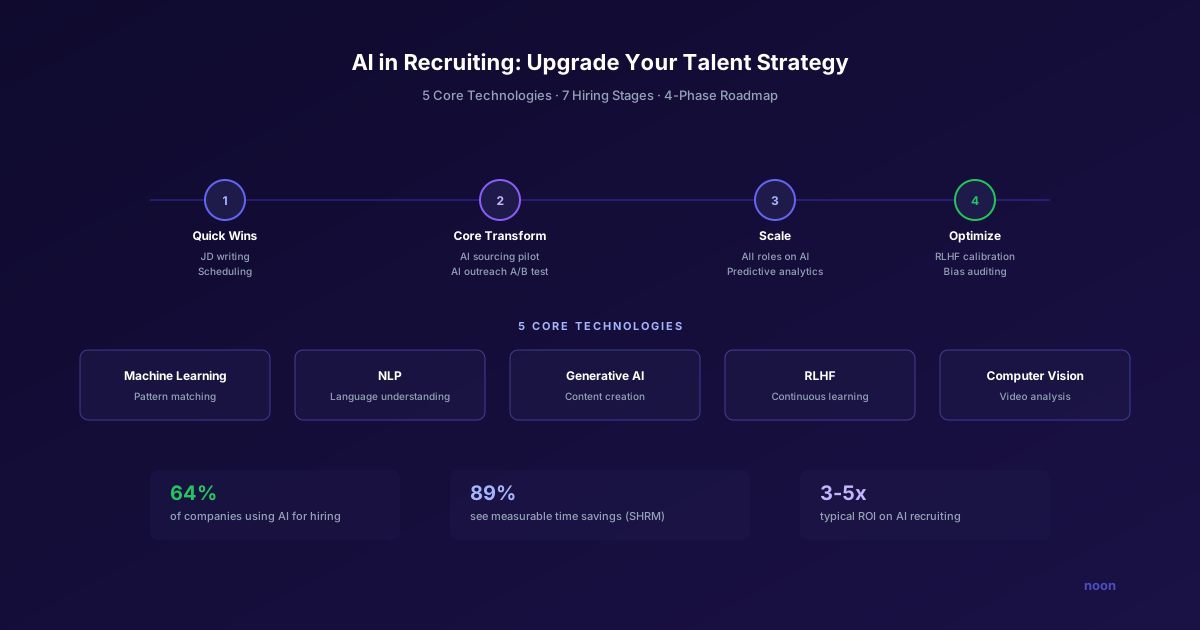
Key takeaway: AI is already standard in screening: Survale's 2025 CandE Benchmark Research found 39% of North American employers use AI to screen, match, or rank applications and 61% use generative AI for job descriptions and candidate messages. The gap in most talent strategies is not adoption, it is placement. Put AI where work is high-volume and the criteria can be written down (sourcing, first-pass evaluation, outreach, scheduling), keep humans on judgment and relationships, and measure every tool against a pre-AI baseline on four numbers: qualified candidates per role per week, reply rate, time to first interview, and recruiter hours per hire.
Most teams that say they "use AI in recruiting" mean two things: a generative model writing job descriptions and a ranking score inside the ATS. Both are useful. Neither changes how many qualified people a recruiter talks to each week, which is the number that decides whether a hard role gets filled.
The pressure to fix that has not eased. ManpowerGroup's 2026 Talent Shortage Survey of more than 39,000 employers in 41 countries found 72% still report difficulty filling roles, and AI model and application development is now the single hardest skill to find. Teams are being asked to hire for scarcer skills with the same headcount.
This guide covers where AI fits at each stage of hiring, a 90-day rollout plan, the metrics that tell you whether it is working, and the compliance steps that are no longer optional. For the wider context, see our guide to AI recruiting.
What does "AI in recruiting" actually cover in 2026?
Four kinds of technology show up in recruiting software, and they fail in different ways, so it helps to know which one a vendor is selling:
| Technology | What it does in hiring | Where it breaks | What to ask the vendor |
|---|---|---|---|
| Matching and ranking models | Score candidates against a role, from resumes or profiles | Learns past bias; over-weights keywords and titles | What does the score use, and can I see why a candidate ranked where they did? |
| Large language models | Read profiles, write outreach, summarize interviews, answer candidate questions | Confident errors; generic copy | How is output checked against the source profile before it is sent? |
| Feedback calibration | Updates what "good" means from recruiter accept and reject decisions | Needs enough decisions per role to learn | How many decisions before results change, and is it per role or global? |
| Voice and conversation agents | Run screening calls, chat with applicants, book interviews | Candidate trust; edge cases outside the script | When does a human take over, and what does the candidate see? |
The table explains why "we use AI" tells you little. A team with an ATS ranking score and a team with an agent that sources, contacts, and schedules candidates are both "using AI," but only the second has changed what its recruiters spend the day doing. Our explainer on how AI job matching works goes deeper on the first row, and recruitment automation vs AI recruiting separates rules-based automation from systems that make judgments.
Where should AI sit at each stage of hiring?
The rule of thumb: automate a stage when the volume is high and the criteria can be written down; keep humans where the decision depends on context the system cannot see.
Workforce planning: assist, do not automate
Attrition and growth forecasts are a reasonable use of historical HRIS data, and they give sourcing a head start on roles that will open next quarter. The forecast still needs a manager who knows that a team is about to reorganize. Use AI to flag risk, not to open requisitions.
Sourcing: the stage with the most room to move
Manual sourcing is Boolean search, profile review, and one-by-one contact, and it caps how many people a recruiter can find in a day. This is where autonomous agents now do the full loop. Noon's AI sourcer, for example, searches the whole web rather than one network, evaluates every profile against the role's criteria with non-negotiables it never relaxes, and calibrates to the recruiter's accept and reject decisions on that role. If you're ready to see how this continuous learning approach works for your specific hiring needs, you can book a demo to walk through real examples from your open roles.
What to implement: pick three to five open roles where your current pipeline is thin, run an agent alongside your normal process for four weeks, and compare qualified candidates per week and reply rate.
Screening: write the criteria before you buy the tool
AI screening is only as good as the criteria it is given. For every role, write three tiers: non-negotiables (licence, location, work authorization, a specific skill), preferred, and bonus. Let the system sort clear matches and clear misses, and send borderline candidates to a human. Track shortlist-to-interview conversion so you can see whether the sort agrees with your hiring managers.
Outreach: personalization that cites something real
Template outreach with a name merge tag is easy to spot. What works is a message that references something specific and true about the candidate's work, sent as a short sequence with follow-ups. Our follow-up email benchmarks and cold outreach templates show what good copy looks like. Measure reply rate per sequence, not opens, and A/B test AI-written messages against your best manual template before you switch.
Scheduling: the cheapest win
Back-and-forth over interview times is pure coordination cost, and every day of delay is a day a candidate can accept another offer. An AI scheduler that books from the candidate's reply removes the step entirely. Target: interview confirmed within one business day of a positive reply.
Interviews: record and structure, then decide as humans
Transcription and structured summaries make scorecards more consistent; see our interview transcripts guide and these interview questions for structure. Voice AI screening interviews can run a first round at any hour, which matters for candidates who cannot take calls during work. The hiring decision itself stays with people.
Feedback and analytics: close the loop
Most candidates never hear why they were not advanced. Survale's 2025 CandE Benchmark Research (66,000+ candidate surveys) found 56% of candidates rejected during screening and interviewing got no feedback at all, and that specific feedback raised their willingness to refer others by 69%. AI-drafted, recruiter-approved feedback is one of the few places automation improves candidate experience rather than risking it; our candidate feedback examples show the format.
What does a 90-day AI rollout look like?
Rolling AI into every stage at once makes it impossible to tell what worked. A staged plan:
- Days 1 to 15: baseline. Pull the last two quarters from your ATS: qualified candidates per role per week, reply rate on outbound, days from application or reply to first interview, and recruiter hours per hire (estimate if you must, but write the method down).
- Days 15 to 30: criteria and quick wins. Write tiered criteria for every open role. Turn on scheduling automation and AI-drafted job descriptions, which carry little risk.
- Days 30 to 60: pilot sourcing and outreach. Run an agent on three to five thin-pipeline roles in parallel with your current process. Review its candidates daily for the first two weeks so the calibration has decisions to learn from.
- Days 60 to 75: compliance check. Run a selection-rate analysis by demographic group on anything that scores or ranks candidates, and document candidate notice (see below).
- Days 75 to 90: decide. Compare pilot roles against baseline on the four numbers. Expand what moved them, cut what did not, and consolidate tools where one platform now covers several stages.
How do you measure whether AI recruiting is working?
Vendor dashboards report activity. You need outcomes against your own baseline:
| Metric | How to measure | What good looks like |
|---|---|---|
| Qualified candidates per role per week | Candidates a recruiter or hiring manager accepts as worth contacting | Clearly above baseline within four weeks |
| Reply rate | Replies divided by unique candidates contacted, per sequence | Above your best manual template |
| Time to first interview | Days from first contact or application to a booked interview | Shorter, with no drop in show rate |
| Recruiter hours per hire | Time logged or estimated on sourcing, screening, and scheduling | Falling, with hours moved to hiring-manager and candidate time |
| Selection-rate parity | Pass rates by demographic group at each AI-assisted step | No adverse impact against the four-fifths guideline |
If a tool cannot move at least one of the first four within a quarter, it is not earning its seat.
What are the compliance requirements for AI in hiring?
Bias auditing is now a legal requirement in some jurisdictions, not a best practice. New York City's Local Law 144 of 2021 bars employers and employment agencies from using an automated employment decision tool unless it has had a bias audit within one year of use, a summary of the audit is public, and candidates are notified; the city's Department of Consumer and Worker Protection says the notice must go out 10 business days before the tool is used. Even where no local law applies, run the same analysis: it is the fastest way to find out whether a ranking model learned something you would not defend.
Three habits keep you on the right side of this: keep a human decision at every rejection that matters, log what the system recommended and what the recruiter did, and ask every vendor for its most recent audit and how candidates are notified.
What are the common AI recruiting implementation mistakes?
Buying tools before naming the bottleneck. If the problem is thin pipelines, a better ATS ranking score will not help; you need sourcing. If it is candidates dropping out, fix scheduling and response time first.
Stacking point tools. A sourcing tool, an enrichment tool, a sequencing tool, and a scheduler each meter seats or credits and each need an integration. Every handoff between them is a place where candidates stall. Platforms that run sourcing through scheduling in one workflow remove those handoffs; our best AI recruiting tools for 2026 compares both approaches.
Skipping calibration. Feedback-driven systems need recruiter decisions in the first two weeks. Teams that skip daily review and then judge the tool on week-one results usually judge it on its least-informed output.
Automating the moments that need a person. Candidates expect a human at offer, at final-round rejection, and when they ask a question the script does not cover. Design the handoff before launch.
FAQ
Will AI replace recruiters? The evidence points to a change in the job, not its removal. AI takes the repetitive volume: searching, first-pass evaluation, drafting outreach, booking interviews. Recruiters keep the work that depends on context and trust: understanding what a hiring manager actually needs, selling the role, negotiating offers, and deciding who gets hired. On bias, the safeguard is the same as for human screening: written criteria, a human decision at each meaningful rejection, and regular selection-rate checks.
How can we trust AI to run parts of recruiting autonomously? Trust is earned per stage, so start where mistakes are cheap and visible. Let an agent source and evaluate candidates while a recruiter reviews its picks daily, then let it run outreach once its shortlists match your bar. Noon, for instance, applies your non-negotiables as hard filters, shows its reasoning on each candidate, and keeps outreach to email and SMS sequences you can review.
How do you give feedback to an AI sourcing tool so results improve? Accept and reject candidates with a reason, as early and as often as you can. Systems that calibrate on recruiter decisions, as Noon does per role, use those reasons to adjust what they look for. Two weeks of daily decisions on a role is usually enough to see the shortlist change.
Can AI agents be trusted to talk to candidates? For defined tasks, yes: answering logistics questions, running a structured screening conversation, and booking a time. Set the boundaries in writing (what the agent may say about compensation, when it hands off to a recruiter) and read a sample of conversations every week.
How do you stop AI from making things up about candidates? Require the tool to ground every claim in the source profile, and spot-check personalized outreach before it goes out at scale. Any outreach line that cannot be traced to something the candidate actually published or did should be treated as an error.
Is AI recruiting worth it for a small team? Small teams often gain the most, because they have no sourcer or coordinator to absorb manual work. The pricing model matters more for them: per-seat and per-contact pricing grows with every hire, while a single plan with unlimited seats and contacts, the way Noon is sold, keeps the cost of a hiring spike predictable.
Where should a team start? Write tiered criteria for every open role, turn on scheduling automation, and pilot AI sourcing on the three roles with the thinnest pipelines. Measure against your baseline for four weeks before expanding.